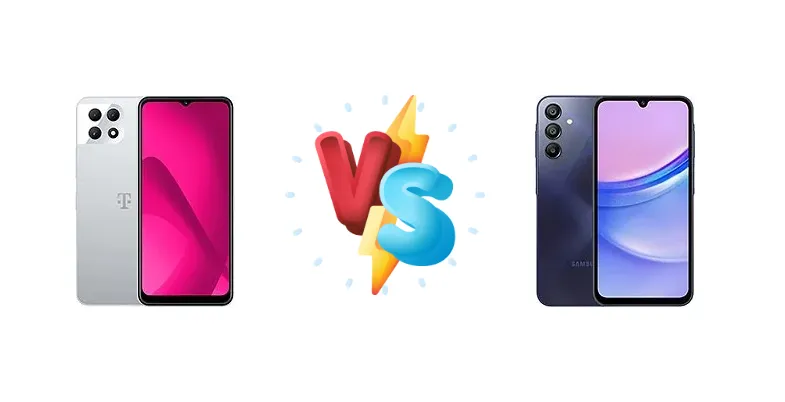
The sub-$200 smartphone market is fiercely competitive. The T-Mobile REVVL 7 and Samsung Galaxy A15 represent compelling options, but cater to slightly different priorities. The REVVL 7 focuses on efficient performance with a newer Snapdragon chipset, while the Galaxy A15 prioritizes battery endurance and a brighter display. This comparison will dissect the key differences to help you choose the right device.
🏆 Quick Verdict
For the average user prioritizing sustained performance and future-proofing, the T-Mobile REVVL 7 is the better choice. Its Snapdragon 6 Gen 1, built on a 4nm process, offers superior efficiency and processing power compared to the Galaxy A15’s Helio G99. However, the A15’s longer battery life in active use is a significant advantage for heavy users.
| Network |
|---|
| 2G bands | GSM 850 / 900 / 1800 / 1900 | GSM 850 / 900 / 1800 / 1900 |
| 3G bands | HSDPA 850 / 1700(AWS) / 2100 | HSDPA 850 / 900 / 2100 |
| 4G bands | 2, 4, 5, 7, 12, 25, 26, 41, 66, 71 | 1, 3, 5, 7, 8, 20, 28, 38, 40, 41 |
| 5G bands | 25, 41, 66, 71, 77 SA/NSA | - |
| Speed | HSPA, LTE, 5G | HSPA, LTE |
| Technology | GSM / HSPA / LTE / 5G | GSM / HSPA / LTE |
| Launch |
|---|
| Announced | 2024, May 13 | 2023, December 11 |
| Status | Available. Released 2024, June | Available. Released 2023, December 16 |
| Body |
|---|
| Build | - | Glass front, plastic back, plastic frame |
| Dimensions | 167.4 x 77.5 x 9.1 mm (6.59 x 3.05 x 0.36 in) | 160.1 x 76.8 x 8.4 mm (6.30 x 3.02 x 0.33 in) |
| SIM | Nano-SIM + eSIM | · Nano-SIM· Nano-SIM + Nano-SIM |
| Weight | 206 g (7.27 oz) | 200 g (7.05 oz) |
| Display |
|---|
| Resolution | 1080 x 2408 pixels, 20:9 ratio (~401 ppi density) | 1080 x 2340 pixels, 19.5:9 ratio (~396 ppi density) |
| Size | 6.58 inches, 104.3 cm2 (~80.4% screen-to-body ratio) | 6.5 inches, 103.7 cm2 (~84.3% screen-to-body ratio) |
| Type | AMOLED, 120Hz | Super AMOLED, 90Hz, 800 nits (HBM) |
| Platform |
|---|
| CPU | Octa-core (4x2.2 GHz Cortex-A78 & 4x1.8 GHz Cortex-A55) | Octa-core (2x2.2 GHz Cortex-A76 & 6x2.0 GHz Cortex-A55) |
| Chipset | Qualcomm SM6450 Snapdragon 6 Gen 1 (4 nm) | Mediatek Helio G99 (6 nm) |
| GPU | Adreno 710 | Mali-G57 MC2 |
| OS | Android 14 | Android 14, up to 4 major Android upgrades, One UI 7 |
| Memory |
|---|
| Card slot | microSDXC | microSDXC (uses shared SIM slot) |
| Internal | 128GB 6GB RAM | 128GB 4GB RAM, 128GB 6GB RAM, 128GB 8GB RAM, 256GB 6GB RAM, 256GB 8GB RAM |
| Main Camera |
|---|
| Features | LED flash, HDR, panorama | LED flash, panorama, HDR |
| Triple | 50 MP, (wide), PDAF
2 MP (macro)
Auxiliary lens | 50 MP, f/1.8, 26mm (wide), 1/2.8", 0.64µm, PDAF
5 MP, f/2.2, 17mm (ultrawide), 1/5.0", 1.12µm
2 MP (macro) |
| Video | 1440p@30fps, 1080p@30/60fps | 1080p@30fps |
| Selfie camera |
|---|
| Single | 8 MP | 13 MP, f/2.0, 26mm (wide), 1/3.06", 1.12µm |
| Video | 1080p@30fps | 1080p@30fps |
| Sound |
|---|
| 35mm jack | Yes | Yes |
| Loudspeaker | Yes, with stereo speakers | Yes |
| Comms |
|---|
| Bluetooth | 5.1, A2DP, LE | 5.3, A2DP, LE |
| NFC | Yes | Yes (market/region dependent) |
| Positioning | GPS | GPS, GALILEO, GLONASS, BDS, QZSS |
| Radio | No | FM radio (market/region dependent) |
| USB | USB Type-C 2.0 | USB Type-C 2.0 |
| WLAN | Wi-Fi 802.11 a/b/g/n/ac, dual-band | Wi-Fi 802.11 a/b/g/n/ac, dual-band, Wi-Fi Direct |
| Features |
|---|
| Sensors | Fingerprint (side-mounted); unspecified sensors | Fingerprint (side-mounted), accelerometer, compass |
| Battery |
|---|
| Charging | 15W wired, PD3.0, QC3 | 25W wired |
| Type | 5000 mAh | 5000 mAh |
| Misc |
|---|
| Colors | Arctic Gray | Brave Black, Optimistic Blue, Magical Blue, Personality Yellow |
| Models | - | SM-A155F, SM-A155F/DSN, SM-A155M, SM-A155M/DS, SM-A155P, SM-A155R |
| Price | About 190 EUR | € 168.99 / $ 125.00 / £ 113.00 |
| SAR | 1.14 W/kg (head) 1.12 W/kg (body) | - |
| SAR EU | - | 0.42 W/kg (head) 1.29 W/kg (body) |
T-Mobile REVVL 7
- More efficient Snapdragon 6 Gen 1 chipset
- Potentially better image processing
- Likely smoother multitasking experience
- Slower 15W charging
- Battery life likely shorter than A15
Samsung Galaxy A15
- Excellent battery life (15:28h active use)
- Brighter 808 nit display
- Faster 25W charging
- Less efficient Helio G99 chipset
- Potentially more throttling under load
Display Comparison
The Samsung Galaxy A15 boasts a significantly brighter display, reaching 808 nits, making it more usable outdoors in direct sunlight. While the REVVL 7’s display specs are not provided, Samsung’s panel technology generally offers vibrant colors and good viewing angles. The A15’s brightness advantage is crucial for users who spend a lot of time outdoors. However, without knowing the REVVL 7’s panel type or refresh rate, a complete assessment is difficult. The A15’s brightness is a clear win, but the REVVL 7 may compensate with color accuracy or a higher refresh rate (speculation based on market trends).
Camera Comparison
Without detailed camera specifications beyond the presence of sensors, a direct comparison is limited. Both phones likely feature a primary camera and supporting lenses. However, the image processing capabilities of Qualcomm’s Snapdragon chipsets are generally more refined than those of MediaTek’s Helio series. This suggests the REVVL 7 may produce more detailed and accurate photos, particularly in challenging lighting conditions. The absence of information regarding sensor size and aperture makes a definitive judgment impossible, but the REVVL 7’s chipset gives it a potential advantage.
Performance
The core difference lies in the chipsets. The T-Mobile REVVL 7’s Qualcomm Snapdragon 6 Gen 1 (4nm) is architecturally superior to the Galaxy A15’s MediaTek Helio G99 (6nm). The 4nm process node of the Snapdragon translates to better power efficiency and thermal management, meaning less throttling during sustained workloads. While both CPUs feature octa-core designs, the Snapdragon utilizes Cortex-A78 cores (higher performance) alongside A55 cores, compared to the A15’s Cortex-A76 and A55 combination. This gives the REVVL 7 an edge in CPU-intensive tasks. The REVVL 7 is likely to offer a smoother experience with multitasking and demanding apps.
Battery Life
The Samsung Galaxy A15 shines in battery life, achieving 15 hours and 28 minutes of active use. While the REVVL 7’s battery capacity is unknown, the Snapdragon 6 Gen 1’s 4nm efficiency should mitigate some of the A15’s advantage. The A15 also supports 25W wired charging, significantly faster than the REVVL 7’s 15W charging. This means the A15 can replenish its battery much quicker, reducing downtime. The A15’s faster charging and longer active use time make it the clear winner for battery-focused users.
Buying Guide
Buy the T-Mobile REVVL 7 if you need a phone that feels responsive for everyday tasks and light gaming, and appreciate a more modern chipset architecture. This phone is ideal for users who value long-term software support and a smoother user experience. Buy the Samsung Galaxy A15 if you prioritize maximizing battery life above all else, and frequently consume media or use your phone for extended periods without access to a charger. It’s a solid choice for those who need a reliable, long-lasting device.
Frequently Asked Questions
❓ Does the MediaTek Helio G99 in the Galaxy A15 get noticeably hot during extended gaming sessions?
The Helio G99, being built on a 6nm process, is prone to more thermal throttling than the Snapdragon 6 Gen 1 (4nm) in the REVVL 7. While it can handle casual gaming, prolonged sessions with demanding titles may result in reduced performance as the chip heats up. Expect some frame rate drops after 30-45 minutes of intense gameplay.
❓ Is the 25W charging on the Galaxy A15 a significant improvement over the REVVL 7's 15W charging in real-world use?
Yes, the 25W charging on the Galaxy A15 is a substantial advantage. It will significantly reduce the time it takes to fully charge the device. While exact 0-100% times aren't available, expect the A15 to charge considerably faster, potentially shaving off 30-60 minutes compared to the REVVL 7.
❓ How does the Snapdragon 6 Gen 1 handle multitasking compared to the Helio G99?
The Snapdragon 6 Gen 1, with its more modern CPU architecture (Cortex-A78 cores), is better equipped for multitasking. It can handle more apps running in the background without significant performance slowdowns. The Helio G99 may struggle with heavier multitasking loads, potentially leading to app reloading or lag.