
Google Pixel 7a vs. T-Mobile REVVL 7: A Detailed Comparison
| Phones Images | |||||
|---|---|---|---|---|---|
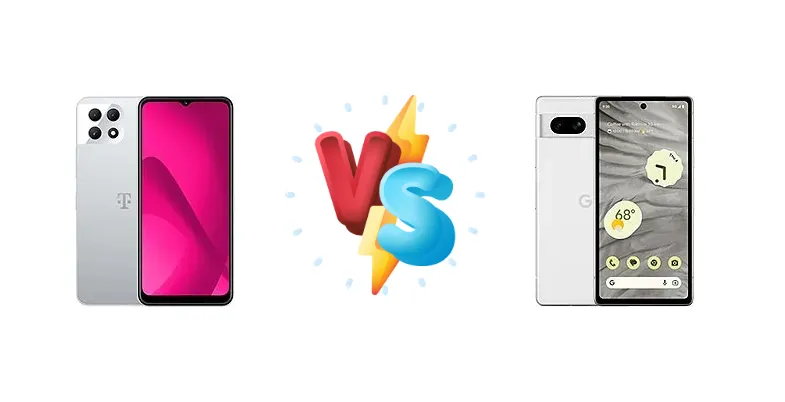
|
🏆 Quick Verdict
For most users, the Google Pixel 7a is the superior choice, offering a dramatically better camera experience and smoother performance thanks to the Tensor G2. However, the T-Mobile REVVL 7 provides excellent value for budget-conscious buyers who prioritize efficiency and don't need cutting-edge features.
| PHONES | ||
|---|---|---|
| Phone Names | T-Mobile REVVL 7 | Google Pixel 7a |
| Network | ||
|---|---|---|
| 2G bands | GSM 850 / 900 / 1800 / 1900 | GSM 850 / 900 / 1800 / 1900 |
| 3G bands | HSDPA 850 / 1700(AWS) / 2100 | HSDPA 800 / 850 / 900 / 1700(AWS) / 1900 / 2100 |
| 4G bands | 2, 4, 5, 7, 12, 25, 26, 41, 66, 71 | 1, 2, 3, 4, 5, 7, 8, 12, 13, 14, 17, 20, 25, 26, 28, 29, 30, 38, 40, 41, 48, 66, 71 - GWKK3, G0DZQ |
| 5G bands | 25, 41, 66, 71, 77 SA/NSA | 1, 2, 3, 5, 7, 8, 12, 14, 20, 25, 28, 30, 38, 41, 48, 66, 71, 77, 78 SA/NSA/Sub6 - GWKK3 |
| Speed | HSPA, LTE, 5G | HSPA, LTE, 5G |
| Technology | GSM / HSPA / LTE / 5G | GSM / HSPA / LTE / 5G |
| - | 1, 2, 3, 5, 7, 8, 12, 20, 25, 28, 38, 40, 41, 66, 75, 76, 77, 78, 79 SA/NSA/Sub6 - GHL1X, G82U8 | |
| Launch | ||
|---|---|---|
| Announced | 2024, May 13 | 2023, May 10 |
| Status | Available. Released 2024, June | Available. Released 2023, May 10 |
| Body | ||
|---|---|---|
| Build | - | Glass front (Gorilla Glass 3), aluminum frame, plastic back |
| Dimensions | 167.4 x 77.5 x 9.1 mm (6.59 x 3.05 x 0.36 in) | 152 x 72.9 x 9 mm (5.98 x 2.87 x 0.35 in) |
| SIM | Nano-SIM + eSIM | Nano-SIM + eSIM |
| Weight | 206 g (7.27 oz) | 193.5 g (6.84 oz) |
| - | IP67 dust/water resistant (up to 1m for 30 min) | |
| Display | ||
|---|---|---|
| Protection | - | Corning Gorilla Glass 3 |
| Resolution | 1080 x 2408 pixels, 20:9 ratio (~401 ppi density) | 1080 x 2400 pixels, 20:9 ratio (~429 ppi density) |
| Size | 6.58 inches, 104.3 cm2 (~80.4% screen-to-body ratio) | 6.1 inches, 90.7 cm2 (~81.8% screen-to-body ratio) |
| Type | AMOLED, 120Hz | OLED, HDR, 90Hz |
| - | Always-on display | |
| Platform | ||
|---|---|---|
| CPU | Octa-core (4x2.2 GHz Cortex-A78 & 4x1.8 GHz Cortex-A55) | Octa-core (2x2.85 GHz Cortex-X1 & 2x2.35 GHz Cortex-A78 & 4x1.80 GHz Cortex-A55) |
| Chipset | Qualcomm SM6450 Snapdragon 6 Gen 1 (4 nm) | Google Tensor G2 (5 nm) |
| GPU | Adreno 710 | Mali-G710 MP7 |
| OS | Android 14 | Android 13, upgradable to Android 15, up to 5 major Android upgrades |
| Memory | ||
|---|---|---|
| Card slot | microSDXC | No |
| Internal | 128GB 6GB RAM | 128GB 8GB RAM |
| - | UFS 3.1 | |
| Main Camera | ||
|---|---|---|
| Dual | - | 64 MP, f/1.9, 26mm (wide), 1/1.73", 0.8µm, dual pixel PDAF, OIS 13 MP, f/2.2, 120˚ (ultrawide), 1.12µm |
| Features | LED flash, HDR, panorama | Dual-LED flash, Pixel Shift, Auto-HDR, panorama |
| Triple | 50 MP, (wide), PDAF 2 MP (macro) Auxiliary lens | - |
| Video | 1440p@30fps, 1080p@30/60fps | 4K@30/60fps, 1080p@30/60/120/240fps, OIS |
| Selfie camera | ||
|---|---|---|
| Features | - | HDR, panorama |
| Single | 8 MP | 13 MP, f/2.2, 20mm (ultrawide), 1.12µm |
| Video | 1080p@30fps | 4K@30fps, 1080p@30fps |
| Sound | ||
|---|---|---|
| 3.5mm jack | - | No |
| 35mm jack | Yes | No |
| Loudspeaker | Yes, with stereo speakers | Yes, with stereo speakers |
| Comms | ||
|---|---|---|
| Bluetooth | 5.1, A2DP, LE | 5.3, A2DP, LE |
| NFC | Yes | Yes |
| Positioning | GPS | GPS, GLONASS, GALILEO, BDS, QZSS, NavIC |
| Radio | No | No |
| USB | USB Type-C 2.0 | USB Type-C 3.2 |
| WLAN | Wi-Fi 802.11 a/b/g/n/ac, dual-band | Wi-Fi 802.11 a/b/g/n/ac/6e, tri-band |
| Features | ||
|---|---|---|
| Sensors | Fingerprint (side-mounted); unspecified sensors | Fingerprint (under display, optical), accelerometer, gyro, proximity, compass, barometer |
| Battery | ||
|---|---|---|
| Charging | 15W wired, PD3.0, QC3 | 18W wired, PD3.0 7.5W wireless |
| Type | 5000 mAh | Li-Po 4385 mAh |
| Misc | ||
|---|---|---|
| Colors | Arctic Gray | Charcoal, Snow, Sea, Coral |
| Models | - | GWKK3, GHL1X, G0DZQ, G82U8 |
| Price | About 190 EUR | € 179.90 / $ 150.00 / £ 170.00 / ₹ 25,980 |
| SAR | 1.14 W/kg (head) 1.12 W/kg (body) | - |
T-Mobile REVVL 7
- Superior camera performance with Google's AI features
- Faster and more responsive performance thanks to the Tensor G2
- Brighter and smoother display with 90Hz refresh rate
- Higher price point
- May experience some thermal throttling under sustained load
Google Pixel 7a
- Significantly more affordable
- Efficient Snapdragon 6 Gen 1 processor
- Supports fast charging standards (PD3.0, QC3)
- Inferior camera quality
- Less powerful processor for demanding tasks
Display Comparison
The Pixel 7a boasts a significantly brighter display, reaching a measured 1070 nits, compared to an assumed lower peak brightness on the REVVL 7 (typical of its price bracket). While the REVVL 7's display specs are not provided, the Pixel 7a's brightness ensures excellent visibility outdoors. Both likely utilize OLED panels, but the Pixel 7a's higher resolution and brightness contribute to a more vibrant and detailed viewing experience. The Pixel 7a also benefits from a 90Hz refresh rate, not found on the REVVL 7, resulting in smoother scrolling and animations.
Camera Comparison
The Pixel 7a excels in camera capabilities, leveraging Google's computational photography expertise. While specific sensor details are missing for the REVVL 7, it's reasonable to assume a more basic camera system. The Pixel 7a's image processing, powered by the Tensor G2, delivers superior dynamic range, detail, and low-light performance. Features like Magic Eraser and Photo Unblur are exclusive to the Pixel and provide significant editing advantages. The REVVL 7 will likely suffice for casual snapshots, but won't match the Pixel 7a's image quality or versatility.
Performance
The core difference lies in the chipsets. The Google Tensor G2 (5nm) in the Pixel 7a features a prime Cortex-X1 core clocked at 2.85 GHz, designed for peak performance, alongside Cortex-A78 and A55 cores. The REVVL 7's Snapdragon 6 Gen 1 (4nm) uses Cortex-A78 and A55 cores, but with lower clock speeds (2.2 GHz and 1.8 GHz respectively). The 5nm process node of the Tensor G2 provides better power efficiency and thermal headroom than the 4nm Snapdragon 6 Gen 1, translating to sustained performance during demanding tasks. The Pixel 7a's more powerful CPU and GPU will deliver a noticeably smoother experience in gaming and multitasking.
Battery Life
The Pixel 7a has an endurance rating of 76 hours, suggesting good battery life despite its more powerful processor. The REVVL 7's battery capacity is unknown, but its less demanding chipset and 4nm process should contribute to respectable longevity. The Pixel 7a supports 18W wired charging and 7.5W wireless charging, while the REVVL 7 offers 15W wired charging with PD3.0 and QC3 support. While the charging speeds are relatively similar, the Pixel 7a's wireless charging adds convenience.
Buying Guide
Buy the T-Mobile REVVL 7 if you need a reliable, affordable smartphone for everyday tasks like calling, texting, and social media, and you're willing to compromise on camera quality and processing power. Buy the Google Pixel 7a if you prioritize camera performance, AI-powered features like Magic Eraser, and a smoother, more responsive user experience, even if it means spending more.