
T-Mobile REVVL 7 Pro vs Nothing Phone (2a) Plus: Which Mid-Range Phone Reigns Supreme?
| Phones Images | |||||
|---|---|---|---|---|---|
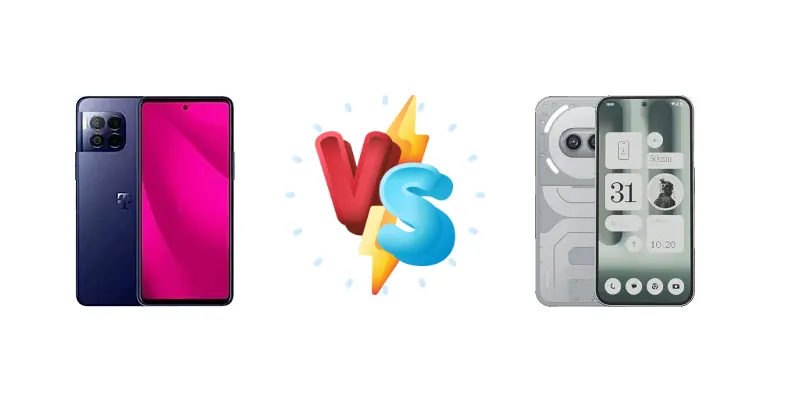
|
🏆 Quick Verdict
For the average user prioritizing a balance of features and value, the Nothing Phone (2a) Plus emerges as the stronger contender. Its significantly faster 50W charging and brighter 1097 nit display, coupled with a more powerful processor, outweigh the REVVL 7 Pro’s wireless charging capability.
| PHONES | ||
|---|---|---|
| Phone Names | T-Mobile REVVL 7 Pro | Nothing Phone (2a) Plus |
| Network | ||
|---|---|---|
| 2G bands | GSM 850 / 900 / 1800 / 1900 | GSM 850 / 900 / 1800 / 1900 |
| 3G bands | HSDPA 850 / 900 / 1700(AWS) / 1900 / 2100 | HSDPA 800 / 850 / 900 / 1700(AWS) / 1900 / 2100 |
| 4G bands | 1, 2, 3, 4, 5, 7, 8, 12, 13, 17, 20, 25, 26, 28, 38, 39, 40, 41, 66, 71 | 1, 3, 4, 5, 7, 8, 18, 19, 20, 26, 28, 38, 39, 40, 41, 42, 66 |
| 5G bands | 1, 3, 7, 25, 28, 38, 41, 66, 71, 77, 78 SA/NSA | 1, 3, 5, 7, 8, 20, 28, 38, 40, 41, 66, 77, 78 SA/NSA |
| Speed | HSPA, LTE, 5G | HSPA, LTE, 5G |
| Technology | GSM / HSPA / LTE / 5G | GSM / HSPA / LTE / 5G |
| Launch | ||
|---|---|---|
| Announced | 2024, May 13 | 2024, July 31 |
| Status | Available. Released 2024, June | Available. Released 2024, August 03 |
| Body | ||
|---|---|---|
| Build | - | Glass front (Gorilla Glass 5), plastic frame, plastic back |
| Dimensions | 168.7 x 78 x 8.6 mm (6.64 x 3.07 x 0.34 in) | 161.7 x 76.3 x 8.5 mm (6.37 x 3.00 x 0.33 in) |
| SIM | Nano-SIM + eSIM | Nano-SIM + Nano-SIM |
| Weight | 198 g (6.98 oz) | 190 g (6.70 oz) |
| Display | ||
|---|---|---|
| Protection | - | Corning Gorilla Glass 5 |
| Resolution | 1080 x 2436 pixels (~393 ppi density) | 1080 x 2412 pixels, 20:9 ratio (~395 ppi density) |
| Size | 6.78 inches, 109.9 cm2 (~83.5% screen-to-body ratio) | 6.7 inches, 107.5 cm2 (~87.1% screen-to-body ratio) |
| Type | AMOLED, 120Hz | AMOLED, 1B colors, 120Hz, 2160Hz PWM, HDR10+, 700 nits (typ), 1100 nits (HBM), 1300 nits (peak) |
| Platform | ||
|---|---|---|
| CPU | Octa-core (4x2.2 GHz Cortex-A78 & 4x1.8 GHz Cortex-A55) | Octa-core (2x3.0 GHz Cortex-A715 & 6x 2.0 GHz Cortex-A510) |
| Chipset | Qualcomm SM6450 Snapdragon 6 Gen 1 (4 nm) | Mediatek Dimensity 7350 Pro (4 nm) |
| GPU | Adreno 710 | Mali-G610 MC4 |
| OS | Android 14 | Android 14, up to 3 major Android upgrades, Nothing OS 3.0 |
| Memory | ||
|---|---|---|
| Card slot | microSDXC | No |
| Internal | 256GB 8GB RAM | 256GB 8GB RAM, 256GB 12GB RAM |
| Main Camera | ||
|---|---|---|
| Dual | - | 50 MP, f/1.9, 24mm (wide), 1/1.57", 1.0µm, PDAF, OIS 50 MP, f/2.2, 114˚ (ultrawide), 1/2.76", 0.64µm |
| Features | Dual-LED flash, HDR, panorama | LED flash, panorama, HDR |
| Quad | 50 MP, (wide), PDAF, OIS 5 MP, (ultrawide) 2 MP (macro) Auxiliary lens | - |
| Video | 1440p@30fps, 1080p@30/60fps | 4K@30fps, 1080p@60/120fps, gyro-EIS |
| Selfie camera | ||
|---|---|---|
| Features | - | HDR |
| Single | 16 MP | 50 MP, f/2.2, (wide), 1/2.76" |
| Video | 1080p@30fps | 4K@30fps |
| Sound | ||
|---|---|---|
| 35mm jack | Yes | No |
| Loudspeaker | Yes, with stereo speakers | Yes, with stereo speakers |
| Comms | ||
|---|---|---|
| Bluetooth | 5.2, A2DP, LE | 5.3, A2DP, LE |
| NFC | Yes | Yes, 360˚ |
| Positioning | GPS | GPS, GALILEO, GLONASS, BDS, QZSS |
| Radio | No | No |
| USB | USB Type-C 3.0 | USB Type-C 2.0, OTG |
| WLAN | Wi-Fi 802.11 a/b/g/n/ac/6e, dual-band | Wi-Fi 802.11 a/b/g/n/ac/6, dual-band, Wi-Fi Direct |
| Features | ||
|---|---|---|
| Sensors | Fingerprint (side-mounted); unspecified sensors | Fingerprint (under display, optical), accelerometer, gyro, proximity, compass |
| Battery | ||
|---|---|---|
| Charging | 25W wired, PD3.0, QC3 15W wireless | 50W wired, 50% in 21 min, 100% in 56 min |
| Type | 5000 mAh | 5000 mAh |
| Misc | ||
|---|---|---|
| Colors | Azurite Blue | Black, Grey |
| Models | - | A142P |
| Price | About 230 EUR | € 269.90 / ₹ 22,599 |
| SAR | 1.38 W/kg (head) 1.41 W/kg (body) | - |
T-Mobile REVVL 7 Pro
- Includes 15W wireless charging for added convenience.
- Potentially lower price point, offering good value.
- 4nm Snapdragon 6 Gen 1 offers decent efficiency.
- Slower 25W wired charging.
- Less powerful processor compared to the Dimensity 7350 Pro.
- Display brightness likely lower than the Nothing Phone (2a) Plus.
Nothing Phone (2a) Plus
- 50W fast charging significantly reduces charging times.
- Brighter 1097 nit display for excellent outdoor visibility.
- More powerful Mediatek Dimensity 7350 Pro processor.
- Lacks wireless charging.
- Potentially higher price compared to the REVVL 7 Pro.
- Design may not appeal to all users.
Display Comparison
The Nothing Phone (2a) Plus boasts a significantly brighter display, reaching a measured 1097 nits, compared to an unstated brightness for the REVVL 7 Pro. This translates to superior visibility outdoors under direct sunlight. While the REVVL 7 Pro’s display specs are unknown, the Nothing Phone (2a) Plus’s brightness advantage is substantial. The Nothing Phone (2a) Plus likely utilizes a higher-quality panel, contributing to better color accuracy and viewing angles, though this requires further testing. The REVVL 7 Pro’s display technology remains unspecified, making a direct comparison difficult, but the Nothing Phone (2a) Plus clearly holds an advantage in brightness.
Camera Comparison
Without detailed camera specifications for the REVVL 7 Pro, a direct comparison is limited. However, the Nothing Phone (2a) Plus is expected to have a more refined camera system, benefiting from its more powerful image signal processor (ISP) within the Dimensity 7350 Pro. The ISP handles image processing, noise reduction, and dynamic range. While megapixel counts aren't everything, the Nothing Phone (2a) Plus’s processing capabilities will likely result in better image quality, particularly in challenging lighting conditions. We can assume the REVVL 7 Pro will offer a functional camera experience, but the Nothing Phone (2a) Plus is poised to deliver more consistently impressive results.
Performance
The Nothing Phone (2a) Plus, powered by the Mediatek Dimensity 7350 Pro, features a more modern CPU architecture with its 2x3.0 GHz Cortex-A715 cores and 6x2.0 GHz Cortex-A510 cores. This contrasts with the T-Mobile REVVL 7 Pro’s Qualcomm SM6450 Snapdragon 6 Gen 1, utilizing 4x2.2 GHz Cortex-A78 and 4x1.8 GHz Cortex-A55 cores. The Dimensity 7350 Pro’s newer architecture generally translates to better single-core and multi-core performance, resulting in snappier app launches and smoother multitasking. Both chipsets are fabricated on a 4nm process, offering good efficiency, but the Dimensity 7350 Pro’s superior core design provides a performance edge. The Nothing Phone (2a) Plus will likely handle demanding games and applications with greater ease.
Battery Life
The Nothing Phone (2a) Plus demonstrates a clear advantage in charging speed, achieving 50% charge in just 21 minutes and a full charge in 56 minutes with its 50W wired charging. The T-Mobile REVVL 7 Pro, with its 25W wired charging, will take considerably longer to fully charge. While the REVVL 7 Pro offers 15W wireless charging, the Nothing Phone (2a) Plus’s faster wired charging is more practical for most users. The Nothing Phone (2a) Plus also boasts an active use score of 16:34h, indicating excellent battery life, though the REVVL 7 Pro’s battery life remains unknown. The faster charging and potentially longer battery life of the Nothing Phone (2a) Plus make it the more convenient option for power users.
Buying Guide
Buy the T-Mobile REVVL 7 Pro if you absolutely need wireless charging and are comfortable with a slightly less powerful processor and dimmer display. It’s a solid choice for users who value convenience and a lower upfront cost. Buy the Nothing Phone (2a) Plus if you prioritize faster charging, a brighter and more vibrant display, and a more responsive user experience. It’s ideal for users who frequently consume media and demand quicker power-ups.