
Google Pixel 8a vs. T-Mobile REVVL 7 Pro: A Detailed Comparison
| Phones Images | |||||
|---|---|---|---|---|---|
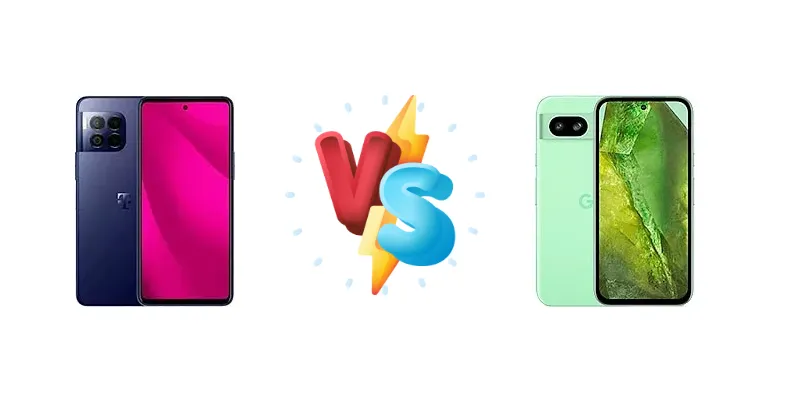
|
🏆 Quick Verdict
For most users, the Google Pixel 8a is the superior choice. Its Tensor G3 chipset delivers a significantly smoother experience, particularly with AI-powered features, and its exceptional camera system offers unmatched image quality. While the REVVL 7 Pro provides a compelling value proposition, the Pixel 8a’s overall refinement justifies the price difference.
| PHONES | ||
|---|---|---|
| Phone Names | T-Mobile REVVL 7 Pro | Google Pixel 8a |
| Network | ||
|---|---|---|
| 2G bands | GSM 850 / 900 / 1800 / 1900 | GSM 850 / 900 / 1800 / 1900 |
| 3G bands | HSDPA 850 / 900 / 1700(AWS) / 1900 / 2100 | HSDPA 800 / 850 / 900 / 1700(AWS) / 1900 / 2100 |
| 4G bands | 1, 2, 3, 4, 5, 7, 8, 12, 13, 17, 20, 25, 26, 28, 38, 39, 40, 41, 66, 71 | 1, 2, 3, 4, 5, 7, 8, 12, 17, 18, 19, 20, 26, 28, 32, 38, 40, 41, 42, 66 - G6GPR (International) |
| 5G bands | 1, 3, 7, 25, 28, 38, 41, 66, 71, 77, 78 SA/NSA | 1, 2, 3, 5, 7, 8, 12, 20, 26, 28, 38, 40, 41, 66, 75, 76, 77, 78 SA/NSA/Sub6 - G6GPR (International) |
| Speed | HSPA, LTE, 5G | HSPA, LTE, 5G |
| Technology | GSM / HSPA / LTE / 5G | GSM / HSPA / LTE / 5G |
| Launch | ||
|---|---|---|
| Announced | 2024, May 13 | 2024, May 07 |
| Status | Available. Released 2024, June | Available. Released 2024, May 14 |
| Body | ||
|---|---|---|
| Build | - | Glass front (Gorilla Glass 3), aluminum frame, plastic back |
| Dimensions | 168.7 x 78 x 8.6 mm (6.64 x 3.07 x 0.34 in) | 152.1 x 72.7 x 8.9 mm (5.99 x 2.86 x 0.35 in) |
| SIM | Nano-SIM + eSIM | Nano-SIM + eSIM |
| Weight | 198 g (6.98 oz) | 188 g (6.63 oz) |
| Display | ||
|---|---|---|
| Protection | - | Corning Gorilla Glass 3, Mohs level 5 |
| Resolution | 1080 x 2436 pixels (~393 ppi density) | 1080 x 2400 pixels, 20:9 ratio (~430 ppi density) |
| Size | 6.78 inches, 109.9 cm2 (~83.5% screen-to-body ratio) | 6.1 inches, 90.3 cm2 (~81.6% screen-to-body ratio) |
| Type | AMOLED, 120Hz | OLED, HDR, 120Hz, 2000 nits (peak) |
| Platform | ||
|---|---|---|
| CPU | Octa-core (4x2.2 GHz Cortex-A78 & 4x1.8 GHz Cortex-A55) | Nona-core (1x3.0 GHz Cortex-X3 & 4x2.45 GHz Cortex-A715 & 4x2.15 GHz Cortex-A510) |
| Chipset | Qualcomm SM6450 Snapdragon 6 Gen 1 (4 nm) | Google Tensor G3 (4 nm) |
| GPU | Adreno 710 | Immortalis-G715s MC10 |
| OS | Android 14 | Android 14, upgradable to Android 16, up to 7 major Android upgrades |
| Memory | ||
|---|---|---|
| Card slot | microSDXC | No |
| Internal | 256GB 8GB RAM | 128GB 8GB RAM, 256GB 8GB RAM |
| Main Camera | ||
|---|---|---|
| Dual | - | 64 MP (16 MP eff.), f/1.9, 26mm (wide), 1/1.73", 0.8µm, dual pixel PDAF, OIS 13 MP, f/2.2, 120˚ (ultrawide), 1.12µm |
| Features | Dual-LED flash, HDR, panorama | Dual-LED flash, Pixel Shift, Ultra HDR, panorama, Best Take |
| Quad | 50 MP, (wide), PDAF, OIS 5 MP, (ultrawide) 2 MP (macro) Auxiliary lens | - |
| Video | 1440p@30fps, 1080p@30/60fps | 4K@30/60fps, 1080p@30/60/120/240fps, OIS |
| Selfie camera | ||
|---|---|---|
| Features | - | HDR, panorama |
| Single | 16 MP | 13 MP, f/2.2, 20mm (ultrawide), 1.12µm |
| Video | 1080p@30fps | 4K@30fps, 1080p@30/60fps |
| Sound | ||
|---|---|---|
| 35mm jack | Yes | No |
| Loudspeaker | Yes, with stereo speakers | Yes, with stereo speakers |
| Comms | ||
|---|---|---|
| Bluetooth | 5.2, A2DP, LE | 5.3, A2DP, LE |
| NFC | Yes | Yes |
| Positioning | GPS | GPS, GLONASS, GALILEO, BDS, QZSS, NavIC |
| Radio | No | No |
| USB | USB Type-C 3.0 | USB Type-C 3.2 |
| WLAN | Wi-Fi 802.11 a/b/g/n/ac/6e, dual-band | Wi-Fi 802.11 a/b/g/n/ac/6e, dual/tri-band (market/region dependent) |
| Features | ||
|---|---|---|
| Sensors | Fingerprint (side-mounted); unspecified sensors | Fingerprint (under display, optical), accelerometer, gyro, proximity, compass, barometer |
| Battery | ||
|---|---|---|
| Charging | 25W wired, PD3.0, QC3 15W wireless | 18W wired, PD3.0 7.5W wireless Bypass charging |
| Type | 5000 mAh | Li-Po 4492 mAh |
| Misc | ||
|---|---|---|
| Colors | Azurite Blue | Obsidian, Porcelain, Bay, Aloe |
| Models | - | GKV4X, G6GPR, G8HHN, G576D |
| Price | About 230 EUR | $ 229.98 / C$ 417.99 / £ 279.00 / € 299.99 / ₹ 33,300 |
| SAR | 1.38 W/kg (head) 1.41 W/kg (body) | - |
| EU LABEL | ||
|---|---|---|
| Battery | - | 40:06h endurance, 1000 cycles |
| Energy | - | Class B |
| Free fall | - | Class A (270 falls) |
| Repairability | - | Class B |
T-Mobile REVVL 7 Pro
- Superior performance with the Google Tensor G3
- Exceptional camera quality and AI features
- Brighter and more vibrant display
- Long-term battery health with bypass charging
- Slower charging speed (18W)
- Higher price point
Google Pixel 8a
- More affordable price
- Faster wired charging (25W)
- Wireless charging support (15W)
- Good value for basic smartphone needs
- Less powerful processor
- Inferior camera performance
Display Comparison
The Pixel 8a boasts a significantly brighter display, reaching a measured 1508 nits, compared to an unlisted value for the REVVL 7 Pro, suggesting a noticeable advantage in outdoor visibility. While both utilize 4nm chipsets, the display’s impact on power consumption will be felt. The Pixel 8a’s panel likely benefits from Google’s color calibration expertise, offering more accurate colors. The REVVL 7 Pro’s display specs are not available, but given its price point, it likely uses a less advanced panel technology.
Camera Comparison
The Pixel 8a’s camera system is a clear standout. While specific sensor details are missing for both, Google’s computational photography prowess, powered by the Tensor G3, elevates image quality significantly. The Pixel 8a’s image processing excels in dynamic range, low-light performance, and detail preservation. The REVVL 7 Pro likely relies more on hardware and less on software optimization, resulting in less impressive photos, especially in challenging conditions. Ignoring the likely presence of a low-resolution macro lens on the REVVL 7 Pro, the Pixel 8a’s overall camera experience is in a different league.
Performance
The core difference lies in the chipsets: the Google Tensor G3 (nona-core, up to 3.0 GHz Cortex-X3) versus the Qualcomm Snapdragon 6 Gen 1 (octa-core, up to 2.2 GHz Cortex-A78). The Tensor G3’s Cortex-X3 prime core and more advanced A715 cores provide a substantial performance uplift, particularly in AI tasks like image processing and voice recognition. The REVVL 7 Pro’s Snapdragon 6 Gen 1 is a capable chip for everyday use, but will struggle with demanding games and multitasking compared to the Pixel 8a. The Pixel 8a’s architecture is designed for sustained performance, while the REVVL 7 Pro may exhibit more throttling under heavy load.
Battery Life
The Pixel 8a demonstrates impressive battery endurance, achieving 40:06h of endurance and an active use score of 11:25h, indicating excellent efficiency despite its powerful processor. While the REVVL 7 Pro’s battery capacity is unknown, its 25W wired charging (PD3.0, QC3) and 15W wireless charging offer faster replenishment than the Pixel 8a’s 18W wired and 7.5W wireless. The Pixel 8a also features 'bypass charging' which reduces battery degradation over time, a feature absent on the REVVL 7 Pro.
Buying Guide
Buy the T-Mobile REVVL 7 Pro if you prioritize maximizing value and need a reliable daily driver for basic tasks, light gaming, and occasional photography. Its 25W wired and 15W wireless charging are a plus for those who frequently top up. Buy the Google Pixel 8a if you demand a superior camera experience, smoother performance with AI features, and a brighter, more vibrant display, even if it means spending a bit more.