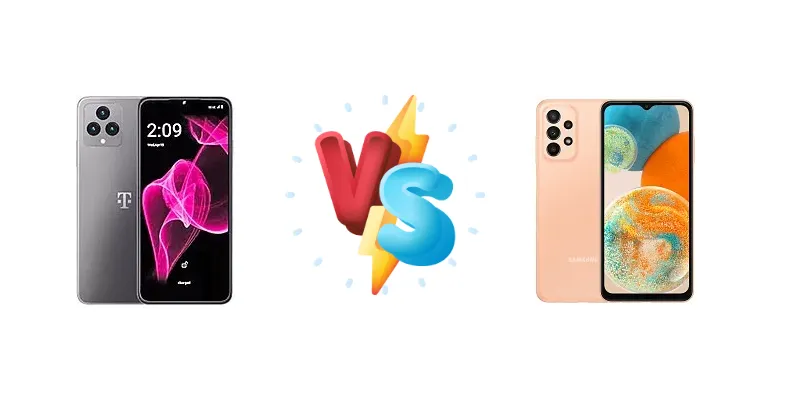
The T-Mobile REVVL 6x and Samsung Galaxy A23 5G represent compelling options in the increasingly competitive sub-$250 5G smartphone market. While both aim to deliver 5G connectivity at an accessible price, they take different approaches to chipset selection and feature implementation. This comparison dissects the key differences to determine which device offers the best value for your money.
🏆 Quick Verdict
For the average user prioritizing consistent performance and faster charging, the Samsung Galaxy A23 5G emerges as the better choice. Its Snapdragon 695, built on a more efficient 6nm process, offers a slight edge in sustained performance, while the 25W charging significantly reduces downtime compared to the REVVL 6x’s 15W charging.
| Network |
|---|
| 2G bands | GSM 850 / 900 / 1800 / 1900 | GSM 850 / 900 / 1800 / 1900 |
| 3G bands | HSDPA 850 / 1700(AWS) / 1900 | HSDPA 850 / 900 / 1700(AWS) / 1900 / 2100 |
| 4G bands | 2, 4, 5, 7, 12, 25, 26, 41, 66, 71 | 1, 2, 3, 4, 5, 7, 8, 12, 17, 20, 26, 28, 32, 38, 40, 41, 66 - International |
| 5G bands | 25, 41, 66, 71, 77 SA/NSA | 1, 3, 7, 8, 20, 28, 38, 40, 41, 77, 78 SA/NSA/Sub6 - International |
| Speed | HSPA, LTE, 5G | HSPA, LTE, 5G |
| Technology | GSM / HSPA / LTE / 5G | GSM / HSPA / LTE / 5G |
| | - | 2, 5, 30, 66, 77 SA/NSA/Sub6/mmWave - USA |
| Launch |
|---|
| Announced | 2023, August 17 | 2022, August 05 |
| Status | Available. Released 2023, August 24 | Available. Released 2022, September 02 |
| Body |
|---|
| Build | - | Glass front (Gorilla Glass 5), plastic frame, plastic back |
| Dimensions | 166.6 x 76.4 x 8.8 mm (6.56 x 3.01 x 0.35 in) | 165.4 x 76.9 x 8.4 mm (6.51 x 3.03 x 0.33 in) |
| SIM | Nano-SIM | · Nano-SIM· Nano-SIM + Nano-SIM |
| Weight | 194 g (6.84 oz) | 197 g (6.95 oz) |
| Display |
|---|
| Protection | - | Corning Gorilla Glass 5 |
| Resolution | 720 x 1600 pixels, 20:9 ratio (~269 ppi density) | 1080 x 2408 pixels, 20:9 ratio (~400 ppi density) |
| Size | 6.52 inches, 102.6 cm2 (~80.6% screen-to-body ratio) | 6.6 inches, 104.9 cm2 (~82.5% screen-to-body ratio) |
| Type | IPS LCD | PLS LCD, 120Hz |
| Platform |
|---|
| CPU | Octa-core (2x2.2 GHz Cortex-A76 & 6x2.0 GHz Cortex-A55) | Octa-core (2x2.2 GHz Kryo 660 Gold & 6x1.7 GHz Kryo 660 Silver) |
| Chipset | Mediatek Dimensity 700 (7 nm) | Qualcomm SM6375 Snapdragon 695 5G (6 nm) |
| GPU | Mali-G57 MC2 | Adreno 619 |
| OS | Android 12 or 13 | Android 12, upgradable to Android 14, One UI 6 |
| Memory |
|---|
| Card slot | microSDXC | microSDXC (dedicated slot) |
| Internal | 64GB 4GB RAM, 128GB 4GB RAM | 64GB 4GB RAM, 64GB 6GB RAM, 128GB 4GB RAM, 128GB 6GB RAM, 128GB 8GB RAM |
| Main Camera |
|---|
| Features | LED flash, HDR, panorama | LED flash, panorama, HDR |
| Quad | - | 50 MP, f/1.8, 26mm (wide), 1/2.76", 0.64µm, PDAF, OIS
5 MP, f/2.2, 13mm, 123˚ (ultrawide), 1/5.0", 1.12µm
2 MP (macro)
Auxiliary lens |
| Triple | 50 MP, (wide), PDAF
2 MP (macro)
Auxiliary lens | - |
| Video | 1080p@30fps | 1080p@30fps |
| Selfie camera |
|---|
| Single | 8 MP (USA)
5 MP (Europe) | 8 MP, f/2.0, 25mm (wide), 1/4.0", 1.12µm - USA
8 MP, f/2.2, 25mm (wide), 1/4.0", 1.12µm - International |
| Video | 1080p@30fps | 1080p@30fps |
| Sound |
|---|
| 3.5mm jack | - | Yes |
| 35mm jack | Yes | Yes |
| Loudspeaker | Yes | Yes |
| Comms |
|---|
| Bluetooth | 5.1, A2DP, LE | 5.1, A2DP, LE |
| NFC | Yes (market/region dependent) | Yes |
| Positioning | GPS | GPS, GLONASS, GALILEO, BDS |
| Radio | No | FM radio (market/region dependent) |
| USB | USB Type-C 2.0 | USB Type-C 2.0 |
| WLAN | Wi-Fi 802.11 a/b/g/n/ac, dual-band, Wi-Fi Direct | Wi-Fi 802.11 a/b/g/n/ac, dual-band, Wi-Fi Direct |
| Features |
|---|
| Sensors | Fingerprint (side-mounted), gyro, accelerometer, proximity, compass, barometer | Fingerprint (side-mounted), accelerometer, gyro, compass, barometer (USA only) |
| | - | Virtual proximity sensing |
| Battery |
|---|
| Charging | 15W wired | 25W wired |
| Type | Li-Ion 4500 mAh | Li-Po 5000 mAh |
| Misc |
|---|
| Colors | Gray, Blue | Black, White, Peach, Blue |
| Models | - | SM-A236U, SM-A236U1, SM-A236B, SM-A236B/DS, SM-A236B/DSN, SM-A236E, SM-S236DL |
| Price | About 190 EUR | $ 84.44 / £ 129.00 / € 125.28 / ₹ 21,000 |
| SAR | - | 0.68 W/kg (head) 0.57 W/kg (body) |
| SAR EU | - | 1.49 W/kg (head) 1.25 W/kg (body) |
| Tests |
|---|
| Battery life | - |
Endurance rating 138h
|
| Camera | - |
Photo / Video |
| Display | - |
Contrast ratio: 1328:1 (nominal) |
| Loudspeaker | - |
-25.9 LUFS (Very good)
|
| Performance | - |
AnTuTu: 318821 (v9)
GeekBench: 1940 (v5.1)
GFXBench: 16fps (ES 3.1 onscreen) |
T-Mobile REVVL 6x
- Lower upfront cost
- 5G connectivity
- Decent performance for basic tasks
- Slower charging (15W)
- Less efficient chipset (7nm)
- Potentially more throttling under load
Samsung Galaxy A23 5G
- Faster charging (25W)
- More efficient chipset (6nm)
- Likely better camera image processing
- Brighter display
- Higher upfront cost
- May not offer significantly longer battery life despite similar endurance rating
Display Comparison
Both the REVVL 6x and Galaxy A23 5G feature displays with a 1328:1 contrast ratio, suggesting similar visual pop. However, the Galaxy A23 5G boasts a measured peak brightness of 508 nits, which will translate to better visibility outdoors under direct sunlight. While neither phone is likely to impress display enthusiasts, the A23’s higher brightness provides a tangible advantage in real-world usability. Details regarding panel technology (LCD vs AMOLED) and refresh rate are missing, but given the price point, both are likely to be 60Hz LCD panels.
Camera Comparison
Both devices are listed as having Photo/Video capabilities, but specific details are absent. Without sensor size, aperture, or image processing details, a direct comparison is difficult. However, Samsung generally excels in image processing, and the A23 5G is likely to deliver more consistent and pleasing results, particularly in challenging lighting conditions. The presence of Optical Image Stabilization (OIS) on the A23 5G (a common feature in Samsung’s A-series) would further enhance image quality and video stabilization, a feature likely absent on the REVVL 6x.
Performance
The core difference lies in the chipsets: the REVVL 6x utilizes the Mediatek Dimensity 700 (7nm) while the Galaxy A23 5G employs the Qualcomm Snapdragon 695 5G (6nm). The 6nm process of the Snapdragon 695 generally leads to improved power efficiency and thermal management compared to the 7nm Dimensity 700. Both CPUs feature an octa-core configuration with similar peak clock speeds (2.2 GHz for the Cortex-A76/Kryo 660 Gold), but the Snapdragon’s Kryo 660 architecture is generally considered more efficient. This translates to potentially less throttling during sustained workloads like gaming. RAM specifications are missing, but are crucial for multitasking performance.
Battery Life
Both phones share an endurance rating of 138 hours, suggesting comparable battery life under similar usage patterns. However, the Galaxy A23 5G’s 25W wired charging is a significant advantage over the REVVL 6x’s 15W charging. This means the A23 5G can replenish its battery much faster, minimizing downtime. While battery capacity isn’t specified, the faster charging speed effectively mitigates any potential capacity differences.
Buying Guide
Buy the T-Mobile REVVL 6x if you prioritize a lower upfront cost and are comfortable with potentially slower app loading times and less demanding gaming. Buy the Samsung Galaxy A23 5G if you prefer a more refined user experience, faster charging, and a chipset built on a more modern manufacturing process, even if it means spending a bit more.
Frequently Asked Questions
❓ Will the Snapdragon 695 in the Galaxy A23 5G handle demanding games like PUBG or Call of Duty?
The Snapdragon 695 is capable of running PUBG and Call of Duty, but you'll likely need to lower graphics settings to achieve a smooth frame rate. The 6nm process helps with sustained performance, but it's not a gaming powerhouse. Expect medium settings at 30-40 FPS.
❓ How long will it take to fully charge the T-Mobile REVVL 6x with its 15W charger?
With a 15W charger, expect the REVVL 6x to take approximately 2.5 to 3 hours to fully charge from 0% to 100%. This is significantly slower than the Galaxy A23 5G's 25W charging.
❓ Does the Galaxy A23 5G support VoLTE and 5G on T-Mobile's network?
Yes, the Samsung Galaxy A23 5G is fully compatible with T-Mobile's VoLTE and 5G networks. It's officially certified for use on T-Mobile's infrastructure.
❓ Is the camera on the REVVL 6x suitable for casual photography?
The REVVL 6x's camera is adequate for casual snapshots in good lighting conditions. However, expect limited performance in low light and a lack of advanced features found on more expensive smartphones.