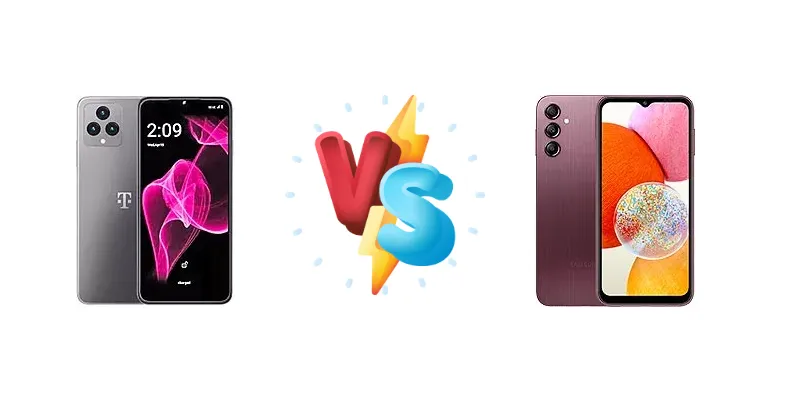
The T-Mobile REVVL 6x and Samsung Galaxy A14 represent compelling options in the sub-$200 smartphone market. Both aim to deliver 5G connectivity and essential features at an accessible price point, but they take different approaches to achieving this. The REVVL 6x prioritizes a more powerful processor, while the Galaxy A14 offers Samsung’s established brand and a potentially more refined software experience, with variations in chipset depending on the region.
🏆 Quick Verdict
For users prioritizing performance and 5G speeds, the T-Mobile REVVL 6x is the better choice, thanks to its Mediatek Dimensity 700 chipset. However, the Samsung Galaxy A14’s potential Exynos 850 variant (depending on your region) offers a more balanced experience, and Samsung’s software support is generally longer-lived.
| Network |
|---|
| 2G bands | GSM 850 / 900 / 1800 / 1900 | GSM 850 / 900 / 1800 / 1900 |
| 3G bands | HSDPA 850 / 1700(AWS) / 1900 | HSDPA 850 / 900 / 2100 |
| 4G bands | 2, 4, 5, 7, 12, 25, 26, 41, 66, 71 | 1, 3, 5, 7, 8, 20, 28, 38, 40, 41 |
| 5G bands | 25, 41, 66, 71, 77 SA/NSA | - |
| Speed | HSPA, LTE, 5G | HSPA, LTE |
| Technology | GSM / HSPA / LTE / 5G | GSM / HSPA / LTE |
| Launch |
|---|
| Announced | 2023, August 17 | 2023, February 28 |
| Status | Available. Released 2023, August 24 | Available. Released 2023, March 27 |
| Body |
|---|
| Build | - | Glass front, plastic back, plastic frame |
| Dimensions | 166.6 x 76.4 x 8.8 mm (6.56 x 3.01 x 0.35 in) | 167.7 x 78 x 9.1 mm (6.60 x 3.07 x 0.36 in) |
| SIM | Nano-SIM | · Nano-SIM· Nano-SIM + Nano-SIM |
| Weight | 194 g (6.84 oz) | 201 g (7.09 oz) |
| Display |
|---|
| Resolution | 720 x 1600 pixels, 20:9 ratio (~269 ppi density) | 1080 x 2408 pixels, 20:9 ratio (~400 ppi density) |
| Size | 6.52 inches, 102.6 cm2 (~80.6% screen-to-body ratio) | 6.6 inches, 104.9 cm2 (~80.2% screen-to-body ratio) |
| Type | IPS LCD | PLS LCD |
| Platform |
|---|
| CPU | Octa-core (2x2.2 GHz Cortex-A76 & 6x2.0 GHz Cortex-A55) | Octa-core (2x2.0 GHz Cortex-A75 & 6x1.8 GHz Cortex-A55) - Version AOcta-core (4x2.0 GHz Cortex-A55 & 4x2.0 GHz Cortex-A55) - Version B |
| Chipset | Mediatek Dimensity 700 (7 nm) | Mediatek MT6769 Helio G80 (12 nm) - Version AExynos 850 (8 nm) - Version B |
| GPU | Mali-G57 MC2 | Mali-G52 MC2 |
| OS | Android 12 or 13 | Android 13, upgradable to Android 15, One UI 7 |
| Memory |
|---|
| Card slot | microSDXC | microSDXC (dedicated slot) |
| Internal | 64GB 4GB RAM, 128GB 4GB RAM | 64GB 4GB RAM, 128GB 4GB RAM, 128GB 6GB RAM |
| Main Camera |
|---|
| Features | LED flash, HDR, panorama | LED flash, panorama, HDR |
| Single | - | 13 MP, f/2.0, (wide) |
| Triple | 50 MP, (wide), PDAF
2 MP (macro)
Auxiliary lens | 50 MP, f/1.8, 26mm (wide), 1/2.75", 0.64µm, PDAF
5 MP, f/2.2, 17mm (ultrawide), 1/5.0", 1.12µm
2 MP (macro) |
| Video | 1080p@30fps | 1080p@30fps |
| Selfie camera |
|---|
| Single | 8 MP (USA)
5 MP (Europe) | 13 MP, f/2.0, 26mm (wide), 1/3.1", 1.12µm |
| Video | 1080p@30fps | 1080p@30fps |
| Sound |
|---|
| 3.5mm jack | - | Yes |
| 35mm jack | Yes | Yes |
| Loudspeaker | Yes | Yes |
| Comms |
|---|
| Bluetooth | 5.1, A2DP, LE | 5.1 or 5.3, A2DP, LE |
| NFC | Yes (market/region dependent) | Yes (market/region dependent) |
| Positioning | GPS | GPS, GALILEO, GLONASS, BDS, QZSS |
| Radio | No | Unspecified |
| USB | USB Type-C 2.0 | USB Type-C 2.0 |
| WLAN | Wi-Fi 802.11 a/b/g/n/ac, dual-band, Wi-Fi Direct | Wi-Fi 802.11 a/b/g/n/ac, dual-band, Wi-Fi Direct |
| Features |
|---|
| Sensors | Fingerprint (side-mounted), gyro, accelerometer, proximity, compass, barometer | Fingerprint (side-mounted), accelerometer, proximity, compass |
| Battery |
|---|
| Charging | 15W wired | 15W wired |
| Type | Li-Ion 4500 mAh | Li-Po 5000 mAh |
| Misc |
|---|
| Colors | Gray, Blue | Black, Dark Red, Silver, Green |
| Models | - | SM-A145F, SM-A145F/DSN, SM-A145M, SM-A145M/DS, SM-A145P, SM-A145R |
| Price | About 190 EUR | € 85.76 / $ 147.60 / £ 79.95 |
| SAR EU | - | 0.46 W/kg (head) 1.37 W/kg (body) |
T-Mobile REVVL 6x
- More powerful processor (Dimensity 700)
- Better thermal efficiency
- Potentially smoother gaming experience
- Less established brand recognition
- Software updates may be less frequent
Samsung Galaxy A14
- Samsung brand reputation
- Potential for longer software support (especially Exynos version)
- Familiar Samsung One UI
- Helio G80 version offers significantly lower performance
- Potentially more throttling under sustained load
Display Comparison
Neither phone boasts a standout display. Both are likely to feature LCD panels, common in this price bracket. The key difference lies in the processing power driving them. While specific display specs (resolution, brightness) are missing, the REVVL 6x’s more capable chipset will contribute to smoother scrolling and faster app loading, indirectly enhancing the visual experience. The Galaxy A14’s display quality will depend heavily on whether it’s the Helio G80 or Exynos 850 variant; the Exynos version will likely offer better graphics processing for display-related tasks.
Camera Comparison
Camera performance is difficult to assess without detailed sensor information. Both phones likely feature a multi-camera setup with a primary sensor and supporting lenses. However, the image signal processor (ISP) within the Dimensity 700 is more advanced, potentially leading to better image processing and noise reduction. The Galaxy A14’s camera performance will again vary based on the chipset; the Exynos 850 offers a more capable ISP than the Helio G80. The inclusion of a 2MP macro camera on both devices is largely a marketing tactic, offering limited real-world benefit due to the small sensor size and lack of optical image stabilization (OIS).
Performance
This is where the REVVL 6x pulls ahead. The Mediatek Dimensity 700 (7nm) is a significantly more modern and efficient chipset than the Helio G80 (12nm) found in some Galaxy A14 models. The Dimensity 700’s Cortex-A76 cores offer a substantial performance boost over the G80’s Cortex-A75 cores. The Exynos 850 (8nm) variant of the Galaxy A14 closes the gap, offering a more competitive CPU and GPU, but still likely falls short of the Dimensity 700 in sustained performance. The 7nm process node of the Dimensity 700 also translates to better thermal efficiency, reducing the likelihood of throttling during extended use. This benefits gamers and users running demanding applications.
Battery Life
Both phones feature 15W wired charging, indicating similar charging speeds. Battery life will depend on usage patterns and chipset efficiency. While specific battery capacities are not provided, the Dimensity 700’s 7nm process node contributes to better power efficiency, potentially offsetting a slightly smaller battery capacity compared to the Galaxy A14. The Exynos 850 variant of the A14 will also be more efficient than the Helio G80 version, leading to comparable battery life to the REVVL 6x.
Buying Guide
Buy the T-Mobile REVVL 6x if you need a phone for demanding tasks like streaming, light gaming, or frequent multitasking, and value raw processing power. Buy the Samsung Galaxy A14 if you prefer a familiar Samsung user interface, potentially longer software support, and a more consistent experience, especially if you find a version equipped with the Exynos 850 chipset.
Frequently Asked Questions
❓ Does the Samsung Galaxy A14 with the Helio G80 chipset struggle with demanding games like PUBG?
Yes, the Helio G80 is a relatively weak chipset and will likely struggle to run PUBG at high settings. Expect noticeable frame drops and potential lag, even on medium settings. The Exynos 850 version will perform better, but still won't match the REVVL 6x's Dimensity 700.
❓ Is the 5G connectivity on the T-Mobile REVVL 6x reliable and fast?
The Mediatek Dimensity 700 supports 5G connectivity, but actual speeds will depend on T-Mobile's network coverage in your area. The Dimensity 700's modem is capable of achieving good 5G speeds, but network conditions are the primary limiting factor.
❓ How does Samsung's One UI compare to the software experience on the T-Mobile REVVL 6x?
Samsung's One UI is a feature-rich and polished software experience, but it can also be more resource-intensive. The REVVL 6x likely runs a near-stock version of Android, which is generally lighter and faster, especially on a less powerful chipset. However, Samsung provides longer software support.
❓ Is the 2MP macro camera on either phone worth using?
Not really. 2MP macro cameras typically produce low-quality images with limited detail. They are often included as a marketing feature but offer little practical benefit in real-world photography.