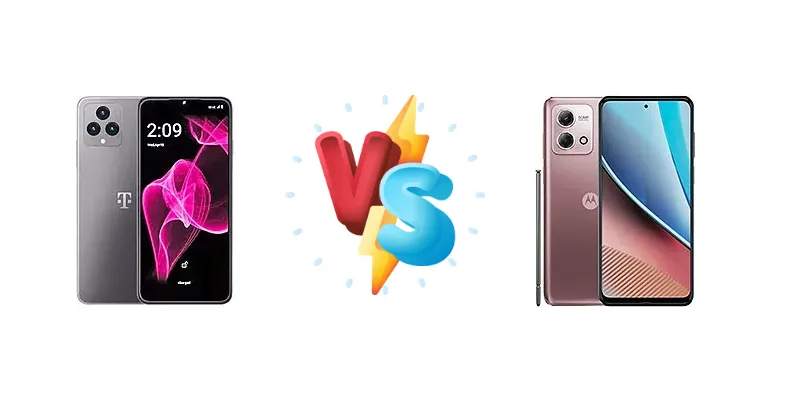
The T-Mobile REVVL 6x and the Motorola Moto G Stylus (2023) represent compelling options in the sub-$200 smartphone market. While both aim to deliver essential features at an accessible price, they diverge significantly in their core hardware. This comparison dissects those differences, focusing on how the Mediatek Dimensity 700 in the REVVL 6x stacks up against the Helio G85 powering the Moto G Stylus, and which phone ultimately provides a better user experience.
🏆 Quick Verdict
For the average user prioritizing consistent performance and future-proofing, the T-Mobile REVVL 6x emerges as the stronger choice. Its Dimensity 700 chipset, built on a more efficient 7nm process, offers a noticeable advantage in CPU and GPU performance over the Moto G Stylus’s 12nm Helio G85, despite both phones sharing 15W charging.
| Network |
|---|
| 2G bands | GSM 850 / 900 / 1800 / 1900 | GSM 850 / 900 / 1800 / 1900 |
| 3G bands | HSDPA 850 / 1700(AWS) / 1900 | HSDPA 850 / 900 / 1700(AWS) / 1900 / 2100 |
| 4G bands | 2, 4, 5, 7, 12, 25, 26, 41, 66, 71 | 1, 2, 3, 4, 5, 7, 8, 12, 13, 14, 17, 25, 26, 29, 30, 38, 41, 66, 71 |
| 5G bands | 25, 41, 66, 71, 77 SA/NSA | - |
| Speed | HSPA, LTE, 5G | HSPA, LTE |
| Technology | GSM / HSPA / LTE / 5G | GSM / HSPA / LTE |
| Launch |
|---|
| Announced | 2023, August 17 | 2023, May 02 |
| Status | Available. Released 2023, August 24 | Available. Released 2023, May 05 |
| Body |
|---|
| Build | - | Glass front, plastic frame, plastic back |
| Dimensions | 166.6 x 76.4 x 8.8 mm (6.56 x 3.01 x 0.35 in) | 162.9 x 74.1 x 9.2 mm (6.41 x 2.92 x 0.36 in) |
| SIM | Nano-SIM | Nano-SIM |
| Weight | 194 g (6.84 oz) | 195 g (6.88 oz) |
| | - | Stylus
Water-repellent design |
| Display |
|---|
| Resolution | 720 x 1600 pixels, 20:9 ratio (~269 ppi density) | 720 x 1600 pixels, 20:9 ratio (~270 ppi density) |
| Size | 6.52 inches, 102.6 cm2 (~80.6% screen-to-body ratio) | 6.5 inches, 102.0 cm2 (~84.5% screen-to-body ratio) |
| Type | IPS LCD | IPS LCD, 90Hz |
| Platform |
|---|
| CPU | Octa-core (2x2.2 GHz Cortex-A76 & 6x2.0 GHz Cortex-A55) | Octa-core (2x2.0 GHz Cortex-A75 & 6x1.8 GHz Cortex-A55) |
| Chipset | Mediatek Dimensity 700 (7 nm) | Mediatek MT6769 Helio G85 (12 nm) |
| GPU | Mali-G57 MC2 | Mali-G52 MC2 |
| OS | Android 12 or 13 | Android 13, planned upgrade to Android 14 |
| Memory |
|---|
| Card slot | microSDXC | microSDXC (dedicated slot) |
| Internal | 64GB 4GB RAM, 128GB 4GB RAM | 64GB 4GB RAM |
| Main Camera |
|---|
| Dual | - | 50 MP, f/1.8, (wide), 0.64µm, PDAF
2 MP (macro) |
| Features | LED flash, HDR, panorama | LED flash, HDR, panorama |
| Triple | 50 MP, (wide), PDAF
2 MP (macro)
Auxiliary lens | 50 MP, f/1.8, (wide), 0.64µm, PDAF
2 MP, f/2.4, (macro) |
| Video | 1080p@30fps | 1080p@30/60fps |
| Selfie camera |
|---|
| Features | - | HDR |
| Single | 8 MP (USA)
5 MP (Europe) | 8 MP, f/2.0, (wide), 1/4.0", 1.12µm |
| Video | 1080p@30fps | 1080p@30fps |
| Sound |
|---|
| 3.5mm jack | - | Yes |
| 35mm jack | Yes | Yes |
| Loudspeaker | Yes | Yes, with stereo speakers |
| Comms |
|---|
| Bluetooth | 5.1, A2DP, LE | 5.0, A2DP, LE |
| NFC | Yes (market/region dependent) | No |
| Positioning | GPS | GPS, GLONASS, GALILEO |
| Radio | No | No |
| USB | USB Type-C 2.0 | USB Type-C 2.0 |
| WLAN | Wi-Fi 802.11 a/b/g/n/ac, dual-band, Wi-Fi Direct | Wi-Fi 802.11 a/b/g/n/ac, dual-band, Wi-Fi Direct |
| Features |
|---|
| Sensors | Fingerprint (side-mounted), gyro, accelerometer, proximity, compass, barometer | Fingerprint (side-mounted), accelerometer, gyro, proximity, compass, barometer |
| Battery |
|---|
| Charging | 15W wired | 15W wired |
| Type | Li-Ion 4500 mAh | Li-Po 5000 mAh |
| Misc |
|---|
| Colors | Gray, Blue | Blue, Rose Gold |
| Price | About 190 EUR | About 200 EUR |
T-Mobile REVVL 6x
- More powerful and efficient Dimensity 700 chipset
- Potentially better thermal management
- Smoother overall user experience
- Limited brand recognition compared to Motorola
- 15W charging is relatively slow
Motorola Moto G Stylus (2023)
- Integrated stylus for note-taking and creativity
- Established Motorola brand reputation
- Potentially better software support (Motorola's near-stock Android)
- Less powerful and efficient Helio G85 chipset
- Higher risk of throttling under sustained load
- Slower app loading and multitasking
Display Comparison
Neither T-Mobile nor Motorola provide detailed display specifications beyond resolution. However, the choice of panel technology and quality is likely similar across both devices given their price points. The absence of high refresh rates is standard in this segment. The real differentiator lies in the processing power driving the UI, which impacts perceived smoothness even on a 60Hz display.
Camera Comparison
Without detailed camera specs beyond the main sensor, a direct comparison is difficult. Both phones likely employ similar image processing techniques for their price range. The absence of Optical Image Stabilization (OIS) on either device suggests reliance on software stabilization. The usefulness of any secondary cameras (often 2MP macro lenses) is questionable, offering limited practical benefit. Image quality will largely depend on software optimization and the quality of the primary sensor, which is not specified in the provided data.
Performance
The core difference between these phones is the chipset. The T-Mobile REVVL 6x’s Mediatek Dimensity 700, fabricated on a 7nm process, boasts a more advanced architecture than the Motorola Moto G Stylus (2023)’s 12nm Helio G85. The Dimensity 700’s Cortex-A76 cores (2x2.2 GHz) offer a significant performance uplift over the G85’s Cortex-A75 cores (2x2.0 GHz). This translates to faster app loading times, smoother multitasking, and improved gaming performance. The 7nm process also contributes to better thermal efficiency, reducing the likelihood of throttling during sustained workloads. While both CPUs feature six Cortex-A55 efficiency cores, the Dimensity 700’s superior architecture provides a clear advantage.
Battery Life
Both the T-Mobile REVVL 6x and the Motorola Moto G Stylus (2023) support 15W wired charging. This relatively slow charging speed means a full 0-100% charge will likely take over two hours. Battery life will depend heavily on usage patterns, but the Dimensity 700’s superior efficiency could translate to slightly longer runtimes on the REVVL 6x, offsetting any potential capacity differences not specified in the data. The 15W charging is a limitation for both devices, making overnight charging the more practical option.
Buying Guide
Buy the T-Mobile REVVL 6x if you need a phone capable of handling moderate multitasking, streaming, and light gaming without significant slowdowns. Its more modern chipset provides a smoother experience for everyday tasks. Buy the Motorola Moto G Stylus (2023) if you prioritize the integrated stylus for note-taking and creative tasks, and are willing to accept slightly lower performance in exchange for that functionality. The G Stylus is geared towards users who actively utilize the stylus feature.
Frequently Asked Questions
❓ Will the Helio G85 in the Moto G Stylus struggle with graphically demanding games like PUBG Mobile?
The Helio G85 is capable of running PUBG Mobile, but you'll likely need to lower the graphics settings to achieve a consistently smooth frame rate. The 12nm process and less powerful GPU compared to the Dimensity 700 in the REVVL 6x mean it's more prone to frame drops and throttling during extended gaming sessions.
❓ Does the T-Mobile REVVL 6x support 5G connectivity, and is it reliable on T-Mobile's network?
Yes, the Mediatek Dimensity 700 chipset includes an integrated 5G modem. The REVVL 6x is designed to work seamlessly with T-Mobile's 5G network, offering fast download and upload speeds where 5G coverage is available. However, 5G performance can vary depending on location and network congestion.
❓ How does Motorola's software support compare to T-Mobile's for the REVVL 6x?
Motorola generally provides a cleaner, near-stock Android experience with faster updates compared to T-Mobile's customized Android builds. While T-Mobile has improved its software support in recent years, Motorola typically offers a more streamlined and timely update schedule, potentially extending the usable lifespan of the Moto G Stylus.