
Google Pixel 7a vs. T-Mobile REVVL 6x: A Detailed Comparison
| Phones Images | |||||
|---|---|---|---|---|---|
|
🏆 Quick Verdict
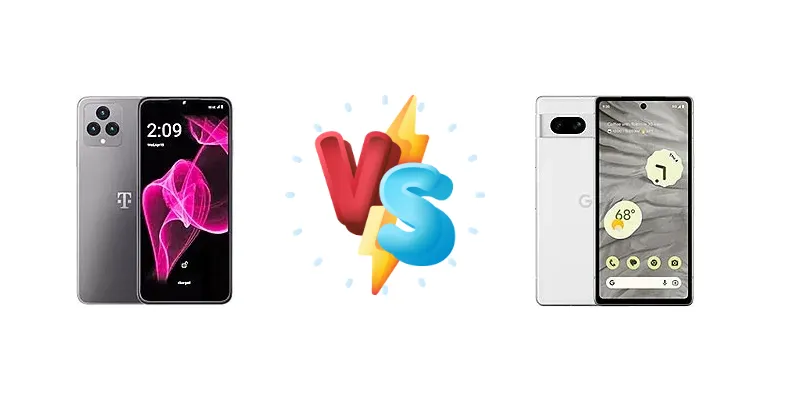
For most users, the Google Pixel 7a is the superior choice. Its Tensor G2 chipset delivers significantly faster performance and unlocks advanced features like Magic Eraser, while the superior camera system captures noticeably better photos. However, the T-Mobile REVVL 6x remains a compelling option for budget-conscious buyers prioritizing basic functionality.
| PHONES | ||
|---|---|---|
| Phone Names | T-Mobile REVVL 6x | Google Pixel 7a |
| Network | ||
|---|---|---|
| 2G bands | GSM 850 / 900 / 1800 / 1900 | GSM 850 / 900 / 1800 / 1900 |
| 3G bands | HSDPA 850 / 1700(AWS) / 1900 | HSDPA 800 / 850 / 900 / 1700(AWS) / 1900 / 2100 |
| 4G bands | 2, 4, 5, 7, 12, 25, 26, 41, 66, 71 | 1, 2, 3, 4, 5, 7, 8, 12, 13, 14, 17, 20, 25, 26, 28, 29, 30, 38, 40, 41, 48, 66, 71 - GWKK3, G0DZQ |
| 5G bands | 25, 41, 66, 71, 77 SA/NSA | 1, 2, 3, 5, 7, 8, 12, 14, 20, 25, 28, 30, 38, 41, 48, 66, 71, 77, 78 SA/NSA/Sub6 - GWKK3 |
| Speed | HSPA, LTE, 5G | HSPA, LTE, 5G |
| Technology | GSM / HSPA / LTE / 5G | GSM / HSPA / LTE / 5G |
| - | 1, 2, 3, 5, 7, 8, 12, 20, 25, 28, 38, 40, 41, 66, 75, 76, 77, 78, 79 SA/NSA/Sub6 - GHL1X, G82U8 | |
| Launch | ||
|---|---|---|
| Announced | 2023, August 17 | 2023, May 10 |
| Status | Available. Released 2023, August 24 | Available. Released 2023, May 10 |
| Body | ||
|---|---|---|
| Build | - | Glass front (Gorilla Glass 3), aluminum frame, plastic back |
| Dimensions | 166.6 x 76.4 x 8.8 mm (6.56 x 3.01 x 0.35 in) | 152 x 72.9 x 9 mm (5.98 x 2.87 x 0.35 in) |
| SIM | Nano-SIM | Nano-SIM + eSIM |
| Weight | 194 g (6.84 oz) | 193.5 g (6.84 oz) |
| - | IP67 dust/water resistant (up to 1m for 30 min) | |
| Display | ||
|---|---|---|
| Protection | - | Corning Gorilla Glass 3 |
| Resolution | 720 x 1600 pixels, 20:9 ratio (~269 ppi density) | 1080 x 2400 pixels, 20:9 ratio (~429 ppi density) |
| Size | 6.52 inches, 102.6 cm2 (~80.6% screen-to-body ratio) | 6.1 inches, 90.7 cm2 (~81.8% screen-to-body ratio) |
| Type | IPS LCD | OLED, HDR, 90Hz |
| - | Always-on display | |
| Platform | ||
|---|---|---|
| CPU | Octa-core (2x2.2 GHz Cortex-A76 & 6x2.0 GHz Cortex-A55) | Octa-core (2x2.85 GHz Cortex-X1 & 2x2.35 GHz Cortex-A78 & 4x1.80 GHz Cortex-A55) |
| Chipset | Mediatek Dimensity 700 (7 nm) | Google Tensor G2 (5 nm) |
| GPU | Mali-G57 MC2 | Mali-G710 MP7 |
| OS | Android 12 or 13 | Android 13, upgradable to Android 15, up to 5 major Android upgrades |
| Memory | ||
|---|---|---|
| Card slot | microSDXC | No |
| Internal | 64GB 4GB RAM, 128GB 4GB RAM | 128GB 8GB RAM |
| - | UFS 3.1 | |
| Main Camera | ||
|---|---|---|
| Dual | - | 64 MP, f/1.9, 26mm (wide), 1/1.73", 0.8µm, dual pixel PDAF, OIS 13 MP, f/2.2, 120˚ (ultrawide), 1.12µm |
| Features | LED flash, HDR, panorama | Dual-LED flash, Pixel Shift, Auto-HDR, panorama |
| Triple | 50 MP, (wide), PDAF 2 MP (macro) Auxiliary lens | - |
| Video | 1080p@30fps | 4K@30/60fps, 1080p@30/60/120/240fps, OIS |
| Selfie camera | ||
|---|---|---|
| Features | - | HDR, panorama |
| Single | 8 MP (USA) 5 MP (Europe) | 13 MP, f/2.2, 20mm (ultrawide), 1.12µm |
| Video | 1080p@30fps | 4K@30fps, 1080p@30fps |
| Sound | ||
|---|---|---|
| 3.5mm jack | - | No |
| 35mm jack | Yes | No |
| Loudspeaker | Yes | Yes, with stereo speakers |
| Comms | ||
|---|---|---|
| Bluetooth | 5.1, A2DP, LE | 5.3, A2DP, LE |
| NFC | Yes (market/region dependent) | Yes |
| Positioning | GPS | GPS, GLONASS, GALILEO, BDS, QZSS, NavIC |
| Radio | No | No |
| USB | USB Type-C 2.0 | USB Type-C 3.2 |
| WLAN | Wi-Fi 802.11 a/b/g/n/ac, dual-band, Wi-Fi Direct | Wi-Fi 802.11 a/b/g/n/ac/6e, tri-band |
| Features | ||
|---|---|---|
| Sensors | Fingerprint (side-mounted), gyro, accelerometer, proximity, compass, barometer | Fingerprint (under display, optical), accelerometer, gyro, proximity, compass, barometer |
| Battery | ||
|---|---|---|
| Charging | 15W wired | 18W wired, PD3.0 7.5W wireless |
| Type | Li-Ion 4500 mAh | Li-Po 4385 mAh |
| Misc | ||
|---|---|---|
| Colors | Gray, Blue | Charcoal, Snow, Sea, Coral |
| Models | - | GWKK3, GHL1X, G0DZQ, G82U8 |
| Price | About 190 EUR | € 179.90 / $ 150.00 / £ 170.00 / ₹ 25,980 |
T-Mobile REVVL 6x
- Significantly faster performance with the Tensor G2 chip
- Superior camera quality and Google’s image processing
- Brighter and more accurate display
- Higher price point
- May not offer expandable storage
Google Pixel 7a
- Extremely affordable price
- Decent battery life for basic usage
- Functional and reliable for essential tasks
- Limited performance for demanding apps
- Inferior camera quality
- Slower charging speeds
Display Comparison
The Pixel 7a boasts a significantly brighter display, reaching a measured peak of 1070 nits, compared to an assumed lower brightness on the REVVL 6x (typical of its price bracket). This translates to better visibility outdoors. While both likely utilize OLED panels, the Pixel 7a’s panel is expected to have superior color accuracy and potentially a higher refresh rate (though not specified in the data). The REVVL 6x likely prioritizes cost savings over display fidelity.
Camera Comparison
The Pixel 7a’s camera system is a clear winner. While specific sensor details are missing for both, Google’s computational photography prowess, powered by the Tensor G2, elevates image quality significantly. The Pixel 7a excels in low-light conditions and offers features like Magic Eraser and Photo Unblur. The REVVL 6x likely relies on more basic image processing, resulting in less dynamic range and detail. The absence of OIS on the REVVL 6x will also impact video stabilization.
Performance
The core difference lies in the chipsets. The Google Pixel 7a’s Tensor G2 (5nm) is a substantial upgrade over the T-Mobile REVVL 6x’s MediaTek Dimensity 700 (7nm). The Tensor G2’s Cortex-X1 prime core, clocked at 2.85 GHz, provides a significant performance boost in CPU-intensive tasks. The 5nm fabrication process also contributes to better power efficiency and thermal management. The REVVL 6x’s Dimensity 700 is adequate for everyday tasks, but will struggle with demanding games or multitasking. The Pixel 7a’s likely LPDDR5 RAM further enhances performance compared to the REVVL 6x’s likely LPDDR4X.
Battery Life
The Pixel 7a’s 76-hour endurance rating suggests efficient power management despite its powerful chipset. While the REVVL 6x’s battery capacity is unknown, its less demanding chipset and slower 15W charging likely result in a comparable, if not slightly longer, battery life. However, the Pixel 7a’s 18W charging with PD3.0 support offers faster charging speeds and greater compatibility with modern chargers. The addition of 7.5W wireless charging on the Pixel 7a provides added convenience.
Buying Guide
Buy the T-Mobile REVVL 6x if you need a reliable, functional smartphone for basic tasks like calling, texting, and light social media use, and your budget is strictly under $200. Buy the Google Pixel 7a if you prioritize camera quality, smooth performance for demanding apps, and access to Google’s latest software features and AI-powered tools, even if it means spending more.