
T-Mobile REVVL 6x Pro vs. Samsung Galaxy A14 5G: A Deep Dive into Affordable 5G
| Phones Images | |||||
|---|---|---|---|---|---|
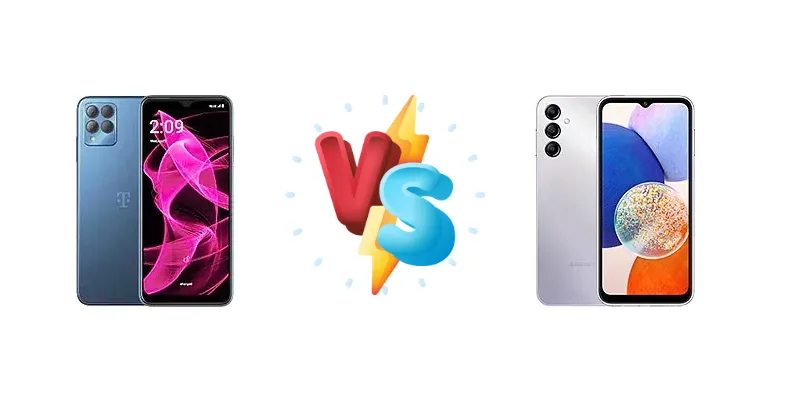
|
🏆 Quick Verdict
For most users, the Samsung Galaxy A14 5G emerges as the stronger choice. Its Exynos 1330 chipset (on the SM-A146B variant) provides a noticeable performance edge over the REVVL 6x Pro’s Dimensity 700, and the measured 519 nits of brightness offers a better viewing experience. While both charge at the same 15W rate, the A14 5G’s endurance rating suggests optimized power management.
| PHONES | ||
|---|---|---|
| Phone Names | T-Mobile REVVL 6x Pro | Samsung Galaxy A14 5G |
| Network | ||
|---|---|---|
| 2G bands | GSM 850 / 900 / 1800 / 1900 | GSM 850 / 900 / 1800 / 1900 |
| 3G bands | HSDPA 850 / 900 / 1700(AWS) / 1900 / 2100 | HSDPA 850 / 900 / 1700(AWS) / 1900 / 2100 |
| 4G bands | 1, 2, 3, 4, 5, 7, 8, 12, 13, 20, 25, 26, 38, 39, 40, 41, 66, 71 | 1, 2, 3, 4, 5, 7, 8, 12, 17, 20, 26, 28, 38, 40, 41, 66 - International |
| 5G bands | 25, 41, 66, 71, 77 SA/NSA | 2, 5, 66, 77 Sub6/mmWave - USA |
| Speed | HSPA, LTE, 5G | HSPA, LTE, 5G |
| Technology | GSM / HSPA / LTE / 5G | GSM / HSPA / LTE / 5G |
| - | 1, 3, 5, 7, 8, 20, 28, 40, 41, 78 SA/NSA/Sub6 - India | |
| Launch | ||
|---|---|---|
| Announced | 2023, August 17 | 2023, January 04 |
| Status | Available. Released 2023, August 24 | Available. Released 2023, January 12 |
| Body | ||
|---|---|---|
| Build | - | Glass front, plastic back, plastic frame |
| Dimensions | 173.9 x 77.8 x 9 mm (6.85 x 3.06 x 0.35 in) | 167.7 x 78 x 9.1 mm (6.60 x 3.07 x 0.36 in) |
| SIM | Nano-SIM | · Nano-SIM· Nano-SIM + Nano-SIM |
| Weight | 223.3 g (7.87 oz) | 202 g (7.13 oz) |
| Display | ||
|---|---|---|
| Resolution | 720 x 1640 pixels (~263 ppi density) | 1080 x 2408 pixels, 20:9 ratio (~400 ppi density) |
| Size | 6.82 inches, 110.5 cm2 (~81.6% screen-to-body ratio) | 6.6 inches, 104.9 cm2 (~80.2% screen-to-body ratio) |
| Type | IPS LCD | PLS LCD, 90Hz |
| Platform | ||
|---|---|---|
| CPU | Octa-core (2x2.2 GHz Cortex-A76 & 6x2.0 GHz Cortex-A55) | Octa-core (2x2.4 GHz Cortex-A78 & 6x2.0 GHz Cortex-A55) - SM-A146BOcta-core (2x2.2 GHz Cortex-A76 & 6x2.0 GHz Cortex-A55) - SM-A146P |
| Chipset | Mediatek Dimensity 700 (7 nm) | Exynos 1330 (5 nm) - SM-A146BMediatek Dimensity 700 (7 nm) - SM-A146P |
| GPU | Mali-G57 MC2 | Mali-G68 MP2 - SM-A146BMali-G57 MC2 - SM-A146P |
| OS | Android 12 or 13 | Android 13, upgradable to Android 15, One UI Core 7 |
| Memory | ||
|---|---|---|
| Card slot | microSDXC | microSDXC (uses shared SIM slot) - USA onlymicroSDXC (dedicated slot) - International |
| Internal | 128GB 6GB RAM, 256GB 6GB RAM | 64GB 4GB RAM, 128GB 4GB RAM, 128GB 6GB RAM, 128GB 8GB RAM |
| Main Camera | ||
|---|---|---|
| Features | LED flash, HDR, panorama | LED flash, panorama, HDR |
| Quad | 50 MP, (wide), PDAF 5 MP, (ultrawide) 2 MP (macro) Auxiliary lens | - |
| Single | - | 13 MP, f/2.0, (wide) |
| Triple | - | 50 MP, f/1.8, 26mm (wide), 1/2.76", 0.64µm, PDAF 2 MP (macro) Auxiliary lens |
| Video | 1080p@30fps | 1080p@30fps |
| Selfie camera | ||
|---|---|---|
| Single | 16 MP | 13 MP, f/2.0, 26mm (wide), 1.12µm |
| Video | 1080p@30fps | 1080p@30fps |
| Sound | ||
|---|---|---|
| 3.5mm jack | - | Yes |
| 35mm jack | Yes | Yes |
| Loudspeaker | Yes | Yes |
| Comms | ||
|---|---|---|
| Bluetooth | 5.1, A2DP, LE | 5.2, A2DP, LE |
| NFC | Yes | Yes |
| Positioning | GPS | GPS, GLONASS, GALILEO |
| Radio | No | FM radio (Exynos 1330 chipset only), recording |
| USB | USB Type-C 2.0 | USB Type-C 2.0 |
| WLAN | Wi-Fi 802.11 a/b/g/n/ac, dual-band, Wi-Fi Direct | Wi-Fi 802.11 a/b/g/n/ac, dual-band, Wi-Fi Direct |
| Features | ||
|---|---|---|
| Sensors | Fingerprint (side-mounted), gyro, accelerometer, proximity, compass, barometer | Fingerprint (side-mounted), accelerometer, gyro, proximity, compass, barometer (USA only) |
| Battery | ||
|---|---|---|
| Charging | 15W wired | 15W wired |
| Type | Li-Ion 5000 mAh | Li-Po 5000 mAh |
| Misc | ||
|---|---|---|
| Colors | Black, Dark Blue | Black, Light Green, Dark Red, Silver |
| Models | - | SM-A146B, SM-A146B/DS, SM-A146P, SM-A146P/DS, SM-A146U, SM-A146U1, SM-A146U1/DS, SM-A146W, SM-A146P/N, SM-A146P/DSN, SM-S146VL, SM-A146M |
| Price | About 210 EUR | $ 77.63 / C$ 151.00 / £ 97.00 / € 159.79 / ₹ 14,990 |
| SAR | - | 1.00 W/kg (head) 1.00 W/kg (body) |
| SAR EU | - | 0.56 W/kg (head) 1.28 W/kg (body) |
| Tests | ||
|---|---|---|
| Battery life | - | Endurance rating 130h |
| Camera | - | Photo / Video |
| Display | - | Contrast ratio: 1334:1 (nominal) |
| Loudspeaker | - | -26.8 LUFS (Good) |
| Performance | - | AnTuTu: 307886 (v9) GeekBench: 1727 (v5.1) GFXBench: 12fps (ES 3.1 onscreen) |
T-Mobile REVVL 6x Pro
- Potentially lower price point (depending on carrier deals)
- Simple, uncluttered software experience
- 5G connectivity
- Less powerful chipset (Dimensity 700)
- Limited display brightness information
- Unspecified battery capacity
Samsung Galaxy A14 5G
- More powerful chipset (Exynos 1330 on SM-A146B)
- Brighter display (519 nits)
- Longer battery endurance (130h)
- Software can feel bloated with Samsung features
- Potential for variant differences (Dimensity 700 on SM-A146P)
- 15W charging is relatively slow
Display Comparison
The Samsung Galaxy A14 5G boasts a measured peak brightness of 519 nits, significantly enhancing visibility in bright sunlight compared to the REVVL 6x Pro, for which brightness data is unavailable. Both displays share a 1334:1 contrast ratio, suggesting similar black levels and color depth. However, the A14 5G’s higher brightness translates to a more usable outdoor experience, making it preferable for users who frequently use their phones outside. The lack of information on the REVVL 6x Pro’s panel type makes it difficult to assess color accuracy or viewing angles.
Camera Comparison
Both devices list 'Photo / Video' capabilities, but lack specific details. Without sensor size or aperture information, a direct comparison is difficult. However, the A14 5G’s brand reputation suggests more refined image processing algorithms. The inclusion of a 2MP macro camera on both devices is largely a marketing tactic, offering limited practical benefit due to the small sensor size and lack of optical image stabilization (OIS). Real-world image quality will likely depend more on software optimization than raw hardware specifications.
Performance
The core difference lies in the chipsets. The Samsung Galaxy A14 5G utilizes either the Exynos 1330 (SM-A146B) or the Mediatek Dimensity 700 (SM-A146P). The Exynos 1330, with its Cortex-A78 cores clocked at 2.4 GHz, offers a performance advantage over the REVVL 6x Pro’s Dimensity 700 (2.2 GHz Cortex-A76 cores). This translates to snappier app launches, smoother multitasking, and improved gaming performance. The 5nm fabrication process of the Exynos 1330 also contributes to better power efficiency compared to the Dimensity 700’s 7nm process, potentially leading to longer battery life under load. Both phones share 6x2.0 GHz Cortex-A55 efficiency cores, meaning background tasks will perform similarly.
Battery Life
The Samsung Galaxy A14 5G achieves an endurance rating of 130 hours, indicating optimized power management. Both phones support 15W wired charging, meaning 0-100% charge times will be comparable, likely exceeding 2 hours. The A14 5G’s higher endurance rating suggests it can extract more usage from its battery capacity, making it a better choice for users who prioritize all-day battery life. The REVVL 6x Pro’s battery capacity is not specified, making a direct comparison challenging.
Buying Guide
Buy the T-Mobile REVVL 6x Pro if you prioritize a simple, straightforward experience and are heavily invested in the T-Mobile ecosystem. It’s a solid option for basic smartphone tasks. Buy the Samsung Galaxy A14 5G if you value a more responsive user experience, a brighter display for outdoor visibility, and the broader Samsung software ecosystem, even if it means potentially dealing with a slightly more complex interface.