
T-Mobile REVVL 6 vs. Samsung Galaxy A14 5G: Which Budget 5G Phone Reigns Supreme?
| Phones Images | |||||
|---|---|---|---|---|---|
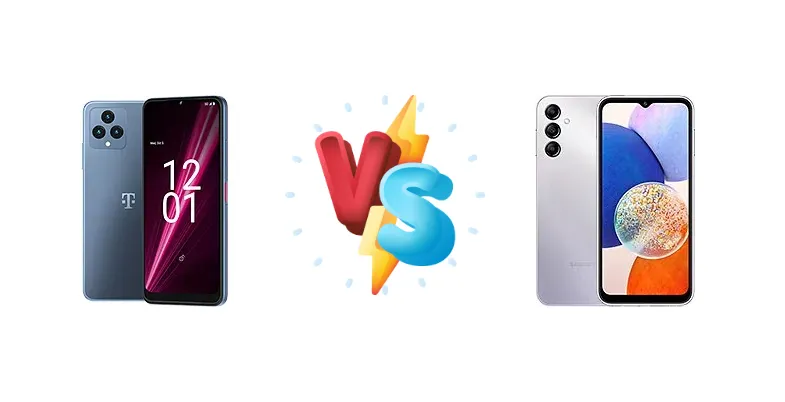
|
🏆 Quick Verdict
For most users, the Samsung Galaxy A14 5G emerges as the better choice. While both phones share 15W charging, the A14 5G’s Exynos 1330 (in the SM-A146B variant) offers a noticeable CPU performance advantage over the REVVL 6’s Dimensity 700, translating to smoother multitasking and app loading.
| PHONES | ||
|---|---|---|
| Phone Names | T-Mobile REVVL 6 | Samsung Galaxy A14 5G |
| Network | ||
|---|---|---|
| 2G bands | GSM 850 / 900 / 1800 / 1900 | GSM 850 / 900 / 1800 / 1900 |
| 3G bands | HSDPA 850 / 900 / 1700(AWS) / 1900 / 2100 | HSDPA 850 / 900 / 1700(AWS) / 1900 / 2100 |
| 4G bands | 1, 2, 3, 4, 5, 7, 8, 12, 13, 20, 25, 26, 28, 38, 39, 40, 41, 71 | 1, 2, 3, 4, 5, 7, 8, 12, 17, 20, 26, 28, 38, 40, 41, 66 - International |
| 5G bands | 25, 41, 66, 71, 77 SA/NSA | 2, 5, 66, 77 Sub6/mmWave - USA |
| Speed | HSPA, LTE, 5G | HSPA, LTE, 5G |
| Technology | GSM / HSPA / LTE / 5G | GSM / HSPA / LTE / 5G |
| - | 1, 3, 5, 7, 8, 20, 28, 40, 41, 78 SA/NSA/Sub6 - India | |
| Launch | ||
|---|---|---|
| Announced | 2022, July 28 | 2023, January 04 |
| Status | Available. Released 2022, July 28 | Available. Released 2023, January 12 |
| Body | ||
|---|---|---|
| Build | - | Glass front, plastic back, plastic frame |
| Dimensions | 166.6 x 76.4 x 8.8 mm (6.56 x 3.01 x 0.35 in) | 167.7 x 78 x 9.1 mm (6.60 x 3.07 x 0.36 in) |
| SIM | Nano-SIM | · Nano-SIM· Nano-SIM + Nano-SIM |
| Weight | 194 g (6.84 oz) | 202 g (7.13 oz) |
| Splash resistant | - | |
| Display | ||
|---|---|---|
| Resolution | 720 x 1600 pixels, 20:9 ratio (~269 ppi density) | 1080 x 2408 pixels, 20:9 ratio (~400 ppi density) |
| Size | 6.52 inches, 102.6 cm2 (~80.6% screen-to-body ratio) | 6.6 inches, 104.9 cm2 (~80.2% screen-to-body ratio) |
| Type | IPS LCD | PLS LCD, 90Hz |
| Platform | ||
|---|---|---|
| CPU | Octa-core (2x2.2 GHz Cortex-A76 & 6x2.0 GHz Cortex-A55) | Octa-core (2x2.4 GHz Cortex-A78 & 6x2.0 GHz Cortex-A55) - SM-A146BOcta-core (2x2.2 GHz Cortex-A76 & 6x2.0 GHz Cortex-A55) - SM-A146P |
| Chipset | Mediatek Dimensity 700 (7 nm) | Exynos 1330 (5 nm) - SM-A146BMediatek Dimensity 700 (7 nm) - SM-A146P |
| GPU | Mali-G57 MC2 | Mali-G68 MP2 - SM-A146BMali-G57 MC2 - SM-A146P |
| OS | Android 12 | Android 13, upgradable to Android 15, One UI Core 7 |
| Memory | ||
|---|---|---|
| Card slot | microSDXC | microSDXC (uses shared SIM slot) - USA onlymicroSDXC (dedicated slot) - International |
| Internal | 64GB 4GB RAM | 64GB 4GB RAM, 128GB 4GB RAM, 128GB 6GB RAM, 128GB 8GB RAM |
| Main Camera | ||
|---|---|---|
| Features | LED flash, HDR, panorama | LED flash, panorama, HDR |
| Single | 5 MP | 13 MP, f/2.0, (wide) |
| Triple | 13 MP, (wide), AF Auxiliary lens 2 MP (macro) | 50 MP, f/1.8, 26mm (wide), 1/2.76", 0.64µm, PDAF 2 MP (macro) Auxiliary lens |
| Video | 1080p@30fps | 1080p@30fps |
| Selfie camera | ||
|---|---|---|
| Single | 5 MP | 13 MP, f/2.0, 26mm (wide), 1.12µm |
| Video | 1080p@30fps | 1080p@30fps |
| Sound | ||
|---|---|---|
| 3.5mm jack | Yes | Yes |
| 35mm jack | Yes | Yes |
| Loudspeaker | Yes | Yes |
| Comms | ||
|---|---|---|
| Bluetooth | 5.1, A2DP, LE | 5.2, A2DP, LE |
| NFC | No | Yes |
| Positioning | GPS | GPS, GLONASS, GALILEO |
| Radio | No | FM radio (Exynos 1330 chipset only), recording |
| USB | USB Type-C 2.0 | USB Type-C 2.0 |
| WLAN | Wi-Fi 802.11 a/b/g/n/ac, dual-band, Wi-Fi Direct | Wi-Fi 802.11 a/b/g/n/ac, dual-band, Wi-Fi Direct |
| Features | ||
|---|---|---|
| Sensors | Fingerprint (side-mounted), gyro, accelerometer, proximity, compass, barometer | Fingerprint (side-mounted), accelerometer, gyro, proximity, compass, barometer (USA only) |
| Battery | ||
|---|---|---|
| Charging | 15W wired | 15W wired |
| Type | Li-Ion 4500 mAh | Li-Po 5000 mAh |
| Misc | ||
|---|---|---|
| Colors | Blue | Black, Light Green, Dark Red, Silver |
| Models | TMAF025G | SM-A146B, SM-A146B/DS, SM-A146P, SM-A146P/DS, SM-A146U, SM-A146U1, SM-A146U1/DS, SM-A146W, SM-A146P/N, SM-A146P/DSN, SM-S146VL, SM-A146M |
| Price | About 170 EUR | $ 77.63 / C$ 151.00 / £ 97.00 / € 159.79 / ₹ 14,990 |
| SAR | - | 1.00 W/kg (head) 1.00 W/kg (body) |
| SAR EU | - | 0.56 W/kg (head) 1.28 W/kg (body) |
| Tests | ||
|---|---|---|
| Battery life | - | Endurance rating 130h |
| Camera | - | Photo / Video |
| Display | - | Contrast ratio: 1334:1 (nominal) |
| Loudspeaker | - | -26.8 LUFS (Good) |
| Performance | - | AnTuTu: 307886 (v9) GeekBench: 1727 (v5.1) GFXBench: 12fps (ES 3.1 onscreen) |
T-Mobile REVVL 6
- Simple, uncluttered software experience
- Affordable price point
- Reliable 5G connectivity
- Older Dimensity 700 chipset
- Potentially lower display brightness
- Limited camera details
Samsung Galaxy A14 5G
- More powerful Exynos 1330 (SM-A146B variant)
- Brighter display for outdoor visibility
- Samsung’s image processing advantages
- Potential for variant confusion (Dimensity 700 version exists)
- Slow 15W charging
- 2MP macro camera is largely unnecessary
Display Comparison
The Samsung Galaxy A14 5G boasts a display with a measured peak brightness of 519 nits and a 1334:1 contrast ratio. While the REVVL 6’s display specifications aren’t provided, the A14 5G’s higher brightness is a clear advantage for outdoor use. Both share the same 1334:1 contrast ratio, suggesting similar color reproduction capabilities. The lack of high refresh rate panels on either device is typical for this price point, but the A14 5G’s brightness gives it an edge.
Camera Comparison
Both devices list 'Photo / Video' capabilities, but lack specific details. Without sensor size or aperture information, a direct comparison is difficult. However, Samsung’s image processing algorithms generally offer more refined results than those found on T-Mobile branded devices. The inclusion of a 2MP macro camera on the A14 5G is largely a marketing gimmick, offering limited practical benefit. Real-world camera performance will likely depend more on software optimization than raw hardware.
Performance
The core difference lies in the chipsets. The Galaxy A14 5G comes in two variants: the SM-A146B with the Exynos 1330 (2x2.4 GHz Cortex-A78 & 6x2.0 GHz Cortex-A55) and the SM-A146P with the Dimensity 700 (2x2.2 GHz Cortex-A76 & 6x2.0 GHz Cortex-A55). The Exynos 1330, found in the SM-A146B, utilizes a more modern CPU architecture (Cortex-A78 vs A76) and higher clock speeds, resulting in demonstrably faster performance in CPU-intensive tasks. The REVVL 6’s Dimensity 700, while capable, is a generation behind. Both phones utilize an octa-core configuration with the same Cortex-A55 efficiency cores, meaning power consumption during light tasks should be comparable. The A14 5G’s potential for smoother multitasking and faster app launches is a significant benefit.
Battery Life
Both the REVVL 6 and Galaxy A14 5G feature 15W wired charging. The A14 5G has an endurance rating of 130 hours, suggesting solid battery life. Without knowing the REVVL 6’s battery capacity or endurance rating, it’s difficult to make a definitive statement. However, the Exynos 1330’s 5nm process node *could* contribute to slightly better power efficiency, offsetting any potential capacity differences. The slow charging speed on both devices means a full charge will take a considerable amount of time.
Buying Guide
Buy the T-Mobile REVVL 6 if you prioritize a simple, streamlined experience and are primarily focused on basic connectivity and media consumption. Buy the Samsung Galaxy A14 5G if you value a more responsive user interface, potentially better camera performance (depending on the variant), and a slightly brighter display for outdoor visibility.