
T-Mobile REVVL 6 Pro vs. Samsung Galaxy A33 5G: A Deep Dive into Affordable 5G
| Phones Images | |||||
|---|---|---|---|---|---|
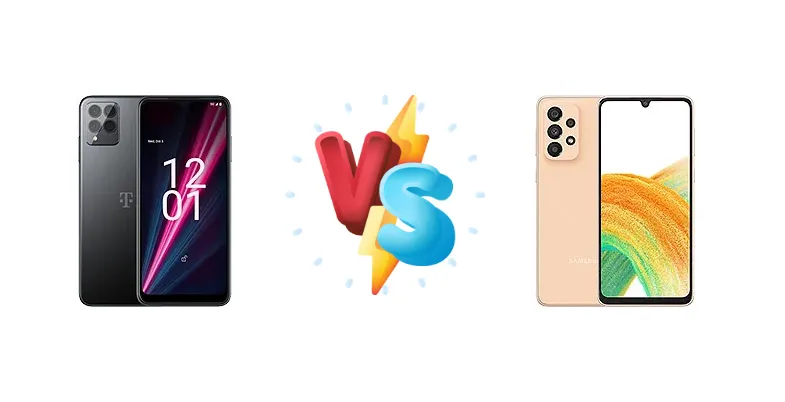
|
🏆 Quick Verdict
For the average user prioritizing overall performance and a brighter, more usable display, the Samsung Galaxy A33 5G emerges as the better choice. Its Exynos 1280 chipset provides a noticeable performance edge, and the 728 nits peak brightness makes it more comfortable to use outdoors. However, the REVVL 6 Pro remains a viable option for those on a tighter budget.
| PHONES | ||
|---|---|---|
| Phone Names | T-Mobile REVVL 6 Pro | Samsung Galaxy A33 5G |
| Network | ||
|---|---|---|
| 2G bands | GSM 850 / 900 / 1800 / 1900 | GSM 850 / 900 / 1800 / 1900 |
| 3G bands | HSDPA 850 / 900 / 1700(AWS) / 1900 / 2100 | HSDPA 850 / 900 / 1700(AWS) / 1900 / 2100 |
| 4G bands | 1, 2, 3, 4, 5, 7, 8, 12, 13, 20, 25, 26, 28, 38, 39, 40, 41, 71 | 1, 2, 3, 4, 5, 7, 8, 12, 17, 20, 26, 28, 32, 38, 40, 41, 66 |
| 5G bands | 25, 41, 66, 71, 77 SA/NSA | 1, 3, 5, 7, 8, 20, 28, 38, 40, 41, 66, 78 SA/NSA/Sub6 |
| Speed | HSPA, LTE, 5G | HSPA, LTE, 5G |
| Technology | GSM / HSPA / LTE / 5G | GSM / HSPA / LTE / 5G |
| Launch | ||
|---|---|---|
| Announced | 2022, July 28 | 2022, March 17 |
| Status | Available. Released 2022, July 28 | Available. Released 2022, April 20 |
| Body | ||
|---|---|---|
| Build | - | Glass front (Gorilla Glass 5), plastic frame, plastic back |
| Dimensions | 173.9 x 77.8 x 9 mm (6.85 x 3.06 x 0.35 in) | 159.7 x 74 x 8.1 mm (6.29 x 2.91 x 0.32 in) |
| SIM | Nano-SIM | · Nano-SIM· Nano-SIM + Nano-SIM |
| Weight | 214 g (7.55 oz) | 186 g (6.56 oz) |
| Splash resistant | IP67 dust/water resistant (up to 1m for 30 min) | |
| Display | ||
|---|---|---|
| Protection | - | Corning Gorilla Glass 5 |
| Resolution | 720 x 1640 pixels (~263 ppi density) | 1080 x 2400 pixels, 20:9 ratio (~411 ppi density) |
| Size | 6.82 inches, 110.5 cm2 (~81.6% screen-to-body ratio) | 6.4 inches, 98.9 cm2 (~83.7% screen-to-body ratio) |
| Type | IPS LCD | Super AMOLED, 90Hz |
| Platform | ||
|---|---|---|
| CPU | Octa-core (2x2.2 GHz Cortex-A76 & 6x2.0 GHz Cortex-A55) | Octa-core (2x2.4 GHz Cortex-A78 & 6x2.0 GHz Cortex-A55) |
| Chipset | Mediatek Dimensity 700 (7 nm) | Exynos 1280 (5 nm) |
| GPU | Mali-G57 MC2 | Mali-G68 |
| OS | Android 12 | Android 12, up to 4 major Android upgrades, One UI 8 |
| Memory | ||
|---|---|---|
| Card slot | microSDXC | microSDXC (uses shared SIM slot) |
| Internal | 128GB 6GB RAM | 128GB 4GB RAM, 128GB 6GB RAM, 128GB 8GB RAM, 256GB 8GB RAM |
| Main Camera | ||
|---|---|---|
| Features | LED flash, HDR, panorama | LED flash, panorama, HDR |
| Quad | 50 MP, (wide), PDAF 5 MP, (ultrawide) 2 MP (macro) Auxiliary lens | 48 MP, f/1.8, 26mm (wide), 1/2.0", 0.8µm, PDAF, OIS 8 MP, f/2.2, 123˚, (ultrawide), 1/4.0", 1.12µm 5 MP (macro) Auxiliary lens |
| Single | 16 MP | 13 MP, f/2.2, (wide), 1/3.1", 1.12µm |
| Video | 1080p@30fps | 4K@30fps, 1080p@30/60fps |
| Selfie camera | ||
|---|---|---|
| Single | 16 MP | 13 MP, f/2.2, (wide), 1/3.1", 1.12µm |
| Video | 1080p@30fps | 4K@30fps, 1080p@30fps |
| Sound | ||
|---|---|---|
| 3.5mm jack | Yes | No |
| 35mm jack | Yes | No |
| Loudspeaker | Yes | Yes, with stereo speakers |
| Comms | ||
|---|---|---|
| Bluetooth | 5.1, A2DP, LE | 5.1, A2DP, LE |
| NFC | Yes | Yes (market/region dependent) |
| Positioning | GPS | GPS, GLONASS, GALILEO, BDS |
| Radio | No | No |
| USB | USB Type-C 2.0 | USB Type-C 2.0, OTG |
| WLAN | Wi-Fi 802.11 a/b/g/n/ac, dual-band, Wi-Fi Direct | Wi-Fi 802.11 a/b/g/n/ac, dual-band, Wi-Fi Direct |
| Features | ||
|---|---|---|
| Sensors | Fingerprint (side-mounted), gyro, accelerometer, proximity, compass, barometer | Fingerprint (under display, optical), accelerometer, gyro, compass |
| - | Virtual proximity sensing | |
| Battery | ||
|---|---|---|
| Charging | 15W wired Wireless | 25W wired |
| Type | Li-Ion 5000 mAh | Li-Po 5000 mAh |
| Misc | ||
|---|---|---|
| Colors | Dark Shadow | Black, White, Blue, Peach |
| Models | TMAF035G | SM-A336E, SM-A336B, SM-A336B/DS, SM-A336B/DSN, SM-A336E/DS, SM-A336M, SM-A3360 |
| Price | About 220 EUR | £ 174.99 / € 187.50 / ₹ 21,999 |
| SAR | - | 0.35 W/kg (head) |
| SAR EU | - | 0.57 W/kg (head) 1.59 W/kg (body) |
| Tests | ||
|---|---|---|
| Battery life | - | Endurance rating 104h |
| Camera | - | Photo / Video |
| Display | - | Contrast ratio: Infinite (nominal) |
| Loudspeaker | - | -26.5 LUFS (Good) |
| Performance | - | AnTuTu: 354420 (v8), 394918 (v9) GeekBench: 1900 (v5.1) GFXBench: 20fps (ES 3.1 onscreen) |
T-Mobile REVVL 6 Pro
- Lower price point makes it highly accessible.
- Acceptable performance for basic smartphone tasks.
- 5G connectivity provides future-proofed data speeds.
- Less powerful chipset compared to the Exynos 1280.
- Likely inferior display quality (brightness, contrast).
- Slower charging speed (15W).
Samsung Galaxy A33 5G
- More powerful Exynos 1280 chipset for smoother performance.
- Brighter display (728 nits) for better outdoor visibility.
- Faster 25W charging for quicker top-ups.
- Higher price compared to the T-Mobile REVVL 6 Pro.
- May include less useful 2MP macro camera.
- Software updates may be slower than on a flagship device.
Display Comparison
The Samsung Galaxy A33 5G boasts a significant advantage in display quality, achieving a measured peak brightness of 728 nits. This is crucial for outdoor visibility, a common pain point for budget phones. While the REVVL 6 Pro’s display specifications are not provided, it’s reasonable to assume it falls short of this brightness level. The Galaxy A33 5G also benefits from an 'Infinite' contrast ratio, suggesting a superior AMOLED panel capable of deeper blacks and more vibrant colors. The REVVL 6 Pro likely utilizes an LCD panel, which typically offers lower contrast.
Camera Comparison
Both devices are listed as having Photo/Video capabilities, but detailed sensor information is lacking for the REVVL 6 Pro. The Galaxy A33 5G likely features a more sophisticated camera system, typical of Samsung’s A-series. While the presence of a 2MP macro camera on the A33 5G is common in this price range, its utility is limited. The key differentiator will be the main sensor size and image processing algorithms, where Samsung typically excels. The A33 5G’s image processing is likely to deliver more consistent results and better dynamic range.
Performance
The core difference lies in the chipsets: the T-Mobile REVVL 6 Pro utilizes the Mediatek Dimensity 700 (7nm), while the Samsung Galaxy A33 5G is powered by the Exynos 1280 (5nm). The Exynos 1280, built on a smaller 5nm process, offers improved power efficiency and transistor density compared to the 7nm Dimensity 700. This translates to better sustained performance and potentially less thermal throttling. The CPU architecture also favors the A33 5G, with its Cortex-A78 cores (2x2.4 GHz) offering a performance uplift over the REVVL 6 Pro’s Cortex-A76 cores (2x2.2 GHz). Both phones share the same Cortex-A55 efficiency cores (6x2.0 GHz), but the A33’s overall CPU and GPU capabilities are demonstrably superior.
Battery Life
Both the T-Mobile REVVL 6 Pro and the Samsung Galaxy A33 5G achieve an endurance rating of 104 hours, suggesting similar overall battery life. However, the Galaxy A33 5G supports 25W wired charging, significantly faster than the REVVL 6 Pro’s 15W charging. This faster charging speed translates to a quicker turnaround time from 0-100%, a practical advantage for users who frequently need to top up their battery.
Buying Guide
Buy the T-Mobile REVVL 6 Pro if you need a functional 5G phone with acceptable performance for basic tasks and are prioritizing the lowest possible price. Buy the Samsung Galaxy A33 5G if you prefer a smoother user experience, a brighter and more vibrant display, and a more capable camera system, even if it means spending a bit more.