
T-Mobile REVVL 5G vs Motorola Moto G Power 5G: A Deep Dive into Chipset and Battery Life
| Phones Images | |||||
|---|---|---|---|---|---|
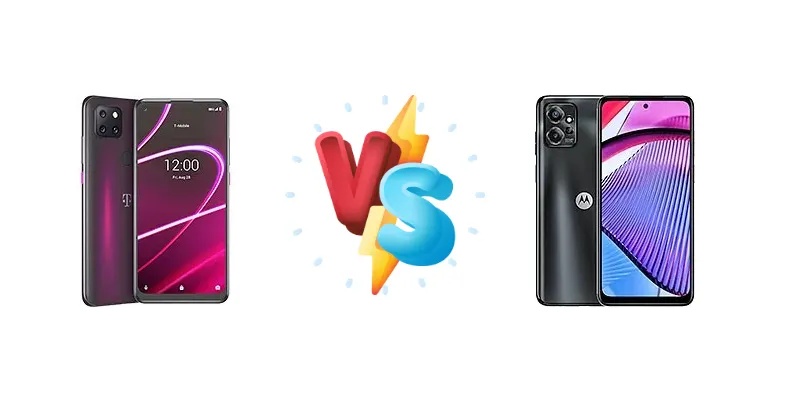
|
🏆 Quick Verdict
For the average user prioritizing battery life and sustained performance, the Motorola Moto G Power 5G is the better choice. Its Dimensity 930, built on a more efficient 6nm process, offers a noticeable advantage in power consumption and thermal management compared to the REVVL 5G’s 7nm Snapdragon 765. While the REVVL 5G is still capable, the Moto G Power 5G provides a smoother, longer-lasting experience.
| PHONES | ||
|---|---|---|
| Phone Names | T-Mobile REVVL 5G | Motorola Moto G Power 5G |
| Network | ||
|---|---|---|
| 2G bands | GSM 850 / 900 / 1800 / 1900 | GSM 850 / 900 / 1800 / 1900 |
| 3G bands | HSDPA 850 / 900 / 1700(AWS) / 1900 / 2100 | HSDPA 850 / 900 / 1700(AWS) / 1900 / 2100 |
| 4G bands | 1, 2, 3, 4, 7, 8, 12, 13, 20, 25, 26, 28, 38, 39, 40, 41, 66, 71 | 1, 2, 3, 4, 5, 7, 8, 12, 13, 14, 17, 20, 25, 26, 29, 30, 38, 39, 40, 41, 48, 66, 71 |
| 5G bands | 2, 25, 41, 66, 71 SA/NSA | 2, 5, 7, 12, 25, 30, 41, 66, 71, 77, 78 SA/NSA/Sub6 |
| Speed | HSPA, LTE, 5G | HSPA, LTE, 5G |
| Technology | GSM / HSPA / LTE / 5G | GSM / HSPA / LTE / 5G |
| Launch | ||
|---|---|---|
| Announced | 2020, August 27. Released 2020, September 04 | 2023, April 06 |
| Status | Discontinued | Available. Released 2023, April 13 |
| Body | ||
|---|---|---|
| Build | - | Glass front, plastic back, plastic frame |
| Dimensions | 165.4 x 76.2 x 9.4 mm (6.51 x 3.00 x 0.37 in) | 163.1 x 74.8 x 8.5 mm (6.42 x 2.94 x 0.33 in) |
| SIM | Nano-SIM | Nano-SIM |
| Weight | 215 g (7.58 oz) | 185 g (6.53 oz) |
| - | Water-repellent design | |
| Display | ||
|---|---|---|
| Resolution | 1080 x 2340 pixels, 19.5:9 ratio (~395 ppi density) | 1080 x 2400 pixels, 20:9 ratio (~405 ppi density) |
| Size | 6.53 inches, 104.7 cm2 (~83.1% screen-to-body ratio) | 6.5 inches, 102.0 cm2 (~83.6% screen-to-body ratio) |
| Type | IPS LCD | IPS LCD, 120Hz |
| Platform | ||
|---|---|---|
| CPU | Octa-core (1x2.4 GHz Kryo 475 Prime & 1x2.2 GHz Kryo 475 Gold & 6x1.8 GHz Kryo 475 Silver) | Octa-core (2x2.2 GHz Cortex-A78 & 6x2.0 GHz Cortex-A55) |
| Chipset | Qualcomm SM7250 Snapdragon 765 5G (7 nm) | Mediatek Dimensity 930 (6 nm) |
| GPU | Adreno 620 | IMG BXM-8-256 |
| OS | Android 10 | Android 13, upgradable to Android 14 |
| Memory | ||
|---|---|---|
| Card slot | microSDXC | microSDXC (dedicated slot) |
| Internal | 128GB 6GB RAM | 128GB 4GB RAM, 256GB 6GB RAM |
| Main Camera | ||
|---|---|---|
| Features | Dual-LED flash, HDR, panorama | LED flash, HDR, panorama |
| Triple | 48 MP, (wide), 1/2.0", 0.8µm, PDAF 8 MP, (ultrawide) 5 MP (macro) | 50 MP, f/1.8, (wide), 0.64µm, PDAF 2 MP (macro) Auxiliary lens |
| Video | 4K@30fps, 1080p@30fps | 1080p@30fps, gyro-EIS |
| Selfie camera | ||
|---|---|---|
| Single | 16 MP | 16 MP, f/2.4, (wide), 1.0µm |
| Video | 1080p@30fps | 1080p@30fps |
| Sound | ||
|---|---|---|
| 3.5mm jack | Yes | Yes |
| 35mm jack | Yes | Yes |
| Loudspeaker | Yes | Yes, with stereo speakers |
| Comms | ||
|---|---|---|
| Bluetooth | 5.0, A2DP, LE | 5.3, A2DP, LE |
| NFC | Yes | No |
| Positioning | GPS | GPS, GLONASS, GALILEO |
| Radio | No | No |
| USB | USB Type-C 2.0 | USB Type-C 2.0 |
| WLAN | Wi-Fi 802.11 a/b/g/n/ac, dual-band, Wi-Fi Direct | Wi-Fi 802.11 a/b/g/n/ac, dual-band |
| Features | ||
|---|---|---|
| Sensors | Fingerprint (rear-mounted), accelerometer, proximity, compass | Fingerprint (side-mounted), accelerometer, gyro, proximity, compass |
| Battery | ||
|---|---|---|
| Charging | - | 15W wired |
| Type | Li-Ion 4500 mAh | Li-Po 5000 mAh |
| Misc | ||
|---|---|---|
| Colors | Nebula Black | Dark Blue |
| Models | T790W, T790Z | - |
| Price | About 340 EUR | $ 97.90 / £ 199.00 |
T-Mobile REVVL 5G
- Proven Qualcomm Snapdragon 765 5G chipset
- Potential for wider carrier compatibility
- T-Mobile ecosystem integration
- Less power-efficient chipset
- Potentially shorter battery life
- Older processor architecture
Motorola Moto G Power 5G
- More efficient MediaTek Dimensity 930 chipset
- Better thermal management
- Longer battery life
- Slower 15W charging
- MediaTek chipset may have limited software support
- Potentially less optimized for certain carrier features
Display Comparison
Detailed display specifications are unavailable, but given the price points, both likely utilize LCD panels. The key difference lies in the underlying processors impacting display responsiveness. The Dimensity 930’s integrated GPU may offer slightly smoother scrolling and transitions. Bezels are expected to be comparable, typical of this price segment. Color accuracy will likely be standard for budget phones, prioritizing saturation over precise calibration.
Camera Comparison
Camera details beyond the presence of sensors are limited. However, the chipset plays a role in image signal processing (ISP). The Dimensity 930’s ISP is likely more advanced, potentially leading to better dynamic range and noise reduction in photos and videos. The REVVL 5G’s Snapdragon 765 ISP is capable, but older. Without knowing sensor sizes and apertures, it’s difficult to definitively declare a winner, but the Dimensity 930 has a processing advantage. The prevalence of 2MP macro lenses on both devices suggests limited utility; focusing on the main sensor quality is more important.
Performance
The core of the difference lies in the chipsets. The Qualcomm Snapdragon 765 5G in the REVVL 5G uses a 7nm process, featuring a Kryo 475 tri-cluster architecture. The Motorola Moto G Power 5G’s MediaTek Dimensity 930, built on a 6nm process, employs a more modern Cortex-A78 and A55 configuration. This 6nm node translates to improved power efficiency, meaning the Dimensity 930 can deliver comparable performance with less heat and battery drain. The Dimensity 930’s Cortex-A78 cores are also architecturally superior to the Kryo 475 Gold, offering better single-core performance, crucial for app launch times and general responsiveness. While both phones likely feature similar RAM configurations, the Dimensity 930 benefits from a more efficient memory controller.
Battery Life
The Moto G Power 5G’s 15W charging is slower than what some competitors offer, but the Dimensity 930’s efficiency mitigates this. The 6nm process allows for longer screen-on time with the same battery capacity (assumed to be similar between the two devices). The Snapdragon 765, while capable, is less efficient, meaning the REVVL 5G will likely require more frequent charging. The Dimensity 930’s power management features contribute to better standby time as well.
Buying Guide
Buy the T-Mobile REVVL 5G if you prioritize a proven Qualcomm chipset and are comfortable with potentially shorter battery life. It's a solid option for users already within the T-Mobile ecosystem. Buy the Motorola Moto G Power 5G if you value all-day battery life, efficient performance, and a more modern chipset architecture, making it ideal for media consumption and moderate gaming.