
T-Mobile REVVL 4+ vs Samsung Galaxy A11: Which Budget Phone Delivers More?
| Phones Images | |||||
|---|---|---|---|---|---|
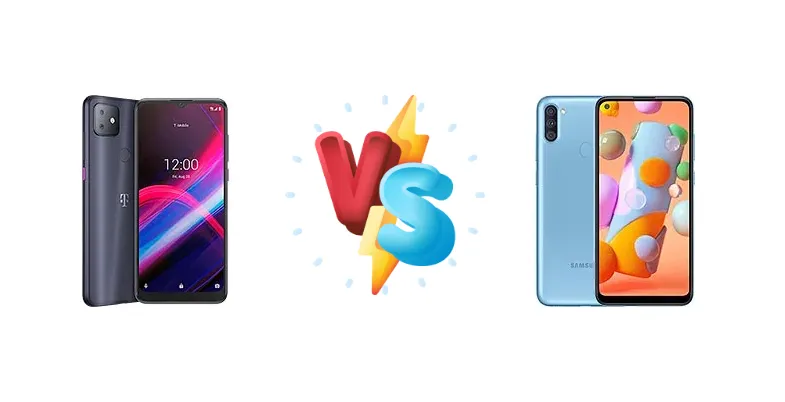
|
🏆 Quick Verdict
For the average user, the T-Mobile REVVL 4+ emerges as the stronger choice. Its Snapdragon 665 chipset, built on a more efficient 11nm process, provides a noticeable performance advantage over the Galaxy A11’s Snapdragon 450, translating to smoother multitasking and a more responsive user interface. While the A11 offers 15W charging, the REVVL 4+'s superior processing power offers a better overall experience.
| PHONES | ||
|---|---|---|
| Phone Names | T-Mobile REVVL 4+ | Samsung Galaxy A11 |
| Network | ||
|---|---|---|
| 2G bands | GSM 850 / 900 / 1800 / 1900 | GSM 850 / 900 / 1800 / 1900 |
| 3G bands | HSDPA 850 / 1700(AWS) / 1900 | HSDPA 850 / 900 / 1900 / 2100 |
| 4G bands | 1, 2, 3, 4, 5, 7, 8, 12, 13, 20, 25, 26, 28, 38, 39, 40, 41, 66, 71 | 1, 2, 3, 5, 7, 8, 20, 28, 38, 40, 41 |
| Speed | HSPA, LTE | HSPA 42.2/5.76 Mbps, LTE Cat4 150/50 Mbps |
| Technology | GSM / HSPA / LTE | GSM / HSPA / LTE |
| - | 1, 2, 3, 4, 5, 7, 8, 12, 13, 17, 20, 25, 26, 28, 38, 39, 40, 41, 66, 71 - SM-A115U | |
| Launch | ||
|---|---|---|
| Announced | 2020, August 27. Released 2020, September 04 | 2020, March 13. Released 2020, May 01 |
| Status | Discontinued | Discontinued |
| Body | ||
|---|---|---|
| Build | - | Glass front, plastic back, plastic frame |
| Dimensions | 165.4 x 75.2 x 8.1 mm (6.51 x 2.96 x 0.32 in) | 161.4 x 76.3 x 8 mm (6.35 x 3.00 x 0.31 in) |
| SIM | Nano-SIM | · Nano-SIM· Nano-SIM + Nano-SIM |
| Weight | 180 g (6.35 oz) | 177 g (6.24 oz) |
| Display | ||
|---|---|---|
| Resolution | 720 x 1440 pixels, 18:9 ratio (~247 ppi density) | 720 x 1560 pixels, 19.5:9 ratio (~268 ppi density) |
| Size | 6.52 inches, 109.7 cm2 (~88.2% screen-to-body ratio) | 6.4 inches, 100.5 cm2 (~81.6% screen-to-body ratio) |
| Type | IPS LCD | PLS LCD |
| Platform | ||
|---|---|---|
| CPU | Octa-core (4x2.0 GHz Kryo 260 Gold & 4x1.8 GHz Kryo 260 Silver) | Octa-core 1.8 GHz Cortex-A53 |
| Chipset | Qualcomm SDM665 Snapdragon 665 (11 nm) | Qualcomm SDM450 Snapdragon 450 (14 nm) |
| GPU | Adreno 610 | Adreno 506 |
| OS | Android 10 | Android 10, upgradable to Android 12, One UI Core 4.1 |
| Memory | ||
|---|---|---|
| Card slot | microSDXC | microSDXC (dedicated slot) |
| Internal | 64GB 4GB RAM | 32GB 2GB RAM, 32GB 3GB RAM, 64GB 3GB RAM, 64GB 4GB RAM |
| eMMC 5.1 | eMMC 5.1 | |
| Main Camera | ||
|---|---|---|
| Dual | 16 MP, PDAF 5 MP | - |
| Features | Dual-LED dual-tone flash, HDR, panorama | LED flash, panorama, HDR |
| Triple | - | 13 MP, f/1.8, 27mm (wide), AF 5 MP, f/2.2, 115˚ (ultrawide) Auxiliary lens |
| Video | 1080p@30fps | 1080p@30fps |
| Selfie camera | ||
|---|---|---|
| Single | 16 MP | 8 MP, f/2.0 |
| Video | 1080p@30fps | 1080p@30fps |
| Sound | ||
|---|---|---|
| 3.5mm jack | Yes | Yes |
| 35mm jack | Yes | Yes |
| Loudspeaker | Yes | Yes |
| Comms | ||
|---|---|---|
| Bluetooth | 5.0, A2DP, LE | 4.2, A2DP, LE |
| NFC | Yes | No |
| Positioning | GPS | GPS, GLONASS, GALILEO, BDS |
| Radio | No | FM radio |
| USB | USB Type-C 2.0 | USB Type-C 2.0 |
| WLAN | Wi-Fi 802.11 a/b/g/n/ac, dual-band, Wi-Fi Direct | Wi-Fi 802.11 b/g/n, Wi-Fi Direct |
| Features | ||
|---|---|---|
| Sensors | Fingerprint (rear-mounted), accelerometer, proximity | Fingerprint (rear-mounted), accelerometer, proximity |
| Battery | ||
|---|---|---|
| Charging | - | 15W wired |
| Type | Li-Ion 4000 mAh | Li-Po 4000 mAh |
| Misc | ||
|---|---|---|
| Colors | Steel Gray | Black, White, Blue, Red |
| Models | 5062W, 5062Z | SM-A115F/DS, SM-A115F, SM-A115M, SM-A115M/DS, SM-A115U, SM-A115A, SM-A115AZ, SM-A115U1, SM-A115W, SM-A115AP, SM-S115DL |
| Price | About 160 EUR | About 160 EUR |
| SAR EU | - | 0.52 W/kg (head) 0.99 W/kg (body) |
T-Mobile REVVL 4+
- Superior processing power with Snapdragon 665
- More efficient 11nm chipset for better battery life
- Potentially better camera image processing
- Charging speed not specified, potentially slower than A11
- Display specs unknown, potentially similar to A11
Samsung Galaxy A11
- 15W wired charging for faster top-ups
- Samsung brand recognition and software experience
- Potentially better color calibration on the display
- Significantly weaker Snapdragon 450 processor
- Less efficient 14nm chipset
- Limited performance for multitasking and gaming
Display Comparison
Neither device boasts a standout display. Both likely utilize LCD panels, common in this price bracket. However, display specs are not provided for either device. Given Samsung’s history, the A11 may have slightly better color calibration, but the REVVL 4+’s processor could potentially drive a higher refresh rate if the panel supports it (though this is speculative). Bezels are expected to be substantial on both, reflecting their budget positioning.
Camera Comparison
Camera details are limited, but the focus should be on the main sensors. Without specific sensor sizes, it’s difficult to make a definitive claim. However, the Snapdragon 665’s image signal processor (ISP) is more advanced than the 450’s, meaning the REVVL 4+ will likely produce better-quality photos, particularly in challenging lighting conditions. The prevalence of 2MP macro/depth sensors on both devices suggests these are largely marketing features and shouldn’t heavily influence purchasing decisions. Image processing algorithms will play a key role, and Samsung typically excels in this area, but the 665’s ISP provides a stronger foundation.
Performance
The core difference lies in the chipsets. The T-Mobile REVVL 4+’s Qualcomm Snapdragon 665 (11nm) is a significant upgrade over the Samsung Galaxy A11’s Snapdragon 450 (14nm). The 665’s octa-core configuration, split between 2.0 GHz Kryo 260 Gold and 1.8 GHz Kryo 260 Silver cores, offers superior performance compared to the A11’s uniformly clocked 1.8 GHz Cortex-A53 cores. The smaller 11nm node of the 665 also translates to improved power efficiency, potentially leading to longer battery life under load. This means the REVVL 4+ will handle app switching, web browsing, and even light gaming with noticeably less lag.
Battery Life
Battery capacity isn’t specified for the REVVL 4+, but the Galaxy A11’s battery life will be impacted by the less efficient Snapdragon 450. The A11’s 15W wired charging is a plus, offering a faster top-up than potentially slower charging on the REVVL 4+. However, the 665’s power efficiency could offset the charging advantage, providing comparable real-world usage time despite a potentially smaller battery capacity. The 14nm process of the Snapdragon 450 will consume more power during intensive tasks.
Buying Guide
Buy the T-Mobile REVVL 4+ if you need a phone capable of handling moderate multitasking, occasional gaming, and a generally smoother user experience. The Snapdragon 665 provides a tangible performance boost. Buy the Samsung Galaxy A11 if you prioritize brand recognition and slightly faster charging, and your usage is limited to basic tasks like calls, texts, and light social media browsing. The A11 is best suited for users who prioritize simplicity over speed.