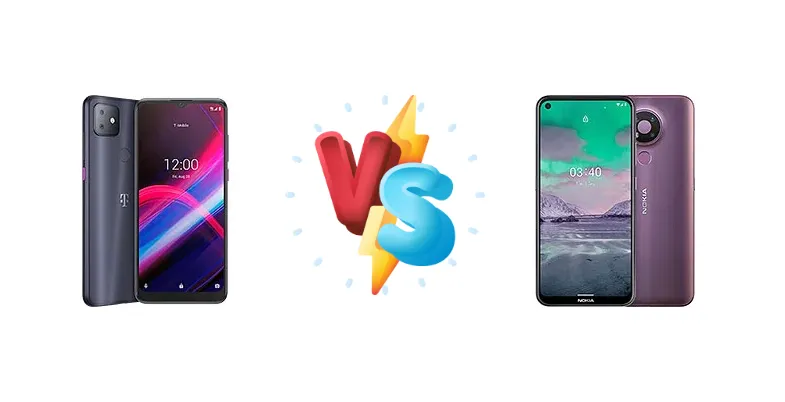
The T-Mobile REVVL 4+ and Nokia 3.4 represent two distinct approaches to the ultra-budget smartphone market. The REVVL 4+ leverages a slightly older, but more powerful, Qualcomm Snapdragon 665, while the Nokia 3.4 opts for the newer, but less performant, Snapdragon 460. This comparison dissects the implications of this chipset choice, alongside other key differences, to determine which phone delivers the best experience for the price.
🏆 Quick Verdict
For most users, the T-Mobile REVVL 4+ emerges as the better choice. Its Snapdragon 665 chipset provides a noticeable performance advantage in everyday tasks and light gaming, offsetting the Nokia 3.4’s slightly cleaner software experience. The Nokia 3.4’s 10W charging is a significant drawback in today’s market.
| Network |
|---|
| 2G bands | GSM 850 / 900 / 1800 / 1900 | GSM 850 / 900 / 1800 / 1900 |
| 3G bands | HSDPA 850 / 1700(AWS) / 1900 | HSDPA 850 / 900 / 1700(AWS) / 1900 / 2100 |
| 4G bands | 1, 2, 3, 4, 5, 7, 8, 12, 13, 20, 25, 26, 28, 38, 39, 40, 41, 66, 71 | 1, 2, 3, 4, 5, 7, 8, 12, 17, 13, 28, 66 |
| Speed | HSPA, LTE | HSPA, LTE |
| Technology | GSM / HSPA / LTE | GSM / HSPA / LTE |
| Launch |
|---|
| Announced | 2020, August 27. Released 2020, September 04 | 2020, September 22. Released 2020, October 26 |
| Status | Discontinued | Discontinued |
| Body |
|---|
| Dimensions | 165.4 x 75.2 x 8.1 mm (6.51 x 2.96 x 0.32 in) | 161 x 76 x 8.7 mm (6.34 x 2.99 x 0.34 in) |
| SIM | Nano-SIM | · Nano-SIM· Nano-SIM + Nano-SIM |
| Weight | 180 g (6.35 oz) | 180 g (6.35 oz) |
| Display |
|---|
| Resolution | 720 x 1440 pixels, 18:9 ratio (~247 ppi density) | 720 x 1560 pixels, 19.5:9 ratio (~269 ppi density) |
| Size | 6.52 inches, 109.7 cm2 (~88.2% screen-to-body ratio) | 6.39 inches, 100.2 cm2 (~81.9% screen-to-body ratio) |
| Type | IPS LCD | IPS LCD, 400 nits (typ) |
| Platform |
|---|
| CPU | Octa-core (4x2.0 GHz Kryo 260 Gold & 4x1.8 GHz Kryo 260 Silver) | Octa-core (4x1.8 GHz Cortex-A73 & 4x1.8 GHz Cortex-A53) |
| Chipset | Qualcomm SDM665 Snapdragon 665 (11 nm) | Qualcomm SM4250 Snapdragon 460 (11 nm) |
| GPU | Adreno 610 | Adreno 610 |
| OS | Android 10 | Android 10, upgradable to Android 11 |
| Memory |
|---|
| Card slot | microSDXC | microSDXC (dedicated slot) |
| Internal | 64GB 4GB RAM | 32GB 3GB RAM, 64GB 3GB RAM, 64GB 4GB RAM |
| | eMMC 5.1 | eMMC 5.1 |
| Main Camera |
|---|
| Dual | 16 MP, PDAF
5 MP | - |
| Features | Dual-LED dual-tone flash, HDR, panorama | LED flash, HDR, panorama |
| Triple | - | 13 MP, (wide), PDAF
5 MP, (ultrawide)
Auxiliary lens |
| Video | 1080p@30fps | 1080p@30fps |
| Selfie camera |
|---|
| Single | 16 MP | 8 MP, (wide) |
| Video | 1080p@30fps | 1080p@30fps |
| Sound |
|---|
| 3.5mm jack | Yes | Yes |
| 35mm jack | Yes | Yes |
| Loudspeaker | Yes | Yes |
| Comms |
|---|
| Bluetooth | 5.0, A2DP, LE | 4.2, A2DP, aptX |
| NFC | Yes | Yes (market/region dependent) |
| Positioning | GPS | GPS, GLONASS, GALILEO, BDS |
| Radio | No | FM radio |
| USB | USB Type-C 2.0 | USB Type-C 2.0 |
| WLAN | Wi-Fi 802.11 a/b/g/n/ac, dual-band, Wi-Fi Direct | Wi-Fi 802.11 b/g/n |
| Features |
|---|
| Sensors | Fingerprint (rear-mounted), accelerometer, proximity | Fingerprint (rear-mounted), accelerometer, gyro, proximity |
| Battery |
|---|
| Charging | - | 10W wired |
| Type | Li-Ion 4000 mAh | Li-Po 4000 mAh |
| Misc |
|---|
| Colors | Steel Gray | Fjord, Dusk, Charcoal |
| Models | 5062W, 5062Z | TA-1288, TA-1285, TA-1283 |
| Price | About 160 EUR | About 100 EUR |
| SAR | - | 0.83 W/kg (head) 1.05 W/kg (body) |
| SAR EU | - | 0.36 W/kg (head) 1.56 W/kg (body) |
T-Mobile REVVL 4+
- More powerful Snapdragon 665 chipset
- Potentially better battery life due to chipset efficiency
- Likely faster app loading and multitasking
- Software experience may be less clean than Nokia's
- Charging speed likely limited to 10W (unconfirmed)
Nokia 3.4
- Clean Android One software experience
- Guaranteed software updates (though limited)
- Potentially more streamlined user interface
- Significantly weaker Snapdragon 460 chipset
- Slow 10W charging
- Noticeably slower performance in demanding tasks
Display Comparison
Neither T-Mobile nor Nokia provide detailed display specifications beyond resolution. However, given the price point, both likely utilize IPS LCD panels. The real difference lies in the processing power driving them. The REVVL 4+'s more capable chipset can render UI elements and graphics more smoothly, resulting in a more fluid visual experience. Bezels are expected to be similar on both devices, reflecting their budget positioning. Color accuracy is unlikely to be a strong point on either.
Camera Comparison
Detailed camera specs are unavailable, but both phones likely feature a multi-camera setup with a primary sensor and supporting lenses. Given the market segment, image quality will be heavily reliant on software processing. The REVVL 4+'s stronger processor could potentially enable more sophisticated image processing algorithms, leading to slightly better results in challenging lighting conditions. However, without knowing sensor sizes and apertures, it’s difficult to make a definitive judgment. The presence of a 2MP macro lens on either device is largely a marketing gimmick and unlikely to deliver significant improvements in image quality.
Performance
The core distinction here is the chipset. The T-Mobile REVVL 4+’s Snapdragon 665, built on an 11nm process, features a Kryo 260 octa-core CPU with a split configuration of 4x2.0 GHz Gold and 4x1.8 GHz Silver cores. This contrasts with the Nokia 3.4’s Snapdragon 460, also 11nm, but utilizing 4x1.8 GHz Cortex-A73 and 4x1.8 GHz Cortex-A53 cores. While both are octa-core, the Kryo 260 cores in the 665 offer superior single-core and multi-core performance. This translates to faster app launch times, smoother scrolling, and a more responsive user interface on the REVVL 4+. The 460 is adequate for basic tasks, but will struggle with more demanding applications. RAM configurations are not specified, but are likely similar, making the chipset the primary bottleneck.
Battery Life
Battery capacity is not specified for either device. However, the Nokia 3.4’s 10W wired charging is a significant disadvantage. In a market where 18W or even 25W charging is becoming standard, 10W feels painfully slow. The REVVL 4+ likely supports a similar charging speed, but the more efficient Snapdragon 665 may result in slightly better battery life overall, even with a similar capacity battery. Users will spend considerably less time tethered to a wall charger with the REVVL 4+.
Buying Guide
Buy the T-Mobile REVVL 4+ if you prioritize responsiveness and smoother multitasking, even if it means accepting a potentially less polished software experience. This phone is ideal for users who occasionally play mobile games or frequently switch between apps. Buy the Nokia 3.4 if you value a clean Android One experience and are primarily focused on basic smartphone functions like calling, texting, and light social media use, and are willing to accept slower performance and slower charging.
Frequently Asked Questions
❓ Will the Nokia 3.4 struggle with popular apps like TikTok or Instagram?
The Snapdragon 460 in the Nokia 3.4 is capable of running these apps, but you may experience noticeable lag when scrolling through feeds or recording videos. The REVVL 4+'s Snapdragon 665 will provide a much smoother experience with these types of applications.
❓ Is the Android One software on the Nokia 3.4 worth sacrificing performance for?
Android One offers a clean, bloatware-free experience with guaranteed software updates. However, the performance difference between the Nokia 3.4 and the REVVL 4+ is substantial. If responsiveness and speed are priorities, the REVVL 4+ is the better choice, even if it means a less polished software experience.
❓ Can either of these phones handle basic mobile games like Candy Crush or Angry Birds?
Both phones can handle casual games like Candy Crush or Angry Birds without issue. However, for more demanding games like PUBG Mobile or Call of Duty Mobile, the REVVL 4+ will offer a significantly better frame rate and smoother gameplay experience.
❓ How long will it take to fully charge the Nokia 3.4 with its 10W charger?
Given the likely battery capacity (around 4000-5000mAh), expect a full charge to take approximately 3-4 hours with the Nokia 3.4’s 10W charger. This is considerably slower than most modern smartphones.