
Motorola Moto G Stylus 5G (2025) vs T-Mobile REVVL 4+: A Detailed Comparison
| Phones Images | |||||
|---|---|---|---|---|---|
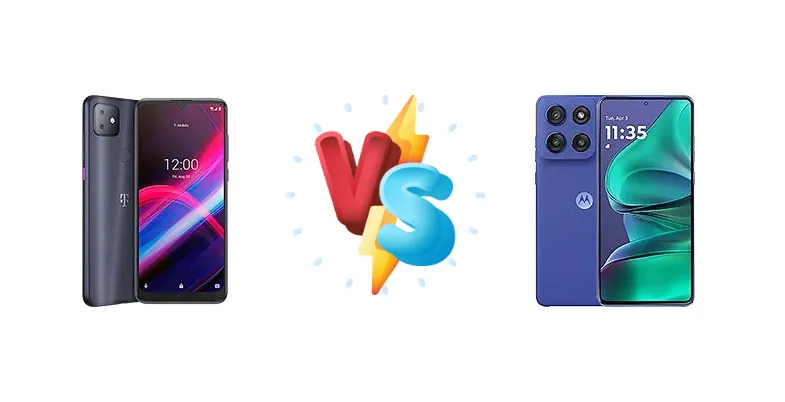
|
🏆 Quick Verdict
For the average user prioritizing performance and future-proofing, the Motorola Moto G Stylus 5G (2025) is the clear winner. Its Snapdragon 6 Gen 3 chipset, coupled with 68W charging and a significantly brighter display, offers a substantial upgrade over the aging Snapdragon 665 in the REVVL 4+.
| PHONES | ||
|---|---|---|
| Phone Names | T-Mobile REVVL 4+ | Motorola Moto G Stylus 5G (2025) |
| Network | ||
|---|---|---|
| 2G bands | GSM 850 / 900 / 1800 / 1900 | GSM 850 / 900 / 1800 / 1900 |
| 3G bands | HSDPA 850 / 1700(AWS) / 1900 | HSDPA 850 / 900 / 1700(AWS) / 1900 / 2100 |
| 4G bands | 1, 2, 3, 4, 5, 7, 8, 12, 13, 20, 25, 26, 28, 38, 39, 40, 41, 66, 71 | 1, 2, 3, 4, 5, 7, 8, 12, 13, 14, 17, 18, 19, 20, 25, 26, 28, 29, 30, 38, 39, 40, 41, 42, 48, 66, 71 |
| 5G bands | - | 1, 2, 3, 5, 7, 12, 14, 20, 25, 26, 28, 29, 30, 38, 40, 41, 48, 66, 70, 71, 77, 78 SA/NSA/Sub6 |
| Speed | HSPA, LTE | HSPA, LTE, 5G |
| Technology | GSM / HSPA / LTE | GSM / HSPA / LTE / 5G |
| Launch | ||
|---|---|---|
| Announced | 2020, August 27. Released 2020, September 04 | 2025, April 08 |
| Status | Discontinued | Available. Released 2025, April 17 |
| Body | ||
|---|---|---|
| Build | - | Glass front (Gorilla Glass 3), silicone polymer (eco leather) back, plastic frame |
| Dimensions | 165.4 x 75.2 x 8.1 mm (6.51 x 2.96 x 0.32 in) | 162.2 x 74.8 x 8.3 mm (6.39 x 2.94 x 0.33 in) |
| SIM | Nano-SIM | Nano-SIM + eSIM |
| Weight | 180 g (6.35 oz) | 191 g (6.74 oz) |
| Display | ||
|---|---|---|
| Protection | - | Corning Gorilla Glass 3 |
| Resolution | 720 x 1440 pixels, 18:9 ratio (~247 ppi density) | 1220 x 2712 pixels, 20:9 ratio (~444 ppi density) |
| Size | 6.52 inches, 109.7 cm2 (~88.2% screen-to-body ratio) | 6.7 inches, 108.4 cm2 (~89.3% screen-to-body ratio) |
| Type | IPS LCD | AMOLED, 1B colors, 120Hz, HDR, 3000 nits (peak) |
| Platform | ||
|---|---|---|
| CPU | Octa-core (4x2.0 GHz Kryo 260 Gold & 4x1.8 GHz Kryo 260 Silver) | Octa-core (4x2.4 GHz Cortex-A78 & 4x1.8 GHz Cortex-A55) |
| Chipset | Qualcomm SDM665 Snapdragon 665 (11 nm) | Qualcomm SM6475-AB Snapdragon 6 Gen 3 (4 nm) |
| GPU | Adreno 610 | Adreno 710 |
| OS | Android 10 | Android 15, up to 2 major Android upgrades |
| Memory | ||
|---|---|---|
| Card slot | microSDXC | microSDXC (dedicated slot) |
| Internal | 64GB 4GB RAM | 128GB 8GB RAM, 256GB 8GB RAM |
| eMMC 5.1 | - | |
| Main Camera | ||
|---|---|---|
| Dual | 16 MP, PDAF 5 MP | 50 MP, f/1.8, 24mm (wide), 1/1.56", 1.0µm, multi-directional PDAF, OIS 13 MP, f/2.2, 16mm, 120˚ (ultrawide), 1/3.0", 1.12µm, PDAF |
| Features | Dual-LED dual-tone flash, HDR, panorama | LED flash, HDR, panorama |
| Video | 1080p@30fps | 4K@30fps, 1080p@30/60/120fps |
| Selfie camera | ||
|---|---|---|
| Features | - | HDR |
| Single | 16 MP | 32 MP, f/2.2, 25mm (wide), 1/3.14", 0.7µm |
| Video | 1080p@30fps | 4K@30fps, 1080p@30/60fps |
| Sound | ||
|---|---|---|
| 3.5mm jack | Yes | - |
| 35mm jack | Yes | Yes |
| Loudspeaker | Yes | Yes, with stereo speakers (with Dolby Atmos) |
| Comms | ||
|---|---|---|
| Bluetooth | 5.0, A2DP, LE | 5.4, A2DP, LE |
| NFC | Yes | Yes |
| Positioning | GPS | GPS, GLONASS, GALILEO |
| Radio | No | No |
| USB | USB Type-C 2.0 | USB Type-C 2.0 |
| WLAN | Wi-Fi 802.11 a/b/g/n/ac, dual-band, Wi-Fi Direct | Wi-Fi 802.11 a/b/g/n/ac/6e, tri-band |
| Features | ||
|---|---|---|
| Sensors | Fingerprint (rear-mounted), accelerometer, proximity | Fingerprint (under display, optical), accelerometer, gyro, proximity, compass |
| Battery | ||
|---|---|---|
| Charging | - | 68W wired 15W wireless |
| Type | Li-Ion 4000 mAh | 5000 mAh |
| Misc | ||
|---|---|---|
| Colors | Steel Gray | Pantone: Gibraltar sea, Surf the Web |
| Models | 5062W, 5062Z | XT2517-1 |
| Price | About 160 EUR | $ 299.99 / C$ 368.17 |
T-Mobile REVVL 4+
- Extremely affordable price point
- Functional and reliable for basic tasks
- May include a headphone jack (common in this segment)
- Outdated Snapdragon 665 chipset
- Slow charging speeds
- Likely lower display quality
Motorola Moto G Stylus 5G (2025)
- Powerful Snapdragon 6 Gen 3 chipset
- Fast 68W wired and 15W wireless charging
- Bright and vibrant display (1870 nits)
- Built-in stylus for added functionality
- Higher price compared to the REVVL 4+
- May require a 5G data plan to fully utilize its capabilities
- Software update support may be limited
Display Comparison
The Motorola Moto G Stylus 5G (2025) boasts a significantly brighter display, reaching a measured 1870 nits. This is a massive leap over what we'd expect from the REVVL 4+, which likely falls in the 400-500 nit range based on its market segment. The higher brightness translates to vastly improved visibility outdoors. While panel technology isn't specified, the brightness alone suggests a more modern IPS LCD or potentially even an OLED panel, whereas the REVVL 4+ likely uses a standard IPS LCD. Bezels are also likely slimmer on the newer Motorola device, contributing to a more immersive viewing experience.
Camera Comparison
Without detailed camera specs for the REVVL 4+, a direct comparison is difficult. However, given its price point, it likely features a basic camera setup. The Motorola Moto G Stylus 5G (2025) will likely feature a more advanced camera system, potentially with a larger main sensor and improved image processing capabilities. While the presence of a 2MP macro camera on either device is unlikely to be a significant selling point, the Motorola's overall image quality will likely be superior due to the more powerful ISP within the Snapdragon 6 Gen 3.
Performance
The core difference lies in the chipsets. The Motorola utilizes the Qualcomm SM6475-AB Snapdragon 6 Gen 3 (4nm), while the REVVL 4+ is powered by the older Qualcomm SDM665 Snapdragon 665 (11nm). The 4nm process node of the Snapdragon 6 Gen 3 offers significantly improved power efficiency and thermal performance compared to the 11nm Snapdragon 665. The CPU architecture is also vastly different; the Motorola features Cortex-A78 cores (4x2.4 GHz) which are considerably more powerful than the Kryo 260 Gold cores (4x2.0 GHz) in the REVVL 4+. This translates to faster app loading times, smoother multitasking, and a more responsive overall experience on the Motorola. The newer chipset also supports faster RAM speeds (likely LPDDR4X or LPDDR5) compared to the REVVL 4+'s likely LPDDR4.
Battery Life
The Motorola Moto G Stylus 5G (2025) achieves an impressive 10:05h of active use, demonstrating excellent battery life. While the REVVL 4+'s battery capacity is unknown, the less efficient Snapdragon 665 chipset will likely result in shorter runtimes. Crucially, the Motorola supports 68W wired charging, allowing for a full charge in under an hour, and 15W wireless charging for added convenience. The REVVL 4+ likely supports significantly slower charging speeds, potentially around 10-15W, resulting in much longer charging times.
Buying Guide
Buy the T-Mobile REVVL 4+ if you need a functional smartphone on an extremely tight budget and don't require 5G or demanding app performance. Buy the Motorola Moto G Stylus 5G (2025) if you prioritize a smoother user experience, faster charging, a brighter and more vibrant display, and the convenience of a built-in stylus for note-taking and creative tasks.