
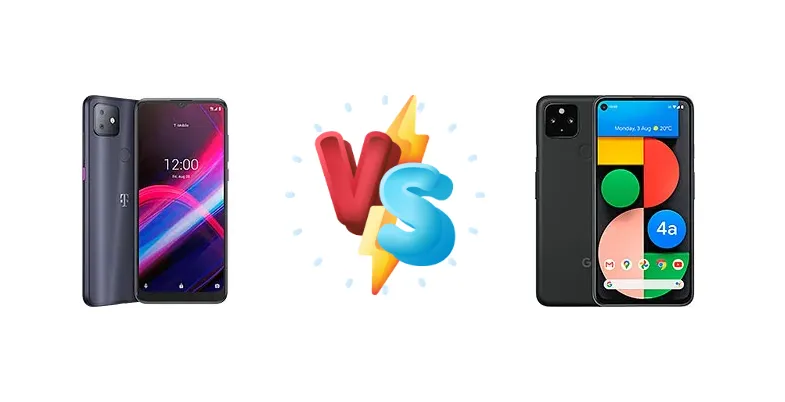
T-Mobile REVVL 4+ vs Google Pixel 4a 5G: A Detailed Performance and Value Showdown
| Phones Images | |||||
|---|---|---|---|---|---|
|
🏆 Quick Verdict
For most users, the Google Pixel 4a 5G is the superior choice. Its Snapdragon 765G chipset delivers significantly faster performance and better gaming capabilities, while the Pixel’s camera software consistently produces higher-quality images. The REVVL 4+ remains a viable option for those on a very tight budget.
| PHONES | ||
|---|---|---|
| Phone Names | T-Mobile REVVL 4+ | Google Pixel 4a 5G |
| Network | ||
|---|---|---|
| 2G bands | GSM 850 / 900 / 1800 / 1900 | GSM 850 / 900 / 1800 / 1900 |
| 3G bands | HSDPA 850 / 1700(AWS) / 1900 | HSDPA 850 / 900 / 1700(AWS) / 1900 / 2100 |
| 4G bands | 1, 2, 3, 4, 5, 7, 8, 12, 13, 20, 25, 26, 28, 38, 39, 40, 41, 66, 71 | 1, 2, 3, 4, 5, 7, 8, 12, 13, 14, 17, 18, 19, 20, 25, 26, 28, 29, 30, 32, 38, 39, 40, 41, 42, 46, 48, 66, 71 |
| 5G bands | - | 1, 2, 3, 5, 7, 8, 12, 28, 41, 66, 71, 77, 78 Sub6, mmWave (market dependant) |
| Speed | HSPA, LTE | HSPA, LTE, 5G |
| Technology | GSM / HSPA / LTE | GSM / HSPA / LTE / 5G |
| Launch | ||
|---|---|---|
| Announced | 2020, August 27. Released 2020, September 04 | 2020, September 30 |
| Status | Discontinued | Available. Released 2020, November 05 |
| Body | ||
|---|---|---|
| Build | - | Glass front (Gorilla Glass 3), plastic back, plastic frame |
| Dimensions | 165.4 x 75.2 x 8.1 mm (6.51 x 2.96 x 0.32 in) | 153.9 x 74 x 8.2 mm (Sub-6) or 8.5 mm (Sub-6 and mmWave) |
| SIM | Nano-SIM | Nano-SIM + eSIM |
| Weight | 180 g (6.35 oz) | 168 g (5G Sub-6); 171 g ( 5G Sub-6 and mmWave) (5.93 oz) |
| Display | ||
|---|---|---|
| Protection | - | Corning Gorilla Glass 3 |
| Resolution | 720 x 1440 pixels, 18:9 ratio (~247 ppi density) | 1080 x 2340 pixels, 19.5:9 ratio (~413 ppi density) |
| Size | 6.52 inches, 109.7 cm2 (~88.2% screen-to-body ratio) | 6.2 inches, 95.7 cm2 (~84.1% screen-to-body ratio) |
| Type | IPS LCD | OLED, HDR |
| - | Always-on display | |
| Platform | ||
|---|---|---|
| CPU | Octa-core (4x2.0 GHz Kryo 260 Gold & 4x1.8 GHz Kryo 260 Silver) | Octa-core (1x2.4 GHz Kryo 475 Prime & 1x2.2 GHz Kryo 475 Gold & 6x1.8 GHz Kryo 475 Silver) |
| Chipset | Qualcomm SDM665 Snapdragon 665 (11 nm) | Qualcomm SM7250 Snapdragon 765G 5G (7 nm) |
| GPU | Adreno 610 | Adreno 620 |
| OS | Android 10 | Android 11, upgradable to Android 14 |
| Memory | ||
|---|---|---|
| Card slot | microSDXC | No |
| Internal | 64GB 4GB RAM | 128GB 6GB RAM |
| eMMC 5.1 | UFS 2.1 | |
| Main Camera | ||
|---|---|---|
| Dual | 16 MP, PDAF 5 MP | 12.2 MP, f/1.7, 27mm (wide), 1/2.55", 1.4µm, dual pixel PDAF, OIS 16 MP, f/2.2, 107˚ (ultrawide), 1.0µm |
| Features | Dual-LED dual-tone flash, HDR, panorama | LED flash, Pixel Shift, Auto-HDR, panorama |
| Video | 1080p@30fps | 4K@30/60fps, 1080p@30/60/120/240fps; gyro-EIS |
| Selfie camera | ||
|---|---|---|
| Features | - | HDR |
| Single | 16 MP | 8 MP, f/2.0, 24mm (wide), 1/4.0", 1.12µm |
| Video | 1080p@30fps | 1080p@30fps |
| Sound | ||
|---|---|---|
| 3.5mm jack | Yes | Yes |
| 35mm jack | Yes | Yes |
| Loudspeaker | Yes | Yes, with stereo speakers |
| Comms | ||
|---|---|---|
| Bluetooth | 5.0, A2DP, LE | 5.0, A2DP, LE, aptX HD |
| NFC | Yes | Yes |
| Positioning | GPS | GPS, GLONASS, GALILEO, QZSS, BDS |
| Radio | No | No |
| USB | USB Type-C 2.0 | USB Type-C 3.1 |
| WLAN | Wi-Fi 802.11 a/b/g/n/ac, dual-band, Wi-Fi Direct | Wi-Fi 802.11 a/b/g/n/ac, dual-band, Wi-Fi Direct |
| Features | ||
|---|---|---|
| Sensors | Fingerprint (rear-mounted), accelerometer, proximity | Fingerprint (rear-mounted), accelerometer, gyro, proximity, compass, barometer |
| Battery | ||
|---|---|---|
| Charging | - | 18W wired, PD2.0 |
| Type | Li-Ion 4000 mAh | Li-Po 3885 mAh |
| Misc | ||
|---|---|---|
| Colors | Steel Gray | Just Black, Clearly White |
| Models | 5062W, 5062Z | GD1YQ, G025I, G025E, G025H, G6QU3 |
| Price | About 160 EUR | About 140 EUR |
T-Mobile REVVL 4+
- Lowest possible price for 5G connectivity
- Functional and reliable for basic smartphone tasks
- Potentially larger battery capacity (unconfirmed)
- Significantly slower performance compared to the Pixel 4a 5G
- Inferior camera quality
- Likely slower software updates
Google Pixel 4a 5G
- Faster and more responsive performance with Snapdragon 765G
- Excellent camera quality thanks to Google’s software
- 18W fast charging with PD2.0
- Higher price point than the REVVL 4+
- May not have expandable storage (unconfirmed)
- Potentially smaller battery capacity (unconfirmed)
Display Comparison
While both phones likely feature LCD panels (data not provided), the core difference lies beneath the hood. The REVVL 4+'s Snapdragon 665 is manufactured on an 11nm process, while the Pixel 4a 5G’s Snapdragon 765G utilizes a more efficient 7nm process. This translates to better thermal management and potentially longer sustained performance on the Pixel. Display specs like resolution and refresh rate are not provided, but the Pixel 4a 5G likely benefits from Google’s display calibration expertise, resulting in more accurate colors.
Camera Comparison
The Pixel 4a 5G’s camera advantage isn’t necessarily about hardware specifications (data not provided), but rather Google’s exceptional computational photography. While the REVVL 4+ may have a higher megapixel count, the Pixel 4a 5G’s image processing algorithms excel in dynamic range, noise reduction, and detail preservation. The Pixel’s software features like Night Sight and Portrait Mode are industry-leading. Without specific sensor size or aperture data for the REVVL 4+, it’s safe to assume the Pixel 4a 5G will deliver superior image quality in most scenarios.
Performance
The Snapdragon 765G in the Pixel 4a 5G is a clear upgrade over the Snapdragon 665 in the REVVL 4+. The 765G’s octa-core CPU configuration, featuring a 2.4 GHz Kryo 475 Prime core, provides a substantial performance boost in CPU-intensive tasks. The 765G also boasts a more capable Adreno 620 GPU, offering a significantly better gaming experience. The REVVL 4+'s Snapdragon 665, while adequate for basic tasks, will struggle with demanding games and multitasking. The 7nm process of the 765G also contributes to improved power efficiency, potentially leading to longer battery life under load.
Battery Life
Battery capacity data is missing for both devices. However, the Pixel 4a 5G’s 18W charging with PD2.0 support offers a faster and more efficient charging experience compared to the REVVL 4+, which likely utilizes a slower charging standard. The Snapdragon 765G’s 7nm process also contributes to better power efficiency, potentially offsetting any capacity difference. While the REVVL 4+ might have a larger battery, the Pixel 4a 5G’s faster charging and more efficient chipset could result in comparable real-world battery life.
Buying Guide
Buy the T-Mobile REVVL 4+ if you need a functional 5G smartphone at the absolute lowest price point and are willing to compromise on performance and camera quality. Buy the Google Pixel 4a 5G if you prioritize a responsive user experience, excellent camera performance, and timely software updates, even if it means spending a bit more.