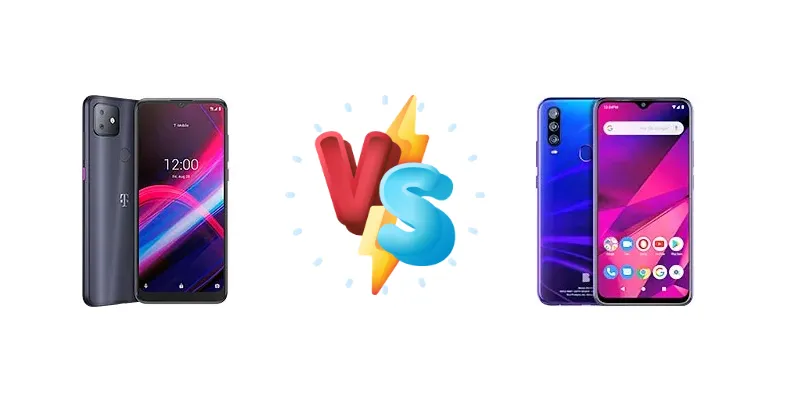
The T-Mobile REVVL 4+ and BLU G9 Pro represent compelling options in the sub-$200 smartphone market. While both aim to deliver essential smartphone functionality at an accessible price, they take different approaches to achieving this. The REVVL 4+ leverages Qualcomm’s Snapdragon 665, while the BLU G9 Pro opts for MediaTek’s Helio P60. This comparison dissects the key differences to determine which device offers the best value for your money.
🏆 Quick Verdict
For the average user prioritizing consistent performance and a well-established ecosystem, the T-Mobile REVVL 4+ is the better choice. While the BLU G9 Pro boasts the convenience of wireless charging, the Snapdragon 665’s architecture provides a more efficient and reliable experience for everyday tasks and light gaming.
| Network |
|---|
| 2G bands | GSM 850 / 900 / 1800 / 1900 | GSM 850 / 900 / 1800 / 1900 |
| 3G bands | HSDPA 850 / 1700(AWS) / 1900 | HSDPA 850 / 900 / 1700(AWS) / 1900 / 2100 |
| 4G bands | 1, 2, 3, 4, 5, 7, 8, 12, 13, 20, 25, 26, 28, 38, 39, 40, 41, 66, 71 | 1, 2, 3, 4, 5, 7, 8, 12, 13, 17, 28 |
| Speed | HSPA, LTE | HSPA 42.2/5.76 Mbps, LTE (2CA) Cat6 300/50 Mbps |
| Technology | GSM / HSPA / LTE | GSM / HSPA / LTE |
| Launch |
|---|
| Announced | 2020, August 27. Released 2020, September 04 | 2019, August. Released 2019, August |
| Status | Discontinued | Discontinued |
| Body |
|---|
| Dimensions | 165.4 x 75.2 x 8.1 mm (6.51 x 2.96 x 0.32 in) | 157 x 75.1 x 8.6 mm (6.18 x 2.96 x 0.34 in) |
| SIM | Nano-SIM | Nano-SIM + Nano-SIM |
| Weight | 180 g (6.35 oz) | 183 g (6.46 oz) |
| Display |
|---|
| Resolution | 720 x 1440 pixels, 18:9 ratio (~247 ppi density) | 1080 x 2340 pixels, 19.5:9 ratio (~409 ppi density) |
| Size | 6.52 inches, 109.7 cm2 (~88.2% screen-to-body ratio) | 6.3 inches, 97.4 cm2 (~82.6% screen-to-body ratio) |
| Type | IPS LCD | IPS LCD |
| Platform |
|---|
| CPU | Octa-core (4x2.0 GHz Kryo 260 Gold & 4x1.8 GHz Kryo 260 Silver) | Octa-core (4x2.0 GHz Cortex-A73 & 4x2.0 GHz Cortex-A53) |
| Chipset | Qualcomm SDM665 Snapdragon 665 (11 nm) | Mediatek MT6771 Helio P60 (12 nm) |
| GPU | Adreno 610 | Mali-G72 MP3 |
| OS | Android 10 | Android 9.0 (Pie), planned upgrade to Android 10 |
| Memory |
|---|
| Card slot | microSDXC | microSDXC |
| Internal | 64GB 4GB RAM | 128GB 4GB RAM |
| | eMMC 5.1 | eMMC 5.1 |
| Main Camera |
|---|
| Dual | 16 MP, PDAF
5 MP | - |
| Features | Dual-LED dual-tone flash, HDR, panorama | LED flash, HDR, panorama |
| Triple | - | 48 MP, f/1.8, 1/2.0", 0.8µm, PDAF
8 MP, f/2.2, (ultrawide)
Auxiliary lens |
| Video | 1080p@30fps | 1080p@30fps |
| Selfie camera |
|---|
| Single | 16 MP | 16 MP, f/2.0 |
| Video | 1080p@30fps | 1080p@30fps |
| Sound |
|---|
| 3.5mm jack | Yes | Yes |
| 35mm jack | Yes | Yes |
| Loudspeaker | Yes | Yes |
| Comms |
|---|
| Bluetooth | 5.0, A2DP, LE | 4.1, A2DP, LE |
| NFC | Yes | No |
| Positioning | GPS | GPS |
| Radio | No | FM radio |
| USB | USB Type-C 2.0 | USB Type-C 2.0, OTG |
| WLAN | Wi-Fi 802.11 a/b/g/n/ac, dual-band, Wi-Fi Direct | Wi-Fi 802.11 a/b/g/n, Wi-Fi Direct |
| Features |
|---|
| Sensors | Fingerprint (rear-mounted), accelerometer, proximity | Fingerprint (rear-mounted), accelerometer, gyro, proximity, compass |
| Battery |
|---|
| Charging | - | 18W wired
10W wireless (Qi) |
| Stand-by | - | Up to 625 h (3G) |
| Talk time | - | Up to 21 h (3G) |
| Type | Li-Ion 4000 mAh | Li-Po 4000 mAh, non-removable |
| Misc |
|---|
| Colors | Steel Gray | Nightfall, Black |
| Models | 5062W, 5062Z | - |
| Price | About 160 EUR | - |
T-Mobile REVVL 4+
- More efficient Snapdragon 665 chipset
- Potentially better image processing
- Reliable Qualcomm software optimization
- Lacks wireless charging
- Likely a basic display
BLU G9 Pro
- Convenient 18W wired and 10W wireless charging
- Potentially slightly better build quality
- Strong single-core performance from Cortex-A73 cores
- Less efficient Helio P60 chipset
- Potential for thermal throttling
- Image processing may be inferior
Display Comparison
Neither device boasts a standout display. Given the lack of display specifications beyond the chipsets, we can infer both likely utilize LCD panels common in this price bracket. The BLU G9 Pro’s inclusion of wireless charging suggests a slightly higher overall build quality, potentially extending to a marginally better display assembly, but this is speculative. Color accuracy and peak brightness are likely similar, targeting basic readability rather than media consumption excellence.
Camera Comparison
Without detailed camera specifications, a direct comparison is difficult. However, both phones likely feature similar budget camera setups. The focus should be on image processing capabilities, which are heavily tied to the chipset. Qualcomm’s Snapdragon typically offers superior image signal processing (ISP) compared to MediaTek’s offerings at this price point, potentially resulting in better dynamic range and low-light performance on the REVVL 4+. The presence of a 2MP macro lens on either device is largely a marketing gimmick and shouldn’t heavily influence purchasing decisions.
Performance
The core difference lies in the chipsets. The T-Mobile REVVL 4+’s Qualcomm Snapdragon 665 (11nm) utilizes a Kryo CPU architecture, known for its balanced performance and efficiency. Its octa-core configuration (4x2.0 GHz Kryo 260 Gold & 4x1.8 GHz Kryo 260 Silver) is designed for efficient task switching. The BLU G9 Pro’s MediaTek Helio P60 (12nm) also features an octa-core setup (4x2.0 GHz Cortex-A73 & 4x2.0 GHz Cortex-A53). While the P60’s Cortex-A73 cores offer strong single-core performance, the 12nm process is less efficient than the Snapdragon 665’s 11nm node. This translates to potentially more heat generation and throttling under sustained load, impacting gaming and demanding applications. The Snapdragon 665 will likely provide a smoother, more consistent experience over time.
Battery Life
The BLU G9 Pro’s 18W wired and 10W wireless charging capabilities are its standout feature. While the REVVL 4+’s battery capacity is unknown, the G9 Pro’s wireless charging offers convenience for users already invested in Qi-compatible accessories. However, the Snapdragon 665’s superior power efficiency may offset the G9 Pro’s faster charging, potentially resulting in comparable real-world battery life despite a potentially smaller battery capacity on the REVVL 4+. The 10W wireless charging is relatively slow, taking significantly longer than wired charging to reach full capacity.
Buying Guide
Buy the T-Mobile REVVL 4+ if you need a dependable daily driver with a focus on stable performance for social media, streaming, and basic productivity. It’s ideal for users who value Qualcomm’s software optimization and a predictable user experience. Buy the BLU G9 Pro if you prioritize the convenience of wireless charging and are comfortable with potentially less consistent performance, and are willing to trade some processing power for that feature.
Frequently Asked Questions
❓ Will the BLU G9 Pro’s Helio P60 struggle with graphically intensive games like PUBG Mobile?
The Helio P60 can run PUBG Mobile, but you’ll likely need to lower the graphics settings to achieve a playable frame rate. The Snapdragon 665 in the REVVL 4+ will offer a more consistent gaming experience, even at medium settings, due to its more efficient architecture and better thermal management.
❓ How long does it realistically take to fully charge the BLU G9 Pro with both wired and wireless charging?
Using the included 18W charger, the BLU G9 Pro should fully charge in approximately 2-2.5 hours. Wireless charging at 10W will take significantly longer, likely exceeding 4-5 hours for a full charge. It's best suited for overnight charging or topping up the battery throughout the day.
❓ Is the software experience significantly different between the T-Mobile REVVL 4+ and the BLU G9 Pro?
The REVVL 4+ benefits from T-Mobile’s software optimizations for Qualcomm chipsets, generally resulting in a cleaner and more stable Android experience. BLU’s software is often more heavily customized, which can introduce bloatware and potential performance inconsistencies.