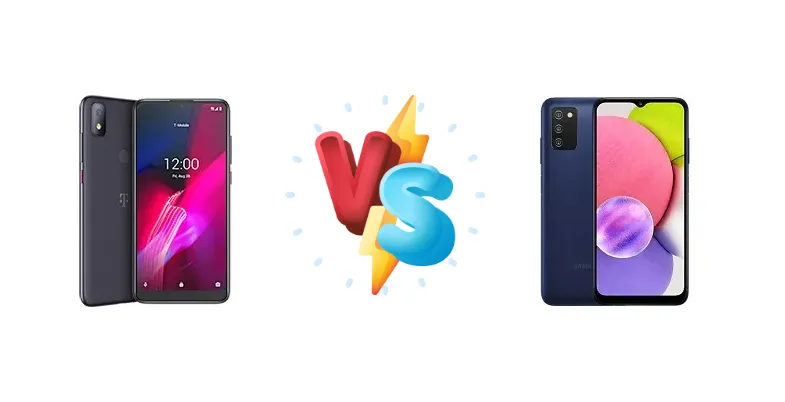
The T-Mobile REVVL 4 and Samsung Galaxy A03s represent the absolute bottom end of the smartphone market, catering to users prioritizing affordability above all else. Both devices aim to deliver basic smartphone functionality at the lowest possible price point, but significant differences in their internal hardware create distinct user experiences. This comparison dissects those differences to determine which phone offers the best value.
🏆 Quick Verdict
For most users, the Samsung Galaxy A03s is the better choice. While both phones are entry-level, the A03s’s Helio P35 chipset provides a noticeable performance boost over the REVVL 4’s Helio A22, making it more responsive for everyday tasks. The similar battery life and slightly brighter display further solidify its advantage.
| Network |
|---|
| 2G bands | GSM 850 / 900 / 1800 / 1900 | GSM 850 / 900 / 1800 / 1900 |
| 3G bands | HSDPA 850 / 1700(AWS) / 1900 | HSDPA 850 / 900 / 2100 |
| 4G bands | 2, 4, 5, 7, 12, 25, 26, 41, 66, 71 | 1, 3, 5, 7, 8, 20, 28, 38, 40, 41 |
| Speed | HSPA, LTE | HSPA 42.2/5.76 Mbps, LTE Cat4 150/50 Mbps |
| Technology | GSM / HSPA / LTE | GSM / HSPA / LTE |
| | - | 2, 4, 5, 7, 12, 13, 14, 25, 26, 41, 66, 71 - SM-A037U |
| Launch |
|---|
| Announced | 2020, August 27. Released 2020, September 04 | 2021, August 18 |
| Status | Discontinued | Available. Released 2021, August 18 |
| Body |
|---|
| Build | - | Glass front, plastic frame, plastic back |
| Dimensions | 159 x 76 x 8.1 mm (6.26 x 2.99 x 0.32 in) | 164.2 x 75.9 x 9.1 mm (6.46 x 2.99 x 0.36 in) |
| SIM | Nano-SIM | Nano-SIM + Nano-SIM |
| Weight | 158.5 (5.61 oz) | 196 g (6.91 oz) |
| Display |
|---|
| Resolution | 720 x 1520 pixels, 19:9 ratio (~270 ppi density) | 720 x 1600 pixels, 20:9 ratio (~270 ppi density) |
| Size | 6.22 inches, 96.6 cm2 (~79.9% screen-to-body ratio) | 6.5 inches, 102.0 cm2 (~81.8% screen-to-body ratio) |
| Type | IPS LCD | PLS LCD |
| Platform |
|---|
| CPU | Quad-core 2.0 GHz Cortex-A53 | Octa-core (4x2.35 GHz Cortex-A53 & 4x1.8 GHz Cortex-A53) |
| Chipset | Mediatek MT6761 Helio A22 (12 nm) | Mediatek MT6765 Helio P35 (12 nm) |
| GPU | PowerVR GE8300 | PowerVR GE8320 |
| OS | Android 10 | Android 11, upgradable to Android 13, One UI 5.1 Core |
| Memory |
|---|
| Card slot | microSDXC | microSDXC (dedicated slot) |
| Internal | 32GB 2GB RAM | 32GB 2GB RAM, 32GB 3GB RAM, 32GB 4GB RAM, 64GB 3GB RAM, 64GB 4GB RAM |
| | eMMC 5.1 | eMMC 5.1 |
| Main Camera |
|---|
| Features | LED flash, HDR, panorama | LED flash |
| Single | 13 MP, PDAF | 5 MP, f/2.2 |
| Triple | - | 13 MP, f/2.2, (wide), AF
2 MP (macro)
Auxiliary lens |
| Video | 1080p@30fps | 1080p@30fps |
| Selfie camera |
|---|
| Single | 5 MP | 5 MP, f/2.2 |
| Video | - | 1080p@30fps |
| Sound |
|---|
| 3.5mm jack | Yes | Yes |
| 35mm jack | Yes | Yes |
| Loudspeaker | Yes | Yes |
| Comms |
|---|
| Bluetooth | 5.0, A2DP, LE | 5.0, A2DP |
| NFC | No | Yes (market/region dependent) |
| Positioning | GPS | GPS, GLONASS, GALILEO, BDS |
| Radio | No | No |
| USB | USB Type-C 2.0 | USB Type-C 2.0 |
| WLAN | Wi-Fi 802.11 a/b/g/n/ac, dual-band, Wi-Fi Direct | Wi-Fi 802.11 b/g/n, Wi-Fi Direct |
| Features |
|---|
| Sensors | Fingerprint (rear-mounted), accelerometer, proximity | Fingerprint (side-mounted), accelerometer, proximity |
| Battery |
|---|
| Charging | - | 15W wired |
| Type | Li-Ion 3500 mAh | Li-Po 5000 mAh |
| Misc |
|---|
| Colors | Graphite | Black, Blue, White |
| Models | 5007Z, 5007W, TMRVL4G | SM-A037F, SM-A037F/DS, SM-A037M, SM-A037G, SM-A037U, SM-S134DL, SM-A037W, SM-A037U1, SM-S135DL |
| Price | About 100 EUR | $ 65.65 / £ 82.99 / ₹ 10,800 |
| SAR EU | - | 0.36 W/kg (head) 1.09 W/kg (body) |
| Tests |
|---|
| Battery life | - |
Endurance rating 122h
|
| Camera | - |
Photo / Video |
| Display | - |
Contrast ratio: 1718:1 (nominal) |
| Loudspeaker | - |
-27.4 LUFS (Good)
|
| Performance | - |
AnTuTu: 103465 (v8), 101299 (v9)
GeekBench: 889 (v5.1)
GFXBench: 5.5fps (ES 3.1 onscreen) |
T-Mobile REVVL 4
- Lowest possible price point
- Acceptable battery life for basic use
- Simple and straightforward Android experience
- Significantly underpowered processor
- Likely limited display brightness
- Poor multitasking performance
Samsung Galaxy A03s
- More powerful Helio P35 chipset
- Brighter display for outdoor visibility
- Faster 15W charging
- Still limited performance for demanding tasks
- Low-resolution camera sensors
- May be slightly more expensive than REVVL 4
Display Comparison
Both the REVVL 4 and A03s feature displays with a 1718:1 contrast ratio, suggesting similar image quality in terms of blacks and whites. However, the A03s boasts a measured peak brightness of 488 nits, significantly exceeding what we’d expect from the REVVL 4 based on its market positioning. This brighter display will be noticeably more usable outdoors. While neither phone is likely to offer exceptional color accuracy, the A03s’s higher brightness provides a more comfortable viewing experience overall.
Camera Comparison
Both phones are listed as having 'Photo / Video' capabilities, but details are sparse. Given their price points, image quality will be limited. It’s safe to assume both rely heavily on software processing to enhance images. The absence of specific sensor details makes a direct comparison difficult, but the A03s’s more powerful chipset *could* translate to slightly faster image processing. The inclusion of a 2MP macro camera on the A03s is unlikely to provide significant benefit due to its low resolution and limited optics.
Performance
The core difference between these two phones lies in their chipsets. The REVVL 4 utilizes the Mediatek Helio A22, a quad-core processor geared towards extremely basic tasks. The A03s, on the other hand, features the Helio P35, an octa-core chip with a more sophisticated configuration (4x2.35 GHz Cortex-A53 & 4x1.8 GHz Cortex-A53). This means the A03s can handle more demanding apps and multitasking with greater ease. While neither phone is a gaming powerhouse, the P35 will deliver a smoother experience in less intensive games. The A22’s limitations will become apparent quickly when running multiple apps or browsing complex websites.
Battery Life
Both the REVVL 4 and A03s achieve an endurance rating of 122 hours, indicating comparable battery life under similar usage conditions. The A03s, however, supports 15W wired charging, which will result in faster charging times compared to the REVVL 4, which likely utilizes a slower charging standard. While both phones should comfortably last a full day for light users, the A03s’s faster charging is a practical advantage.
Buying Guide
Buy the T-Mobile REVVL 4 if you absolutely need the lowest possible upfront cost and your smartphone usage is limited to basic calling, texting, and very light app use. Buy the Samsung Galaxy A03s if you want a more fluid user experience, slightly better multitasking capabilities, and a display that’s easier to see in direct sunlight, even if it means spending a little more.
Frequently Asked Questions
❓ Will the Samsung Galaxy A03s struggle with popular apps like Facebook or WhatsApp?
While the A03s won't offer a blazing-fast experience, its Helio P35 chipset is capable of running Facebook and WhatsApp without significant lag. However, expect longer loading times and potential slowdowns when multitasking with other apps. The REVVL 4's Helio A22 would likely struggle more noticeably with these apps.
❓ Is the 15W charging on the A03s a significant improvement over the REVVL 4?
Yes, 15W charging is a noticeable improvement. While neither phone will charge incredibly quickly, the A03s will reach a full charge significantly faster than the REVVL 4, which likely uses a slower charging standard. This is particularly useful for users who need to quickly top up their battery before leaving the house.
❓ Can either of these phones handle basic mobile gaming?
Both phones can handle *very* basic mobile games, but don't expect a smooth experience with graphically demanding titles. The A03s’s Helio P35 will provide a slightly better gaming experience than the REVVL 4’s Helio A22, allowing for playable frame rates in less intensive games. Lowering graphics settings is essential on both devices.