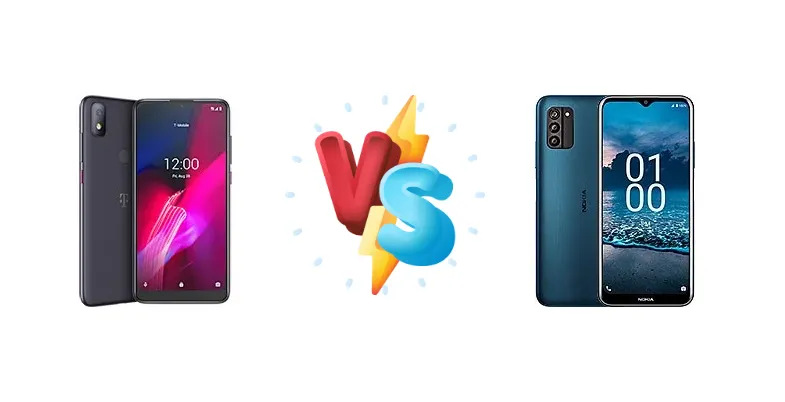
The T-Mobile REVVL 4 and Nokia G100 represent two approaches to the ultra-budget smartphone market. The REVVL 4 prioritizes affordability, while the Nokia G100 aims for a more balanced experience with a more modern chipset. This comparison dissects their key differences to help you determine which device best suits your needs.
🏆 Quick Verdict
For most users, the Nokia G100 is the superior choice. Its Qualcomm Snapdragon 662 chipset, with its octa-core configuration, provides a significantly smoother and more responsive experience than the T-Mobile REVVL 4’s MediaTek Helio A22. While the REVVL 4 is cheaper, the performance gap justifies the price difference for all but the most basic users.
| Network |
|---|
| 2G bands | GSM 850 / 900 / 1800 / 1900 | GSM 850 / 900 / 1800 / 1900 |
| 3G bands | HSDPA 850 / 1700(AWS) / 1900 | HSDPA 850 / 1700(AWS) / 1900 |
| 4G bands | 2, 4, 5, 7, 12, 25, 26, 41, 66, 71 | 2, 4, 5, 7, 12, 13, 17, 44, 66, 71 |
| Speed | HSPA, LTE | HSPA, LTE |
| Technology | GSM / HSPA / LTE | GSM / HSPA / LTE |
| Launch |
|---|
| Announced | 2020, August 27. Released 2020, September 04 | 2022, September 22 |
| Status | Discontinued | Available. Released 2022, October |
| Body |
|---|
| Build | - | Glass front, plastic frame, plastic back |
| Dimensions | 159 x 76 x 8.1 mm (6.26 x 2.99 x 0.32 in) | 166.6 x 76.7 x 8.9 mm (6.56 x 3.02 x 0.35 in) |
| SIM | Nano-SIM | Nano-SIM |
| Weight | 158.5 (5.61 oz) | 195.1 g (6.88 oz) |
| Display |
|---|
| Resolution | 720 x 1520 pixels, 19:9 ratio (~270 ppi density) | 720 x 1600 pixels, 20:9 ratio (~269 ppi density) |
| Size | 6.22 inches, 96.6 cm2 (~79.9% screen-to-body ratio) | 6.52 inches, 102.6 cm2 (~80.3% screen-to-body ratio) |
| Type | IPS LCD | IPS LCD |
| Platform |
|---|
| CPU | Quad-core 2.0 GHz Cortex-A53 | Octa-core (4x2.0 GHz Kryo 260 Gold & 4x1.8 GHz Kryo 260 Silver) |
| Chipset | Mediatek MT6761 Helio A22 (12 nm) | Qualcomm SM6115 Snapdragon 662 (11 nm) |
| GPU | PowerVR GE8300 | Adreno 610 |
| OS | Android 10 | Android 12 |
| Memory |
|---|
| Card slot | microSDXC | microSDXC |
| Internal | 32GB 2GB RAM | 32GB 3GB RAM, 128GB 4GB RAM |
| | eMMC 5.1 | - |
| Main Camera |
|---|
| Features | LED flash, HDR, panorama | LED flash, HDR, panorama |
| Single | 13 MP, PDAF | - |
| Triple | - | 13 MP, f/1.8, (wide), AF
5 MP, f/2.2, 115˚ (ultrawide), 1/5.0"
Auxiliary lens |
| Video | 1080p@30fps | 1080p@30fps |
| Selfie camera |
|---|
| Single | 5 MP | 8 MP, f/2.0, (wide), 1/4.0", 1.12µm |
| Video | - | 1080p@30fps |
| Sound |
|---|
| 3.5mm jack | Yes | - |
| 35mm jack | Yes | Yes |
| Loudspeaker | Yes | Yes |
| Comms |
|---|
| Bluetooth | 5.0, A2DP, LE | 5.0, A2DP, LE |
| NFC | No | No |
| Positioning | GPS | GPS |
| Radio | No | FM radio |
| USB | USB Type-C 2.0 | USB Type-C 2.0, OTG |
| WLAN | Wi-Fi 802.11 a/b/g/n/ac, dual-band, Wi-Fi Direct | Wi-Fi 802.11 b/g/n/ac, dual-band |
| Features |
|---|
| Sensors | Fingerprint (rear-mounted), accelerometer, proximity | Fingerprint (side-mounted), accelerometer, gyro, proximity, barometer |
| Battery |
|---|
| Charging | - | 15W wired |
| Type | Li-Ion 3500 mAh | Li-Po 5000 mAh |
| Misc |
|---|
| Colors | Graphite | Nordic Blue |
| Models | 5007Z, 5007W, TMRVL4G | - |
| Price | About 100 EUR | About 60 EUR |
T-Mobile REVVL 4
- Lowest possible price point
- Simple and straightforward user experience
- Acceptable for basic communication tasks
- Poor performance with demanding apps
- Likely limited software updates
- Inferior chipset compared to competitors
Nokia G100
- Significantly better performance with Snapdragon 662
- Faster charging at 15W
- More future-proofed for software updates
- Higher price than the REVVL 4
- May still struggle with graphically intensive games
- Display quality likely remains budget-focused
Display Comparison
Neither device is expected to boast a high-end display. Given the context data focuses on processing power, we can infer both likely utilize LCD panels. The Nokia G100, positioned slightly higher in the market, may benefit from better color calibration. However, without specific display specs, it's difficult to assess differences in brightness or resolution. Bezels are likely substantial on both devices, reflecting their budget nature.
Camera Comparison
Without detailed camera specifications, a direct comparison is limited. However, the Nokia G100’s higher overall positioning suggests a potentially more capable camera system. The Snapdragon 662 also includes a more advanced image signal processor (ISP) than the Helio A22, which could result in better image quality, particularly in low-light conditions. It’s reasonable to assume both phones will include a primary camera and potentially depth or macro sensors, but the quality of these secondary sensors is likely to be minimal on both devices.
Performance
The core difference lies in the chipsets. The Nokia G100’s Qualcomm Snapdragon 662 (11nm) is a substantial upgrade over the T-Mobile REVVL 4’s MediaTek Helio A22 (12nm). The Snapdragon 662’s octa-core architecture – featuring four 2.0 GHz Kryo 260 Gold cores and four 1.8 GHz Kryo 260 Silver cores – allows for more efficient multitasking and handling of demanding applications. The Helio A22’s quad-core Cortex-A53 configuration at 2.0 GHz will struggle with anything beyond basic tasks. The 11nm process node of the Snapdragon 662 also contributes to better power efficiency, potentially leading to longer battery life under load. This translates to a noticeably snappier experience for the Nokia G100, especially when switching between apps or browsing the web.
Battery Life
The Nokia G100 includes 15W wired charging, a feature absent from the REVVL 4’s specifications. While battery capacity isn’t specified for either device, the Snapdragon 662’s improved power efficiency suggests the Nokia G100 could achieve comparable or even better battery life despite potentially having a similar capacity battery. The 15W charging will also reduce the time needed to replenish the battery, offering a convenience advantage.
Buying Guide
Buy the T-Mobile REVVL 4 if you absolutely need the lowest possible price and your smartphone usage is limited to calls, texts, and very light app usage. Buy the Nokia G100 if you value a smoother user experience, occasional gaming, and a more future-proofed device, even if it means spending a bit more upfront.
Frequently Asked Questions
❓ Will the T-Mobile REVVL 4 struggle with popular social media apps like TikTok or Instagram?
Yes, the MediaTek Helio A22 chipset in the REVVL 4 is likely to exhibit noticeable lag and slowdown when running demanding apps like TikTok or Instagram, especially when multitasking. The limited processing power and RAM will struggle to handle the complex algorithms and graphics rendering required by these platforms.
❓ Can the Nokia G100 handle basic mobile gaming?
The Nokia G100, with its Snapdragon 662, can handle basic mobile gaming reasonably well. While it won't deliver a high-end gaming experience, it should be capable of running popular titles like PUBG Mobile or Call of Duty Mobile at lower settings with acceptable frame rates. Expect some graphical compromises to maintain smooth gameplay.
❓ How long will software updates be supported on each device?
T-Mobile typically offers limited software support for its REVVL series. The Nokia G100, benefiting from Nokia’s commitment to Android updates, is likely to receive more frequent security patches and potentially one or two major Android version upgrades, extending its usable lifespan.
❓ Is the difference in performance between these two phones noticeable in everyday use?
Absolutely. The Snapdragon 662 in the Nokia G100 provides a significantly smoother and more responsive experience when navigating the user interface, opening apps, and browsing the web. The REVVL 4’s Helio A22 will feel sluggish in comparison, especially when multitasking.