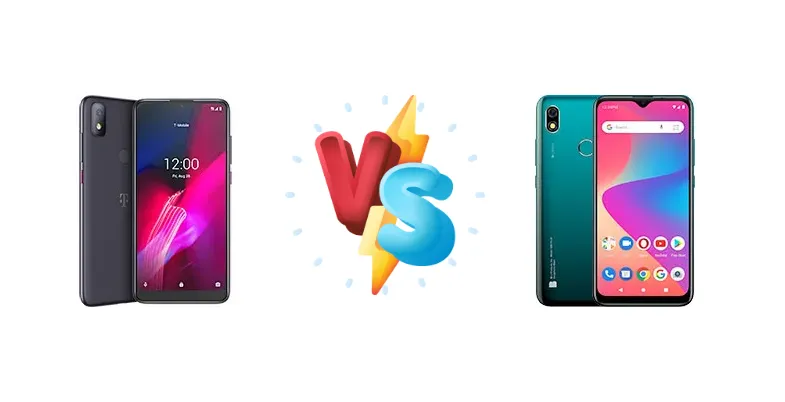
The T-Mobile REVVL 4 and BLU G50 Plus represent the extreme end of the smartphone price spectrum. Both aim to deliver essential functionality at a minimal cost, but they take different approaches to achieving this. This comparison dissects their core components to determine which offers the best value for users prioritizing affordability.
🏆 Quick Verdict
For the average user seeking a functional, if basic, smartphone experience, the T-Mobile REVVL 4 is the better choice. Its Mediatek Helio A22, while not powerful, utilizes a more modern manufacturing process and CPU architecture than the BLU G50 Plus, resulting in a smoother, more responsive user experience.
| Network |
|---|
| 2G bands | GSM 850 / 900 / 1800 / 1900 | GSM 850 / 900 / 1800 / 1900 |
| 3G bands | HSDPA 850 / 1700(AWS) / 1900 | HSDPA 850 / 900 / 1700(AWS) / 1900 / 2100 |
| 4G bands | 2, 4, 5, 7, 12, 25, 26, 41, 66, 71 | 1, 2, 3, 4, 5, 7, 12, 17, 28 |
| Speed | HSPA, LTE | HSPA, LTE |
| Technology | GSM / HSPA / LTE | GSM / HSPA / LTE |
| Launch |
|---|
| Announced | 2020, August 27. Released 2020, September 04 | 2020, September 22. Released 2020, September 22 |
| Status | Discontinued | Discontinued |
| Body |
|---|
| Dimensions | 159 x 76 x 8.1 mm (6.26 x 2.99 x 0.32 in) | 158.7 x 76 x 9.1 mm (6.25 x 2.99 x 0.36 in) |
| SIM | Nano-SIM | Nano-SIM + Nano-SIM |
| Weight | 158.5 (5.61 oz) | 180 g (6.35 oz) |
| Display |
|---|
| Resolution | 720 x 1520 pixels, 19:9 ratio (~270 ppi density) | 720 x 1520 pixels, 19:9 ratio (~271 ppi density) |
| Size | 6.22 inches, 96.6 cm2 (~79.9% screen-to-body ratio) | 6.2 inches, 95.9 cm2 (~79.5% screen-to-body ratio) |
| Type | IPS LCD | IPS LCD |
| Platform |
|---|
| CPU | Quad-core 2.0 GHz Cortex-A53 | Octa-core 1.6 GHz Cortex-A55 |
| Chipset | Mediatek MT6761 Helio A22 (12 nm) | - |
| GPU | PowerVR GE8300 | IMG8322 |
| OS | Android 10 | Android 10 |
| Memory |
|---|
| Card slot | microSDXC | microSDXC |
| Internal | 32GB 2GB RAM | 32GB 2GB RAM |
| | eMMC 5.1 | eMMC 5.1 |
| Main Camera |
|---|
| Features | LED flash, HDR, panorama | LED flash, HDR, panorama |
| Single | 13 MP, PDAF | 13 MP, AF |
| Video | 1080p@30fps | 1080p@30fps |
| Selfie camera |
|---|
| Single | 5 MP | 8 MP |
| Video | - | 720p@30fps |
| Sound |
|---|
| 3.5mm jack | Yes | Yes |
| 35mm jack | Yes | Yes |
| Loudspeaker | Yes | Yes |
| Comms |
|---|
| Bluetooth | 5.0, A2DP, LE | 4.1, A2DP, LE |
| NFC | No | No |
| Positioning | GPS | GPS |
| Radio | No | FM radio |
| USB | USB Type-C 2.0 | USB Type-C 2.0 |
| WLAN | Wi-Fi 802.11 a/b/g/n/ac, dual-band, Wi-Fi Direct | Wi-Fi 802.11 b/g/n, Wi-Fi Direct |
| Features |
|---|
| Sensors | Fingerprint (rear-mounted), accelerometer, proximity | Fingerprint (rear-mounted), accelerometer, proximity |
| Battery |
|---|
| Charging | - | 10W wired |
| Type | Li-Ion 3500 mAh | Li-Po 4000 mAh |
| Misc |
|---|
| Colors | Graphite | Black, Blue, Red, Green |
| Models | 5007Z, 5007W, TMRVL4G | - |
| Price | About 100 EUR | About 90 EUR |
T-Mobile REVVL 4
- More modern CPU architecture (Cortex-A53 vs A55)
- Potentially better power efficiency due to 12nm process
- Likely smoother user experience for basic tasks
- Fewer CPU cores than the BLU G50 Plus
- Display specifications are unknown and likely basic
BLU G50 Plus
- Octa-core processor may handle multitasking slightly better (in theory)
- Potentially larger battery capacity (unconfirmed)
- 10W charging support
- Less efficient processor architecture (Cortex-A55)
- Likely slower performance in demanding tasks
- 10W charging is slow
Display Comparison
Neither device boasts a standout display. Given the price point, both likely utilize LCD panels with 720p+ resolutions. Without specific brightness or color gamut data, it's difficult to declare a winner. However, the REVVL 4's potential for better image processing from its more capable chipset *could* translate to slightly more vibrant visuals, even on a similar panel. Bezels are expected to be substantial on both.
Camera Comparison
Camera performance is likely to be similar – basic. Both phones will struggle in low light. Without sensor size or aperture information, it’s impossible to make a definitive statement. However, the REVVL 4’s more capable chipset could offer slightly better image processing, potentially resulting in more detailed and less noisy photos. The prevalence of 2MP macro lenses on both devices suggests they are included for marketing purposes rather than genuine photographic utility.
Performance
The core difference lies in the processors. The T-Mobile REVVL 4’s Mediatek MT6761 Helio A22 (12nm) features a quad-core 2.0 GHz Cortex-A53 CPU. The BLU G50 Plus utilizes an octa-core 1.6 GHz Cortex-A55 CPU. While the G50 Plus has more cores, the Cortex-A55 architecture is a modest improvement over the A53, and the 12nm process node of the Helio A22 offers better power efficiency. This means the REVVL 4 is likely to feel snappier in everyday tasks, despite having fewer cores. The G50 Plus’s reliance on more cores at a lower clock speed may lead to increased power draw for similar workloads. RAM specifications are missing for both, but expect 2-3GB, further limiting multitasking capabilities.
Battery Life
Battery capacity is unspecified for both devices. The BLU G50 Plus supports 10W wired charging, which is slow by modern standards. The REVVL 4’s charging speed is unknown, but the more efficient Helio A22 chipset could translate to longer battery life despite a potentially smaller battery capacity. The G50 Plus’s less efficient processor will likely consume more power during active use, potentially negating any capacity advantage.
Buying Guide
Buy the T-Mobile REVVL 4 if you need a phone for basic tasks like calling, texting, and light social media browsing, and value a slightly more responsive interface. Buy the BLU G50 Plus if you prioritize a potentially larger battery capacity (though not specified) and are willing to accept a less efficient processor for extended standby times, or if you find it at a significantly lower price point.
Frequently Asked Questions
❓ Will the BLU G50 Plus struggle with popular apps like Facebook or WhatsApp?
The BLU G50 Plus’s Cortex-A55 processor, while having eight cores, is relatively low-powered. Expect noticeable lag and slowdowns when running multiple apps or using resource-intensive features within Facebook or WhatsApp. The T-Mobile REVVL 4, despite having fewer cores, will likely handle these apps more smoothly due to its more efficient processor.
❓ Is the 10W charging on the BLU G50 Plus a significant drawback?
Yes, 10W charging is quite slow compared to modern standards. Expect a full charge to take several hours. While not a deal-breaker for a budget phone, it means you'll need to plan ahead and charge overnight. The REVVL 4’s charging speed is unknown, but even if it’s also 10W, the more efficient processor may mean you need to charge it less frequently.
❓ Can either of these phones handle basic mobile gaming?
Both phones will struggle with demanding games. Simple 2D games should be playable at low settings, but don't expect a smooth experience with titles like PUBG or Call of Duty. The REVVL 4’s processor might offer slightly better frame rates in less demanding games, but neither phone is designed for gaming.