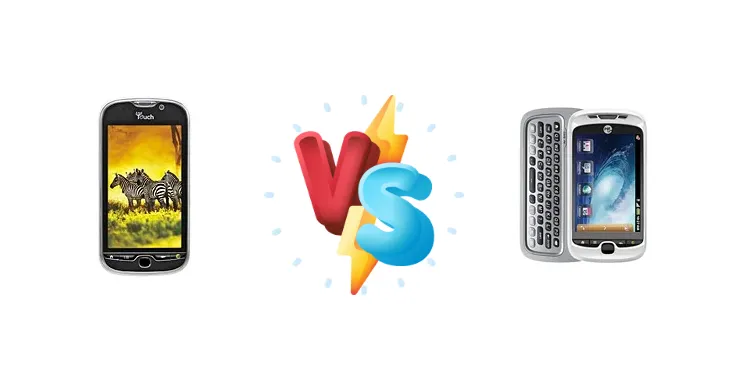
Remember the dawn of Android? T-Mobile's myTouch series was instrumental in popularizing the platform. Today, we're revisiting two key models: the myTouch 4G and the myTouch 3G Slide. Let's see how these phones stack up against each other, considering their age and original impact.
🏆 Quick Verdict
The myTouch 4G is the clear winner. Its Snapdragon processor and faster data speeds offer a significantly smoother experience compared to the 3G Slide. While both are relics of the past, the 4G provides a more usable, albeit still dated, Android experience.
| Network |
|---|
| 2G bands | GSM 850 / 900 / 1800 / 1900 | GSM 850 / 900 / 1800 / 1900 |
| 3G bands | HSDPA 900 / 1700 / 2100 | HSDPA 1700 / 2100 |
| 4G bands | 1, 3, 7, 8, 20 | - |
| Speed | HSPA 14.4/5.76 Mbps | HSPA 7.2/2 Mbps |
| Technology | GSM / HSPA | GSM / HSPA |
| Launch |
|---|
| Announced | 2010, October. Released 2010, November | 2010, April. Released 2010, June |
| Status | Discontinued | Discontinued |
| Body |
|---|
| Build | Glass front, plastic back, plastic frame | - |
| Dimensions | 121.9 x 61 x 10.2 mm (4.80 x 2.40 x 0.40 in) | 114 x 58 x 15 mm (4.49 x 2.28 x 0.59 in) |
| Keyboard | - | QWERTY |
| SIM | Mini-SIM | Mini-SIM |
| Weight | 153.1 g (5.40 oz) | 167 (5.89 oz) |
| | Optical trackpad | Optical trackpad |
| Display |
|---|
| Protection | - | Corning Gorilla Glass |
| Resolution | 480 x 800 pixels, 5:3 ratio (~246 ppi density) | 320 x 480 pixels, 3:2 ratio (~170 ppi density) |
| Size | 3.8 inches, 41.1 cm2 (~55.3% screen-to-body ratio) | 3.4 inches, 34.4 cm2 (~52.1% screen-to-body ratio) |
| Type | TFT | TFT, 65K colors |
| Platform |
|---|
| CPU | 1.0 GHz Scorpion | 600 MHz ARM 11 |
| Chipset | Qualcomm MSM8255 Snapdragon S2 | - |
| GPU | Adreno 205 | Adreno 130 |
| OS | Android 2.2 (Froyo), upgradable to 2.3 (Gingerbread), Sense UI | Android 2.1 (Eclair), upgradable to 2.2 (Froyo) |
| Memory |
|---|
| Card slot | microSDHC (dedicated slot), 8 GB included | microSDHC (dedicated slot), 8 GB included |
| Internal | 4GB 768MB RAM | 512MB RAM, 512MB |
| Main Camera |
|---|
| Dual | 16 MP, f/1.8, PDAF
2 MP, f/2.4, (depth) | - |
| Features | LED flash | LED flash |
| Single | 5 MP, AF | 5 MP, AF |
| Video | 720p@30fps | Yes |
| Selfie camera |
|---|
| Single | VGA videocall camera | - |
| | - | No |
| Sound |
|---|
| 3.5mm jack | Yes | Yes |
| 35mm jack | Yes | Yes |
| Loudspeaker | Yes | Yes |
| Comms |
|---|
| Bluetooth | 2.1, A2DP | 2.1, A2DP, EDR |
| NFC | Yes (market/region dependent) | - |
| Positioning | GPS, A-GPS | GPS, A-GPS |
| Radio | FM radio | No |
| USB | miniUSB 2.0 | microUSB 2.0 |
| WLAN | Wi-Fi 802.11 b/g/n, DLNA, hotspot | Wi-Fi 802.11 b/g |
| Features |
|---|
| Browser | HTML, Adobe Flash | HTML |
| Sensors | Accelerometer, proximity | Accelerometer |
| | MP4/H.264 player
MP3/WAV/eAAC+ player
Organizer
Document viewer
Voice memo/dial/commands
Predictive text input (Swype) | MP4/H.264 player
MP3/WAV/eAAC+ player
Organizer
Document viewer
Voice memo
Predictive text input |
| Battery |
|---|
| Stand-by | Up to 552 h (2G) / Up to 432 h (3G) | Up to 286 h |
| Talk time | Up to 9 h (2G) / Up to 10 h 20 min (3G) | Up to 6 h 40 min |
| Type | Removable Li-Ion 1400 mAh battery | Removable Li-Ion 1300 mAh battery |
| Misc |
|---|
| Colors | Black | White, Black, Red |
| Models | STK-LX1 | - |
| Price | About 280 EUR | About 330 EUR |
| SAR | - | 0.75 W/kg (head) 0.65 W/kg (body) |
T-Mobile myTouch 4G
- Faster processor
- Larger display
- 5MP Camera
- Generally better battery life
- Outdated resistive touchscreen
- Limited storage
- Slow data speeds compared to modern phones
T-Mobile myTouch 3G Slide
- Unique sliding form factor
- Compact size
- Relatively lightweight
- Slow processor
- Smaller display
- Lower resolution camera
- Poor battery life compared to modern phones
Display Comparison
The myTouch 4G boasts a larger 3.8-inch display compared to the 3.2-inch screen on the 3G Slide. Both utilize resistive touchscreens, which are less responsive than modern capacitive displays. The 4G's larger size offers a slightly better viewing experience, but both screens are noticeably dated.
Camera Comparison
Both phones feature modest cameras for their time. The myTouch 4G has a 5MP camera, while the 3G Slide has a 3.2MP camera. Image quality on both is poor by modern standards, with limited detail and noticeable noise. Don't expect to take stunning photos with either device.
Performance
This is where the myTouch 4G truly shines. Its 1.0 GHz Qualcomm Snapdragon S2 processor is a substantial upgrade over the 3G Slide's 600 MHz ARM 11. Expect noticeably faster app loading, smoother scrolling, and a generally more responsive user interface on the 4G. The 3G Slide can feel sluggish by today's standards.
Battery Life
The myTouch 4G generally offered slightly better battery life due to its more efficient processor, though both phones would require daily charging with moderate use. Battery degradation over time is a significant factor with both devices.
Buying Guide
The T-Mobile myTouch 4G is for nostalgia enthusiasts or those seeking a basic Android phone for very light use. The myTouch 3G Slide is best left to collectors or those deeply attached to its sliding form factor, understanding its limitations.
Frequently Asked Questions
❓ Are these phones still usable in 2024?
Technically yes, but with significant limitations. Network compatibility and app support are major concerns. They're best suited for very basic tasks or as collector's items.
❓ Can I update the Android version on either phone?
No. Both phones are running outdated versions of Android (2.2 Froyo for the 4G and 2.1 Eclair for the 3G Slide) and are no longer receiving updates.