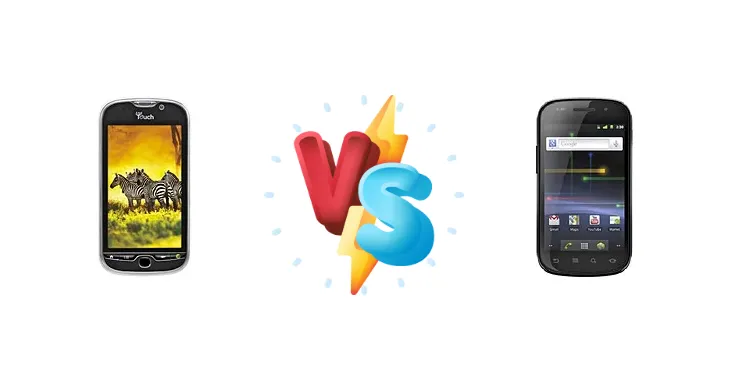
The T-Mobile myTouch 4G and Samsung Google Nexus S were both significant Android phones of their time, offering early glimpses into the platform's potential. But which one truly delivered a better experience? This review dives deep into their specs, performance, and features to help you decide which phone reigned supreme.
🏆 Quick Verdict
The Samsung Google Nexus S edges out the myTouch 4G thanks to its superior processor (Cortex-A8 vs. Scorpion), cleaner Android experience, and generally better software updates. While the myTouch 4G had 4G capabilities, the Nexus S's overall performance and software made it the more desirable device.
| Network |
|---|
| 2G bands | GSM 850 / 900 / 1800 / 1900 | GSM 850 / 900 / 1800 / 1900 |
| 3G bands | HSDPA 900 / 1700 / 2100 | HSDPA 900 / 1700 / 2100 |
| 4G bands | 1, 3, 7, 8, 20 | - |
| Speed | HSPA 14.4/5.76 Mbps | HSPA 7.2/5.76 Mbps |
| Technology | GSM / HSPA | GSM / HSPA |
| Launch |
|---|
| Announced | 2010, October. Released 2010, November | 2010, December. Released 2010, December |
| Status | Discontinued | Discontinued |
| Body |
|---|
| Build | Glass front, plastic back, plastic frame | - |
| Dimensions | 121.9 x 61 x 10.2 mm (4.80 x 2.40 x 0.40 in) | 123.9 x 63 x 10.9 mm (4.88 x 2.48 x 0.43 in) |
| SIM | Mini-SIM | Mini-SIM |
| Weight | 153.1 g (5.40 oz) | 129 g (4.55 oz) |
| | Optical trackpad | - |
| Display |
|---|
| Protection | - | Oleophobic coating |
| Resolution | 480 x 800 pixels, 5:3 ratio (~246 ppi density) | 480 x 800 pixels, 5:3 ratio (~233 ppi density) |
| Size | 3.8 inches, 41.1 cm2 (~55.3% screen-to-body ratio) | 4.0 inches, 45.5 cm2 (~58.3% screen-to-body ratio) |
| Type | TFT | Super AMOLED |
| Platform |
|---|
| CPU | 1.0 GHz Scorpion | 1.0 GHz Cortex-A8 |
| Chipset | Qualcomm MSM8255 Snapdragon S2 | Hummingbird |
| GPU | Adreno 205 | PowerVR SGX540 |
| OS | Android 2.2 (Froyo), upgradable to 2.3 (Gingerbread), Sense UI | Android 2.3 (Gingerbread), 4.1.2 (Jelly Bean), not upgradable to 4.2 (Jelly Bean) |
| Memory |
|---|
| Card slot | microSDHC (dedicated slot), 8 GB included | No |
| Internal | 4GB 768MB RAM | 16GB 512MB RAM |
| Main Camera |
|---|
| Dual | 16 MP, f/1.8, PDAF
2 MP, f/2.4, (depth) | - |
| Features | LED flash | LED flash |
| Single | 5 MP, AF | 5 MP, AF |
| Video | 720p@30fps | w480p@30fps |
| Selfie camera |
|---|
| Single | VGA videocall camera | VGA |
| Sound |
|---|
| 3.5mm jack | Yes | Yes |
| 35mm jack | Yes | Yes |
| Loudspeaker | Yes | Yes |
| Comms |
|---|
| Bluetooth | 2.1, A2DP | 2.1, A2DP |
| NFC | Yes (market/region dependent) | Yes |
| Positioning | GPS, A-GPS | GPS, A-GPS |
| Radio | FM radio | No |
| USB | miniUSB 2.0 | microUSB 2.0 |
| WLAN | Wi-Fi 802.11 b/g/n, DLNA, hotspot | Wi-Fi 802.11 b/g/n, DLNA, hotspot |
| Features |
|---|
| Browser | HTML, Adobe Flash | HTML, Adobe Flash |
| Sensors | Accelerometer, proximity | Accelerometer, gyro, proximity, compass |
| | MP4/H.264 player
MP3/WAV/eAAC+ player
Organizer
Document viewer
Voice memo/dial/commands
Predictive text input (Swype) | MP4/H.264 player
MP3/WAV/eAAC+ player
Organizer
Photo/video editor
Voice memo/dial/commands
Predictive text input
Near Field Communications |
| Battery |
|---|
| Stand-by | Up to 552 h (2G) / Up to 432 h (3G) | Up to 713 h (2G) / Up to 428 h (3G) |
| Talk time | Up to 9 h (2G) / Up to 10 h 20 min (3G) | Up to 14 h (2G) / Up to 6 h 40 min (3G) |
| Type | Removable Li-Ion 1400 mAh battery | Removable Li-Ion 1500 mAh battery |
| Misc |
|---|
| Colors | Black | Black, White |
| Models | STK-LX1 | - |
| Price | About 280 EUR | About 170 EUR |
| SAR | - | 0.58 W/kg (head) 0.90 W/kg (body) |
| SAR EU | - | 0.47 W/kg (head) |
| Tests |
|---|
| Audio quality | - |
Noise -90.2dB / Crosstalk -90.8dB |
| Camera | - |
Photo |
| Loudspeaker | - |
Voice 68dB / Noise 66dB / Ring 69dB
|
T-Mobile myTouch 4G
- 4G Connectivity
- Physical Keyboard
- Decent Battery Life
- Slower Processor
- Less Smooth Android Experience
- Outdated Software
Samsung Google Nexus S
- Faster Processor (Cortex-A8)
- Cleaner Android Experience
- Better Display
- More Frequent Updates (at the time)
- No Physical Keyboard
- Older Device (Availability)
- Limited Availability of Parts
Display Comparison
Both phones featured Super AMOLED displays, but the Nexus S generally had slightly better color accuracy and viewing angles. The myTouch 4G's screen was adequate, but the Nexus S's display was noticeably more vibrant. Resolution was similar, around 800x480.
Camera Comparison
The Nexus S had a 5MP camera, while the myTouch 4G had a similar resolution. Image quality was generally better on the Nexus S, with more accurate colors and better low-light performance. Both cameras were adequate for basic photography but lacked advanced features.
Performance
The Nexus S's 1.0 GHz Cortex-A8 processor significantly outperformed the myTouch 4G's 1.0 GHz Scorpion processor. Apps launched faster, multitasking was smoother, and overall responsiveness was superior on the Nexus S. The Hummingbird chipset also contributed to better efficiency.
Battery Life
Battery life was comparable between the two devices, typically lasting a full day with moderate use. Both phones were susceptible to battery drain with heavy usage, such as gaming or video streaming.
Buying Guide
The T-Mobile myTouch 4G is best suited for users who prioritize 4G connectivity and a physical keyboard. The Samsung Google Nexus S is ideal for those seeking a smoother Android experience, faster performance, and a more modern design, assuming they can find one in good condition.
Frequently Asked Questions
❓ Which phone had better software support?
The Samsung Google Nexus S received more frequent and timely software updates directly from Google, providing a more up-to-date Android experience.
❓ Is it worth buying either of these phones today?
Given their age, neither phone is recommended for primary use. However, they can be interesting for collectors or those wanting to experience older Android devices. Finding working devices and replacement parts may be challenging.