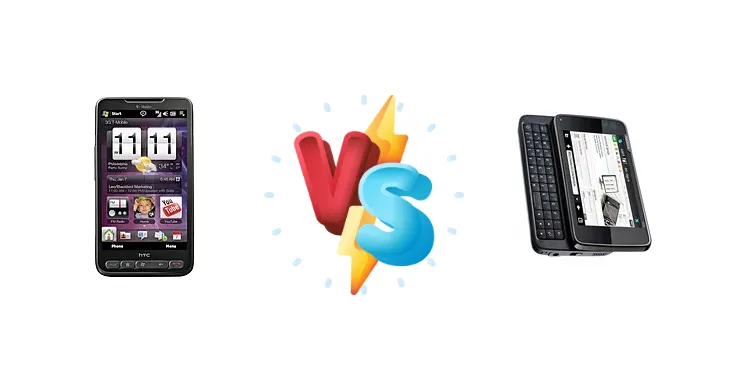
The T-Mobile HD2 and Nokia N900 represent a fascinating era in smartphone history – a time before iOS and Android dominated. Both devices offered unique approaches to mobile computing, but which one ultimately delivered a better experience? Let's dive into a detailed comparison to settle the debate.
🏆 Quick Verdict
The HD2 boasts a faster processor and a more modern (though still dated) Windows Mobile experience. However, the N900's open-source Maemo OS and web-centric design offer a unique appeal. For raw speed, HD2 wins; for customization and web browsing, the N900 holds its own.
| Network |
|---|
| 2G bands | GSM 850 / 900 / 1800 / 1900 | GSM 850 / 900 / 1800 / 1900 |
| 3G bands | HSDPA 1700 / 2100 | HSDPA 900 / 1700 / 2100 |
| Speed | HSPA 7.2/2 Mbps | HSPA 10.2/2 Mbps |
| Technology | GSM / HSPA | GSM / HSPA |
| Launch |
|---|
| Announced | 2010, January. Released 2010, March | 2009, August. Released 2009, November |
| Status | Discontinued | Discontinued |
| Body |
|---|
| Dimensions | 122 x 67 x 11 mm (4.80 x 2.64 x 0.43 in) | 110.9 x 59.8 x 18 mm, 113 cc (4.37 x 2.35 x 0.71 in) |
| Keyboard | - | QWERTY |
| SIM | Mini-SIM | Mini-SIM |
| Weight | 157 g (5.54 oz) | 181 g (6.38 oz) |
| Display |
|---|
| Resolution | 480 x 800 pixels, 5:3 ratio (~217 ppi density) | 800 x 480 pixels, 5:3 ratio (~267 ppi density) |
| Size | 4.3 inches, 52.6 cm2 (~64.4% screen-to-body ratio) | 3.5 inches, 34.9 cm2 (~52.6% screen-to-body ratio) |
| Type | TFT, 65K colors | TFT resistive touchscreen, 65K colors |
| Platform |
|---|
| CPU | 1.0 GHz Scorpion | 600 MHz Cortex-A8 |
| Chipset | Qualcomm QSD8250 Snapdragon S1 | TI OMAP 3430 |
| GPU | Adreno 200 | PowerVR SGX530 |
| OS | Microsoft Windows Mobile 6.5 Professional, Sense UI | Maemo 5 |
| Memory |
|---|
| Card slot | microSDHC (dedicated slot), 16 GB included | microSDHC (dedicated slot) |
| Internal | 576MB RAM, 1GB ROM | 32GB 256MB RAM |
| Main Camera |
|---|
| Features | Dual-LED flash | Carl Zeiss optics, Dual-LED flash |
| Single | 5 MP, AF | 5 MP, AF |
| Video | 480p@30fps | 480p@25fps |
| Selfie camera |
|---|
| Single | - | VGA |
| | No | - |
| Sound |
|---|
| 3.5mm jack | Yes | Yes |
| 35mm jack | Yes | Yes |
| Loudspeaker | Yes | Yes, with stereo speakers |
| Comms |
|---|
| Bluetooth | 2.1, A2DP | 2.1, A2DP |
| Infrared port | - | Yes |
| Positioning | GPS, A-GPS; NaviPanel | GPS, A-GPS; Ovi Maps |
| Radio | Stereo FM radio, RDS | Stereo FM radio (via third party software); FM transmitter |
| USB | microUSB | microUSB 2.0 |
| WLAN | Wi-Fi 802.11 b/g | Wi-Fi 802.11 b/g, DLNA |
| Features |
|---|
| Browser | WAP 2.0/xHTML, HTML | xHTML, HTML, Adobe Flash |
| Sensors | Accelerometer, proximity, compass | Accelerometer, proximity |
| | MP3/WAV/WMA/eAAC+ player
MP4/WMV/H.264 player
Pocket Office
HTC Peep, HTC Footprints
T-mobile services: MobiTV, BLOCKBUSTER, Barnes & Nobl, Gogo Inflight Internet
Transformers & Transformers 2 movies preloaded
Voice memo
Predictive text input | MP3/WMA/WAV/eAAC+ player
WMV/RealVideo/MP4/AVI/XviD/DivX player
TV-out
PDF document viewer
Photo editor
|
| Battery |
|---|
| Music play | - | Up to 24 h 30 min |
| Stand-by | Up to 480 h | Up to 278 h (2G) / Up to 250 h (3G) |
| Talk time | Up to 6 h | Up to 6 h 30 min (2G) / Up to 4 h 30 min (3G) |
| Type | Removable Li-Ion 1230 mAh battery | Removable Li-Ion 1320 mAh battery (BL-5J) |
| Misc |
|---|
| Colors | Black | Black |
| Price | About 230 EUR | About 160 EUR |
| SAR | - | 0.92 W/kg (head) 0.82 W/kg (body) |
| SAR EU | - | 0.80 W/kg (head) |
| Tests |
|---|
| Audio quality | - |
Noise -93.7dB / Crosstalk -86.9dB |
| Camera | - |
Photo |
| Loudspeaker | - |
Voice 66dB / Noise 66dB / Ring 70dB |
T-Mobile HD2
- Faster processor
- Windows Mobile familiarity (for some)
- Slightly larger screen
- More readily available accessories (historically)
- Outdated Windows Mobile OS
- Poor screen quality
- Limited app ecosystem
- Battery life could be better
Nokia N900
- Excellent AMOLED display
- Open-source Maemo OS (highly customizable)
- Good web browsing experience
- Decent battery life
- Unique design
- Slower processor
- Limited app ecosystem
- Outdated OS
- Smaller screen
- Can be difficult to find parts/support
Display Comparison
The HD2 features a 4.2-inch TFT touchscreen with a 320x240 resolution, while the N900 has a 3.2-inch AMOLED display with a 640x480 resolution. The N900's AMOLED screen offers significantly better contrast and color reproduction, making it the clear winner in display quality, despite the smaller size.
Camera Comparison
Both phones feature basic cameras – the HD2 with a 5MP camera and the N900 with an 8MP camera. Image quality on both is poor by today's standards, but the N900's higher resolution *might* yield slightly better results in ideal conditions. Neither is a serious contender for photography.
Performance
The HD2's 1.0 GHz Scorpion processor gives it a noticeable edge over the N900's 600 MHz Cortex-A8. While both phones feel sluggish by modern standards, the HD2 generally handles tasks more smoothly. However, Maemo's efficient design helps the N900 remain surprisingly responsive.
Battery Life
The Nokia N900 generally offers better battery life than the HD2, thanks to its efficient Maemo OS and slightly larger battery capacity. Expect around 8-10 hours of moderate use on the N900 versus 6-8 hours on the HD2.
Buying Guide
The T-Mobile HD2 is for those nostalgic for Windows Mobile and seeking a slightly faster experience. The Nokia N900 is ideal for developers, Linux enthusiasts, and users who prioritize web browsing and customization over sheer processing power. Both are niche purchases today.
Frequently Asked Questions
❓ Are these phones still usable in 2024?
Yes, but with caveats. Network compatibility can be an issue, and app support is extremely limited. They are primarily collector's items or for those seeking a retro mobile experience.
❓ Which OS is better: Windows Mobile or Maemo?
It depends on your priorities. Windows Mobile is more familiar to some, while Maemo offers greater customization and a more open ecosystem. Both are significantly outdated compared to modern mobile OSes.