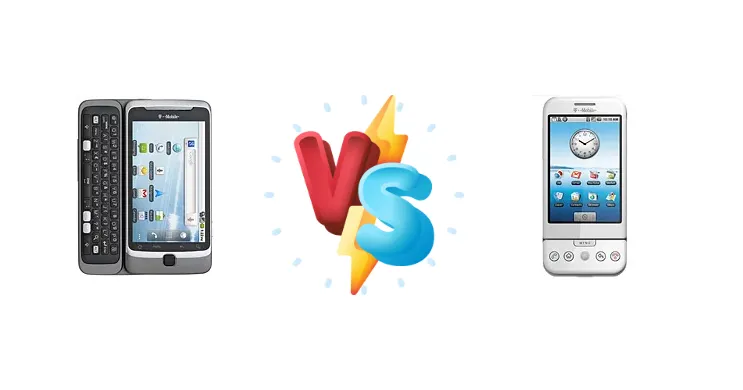
The T-Mobile G1 and G2 represent pivotal moments in the history of Android. These phones weren't just devices; they were gateways to a new mobile operating system. But which of these pioneering smartphones holds up better today? Let's dive into a detailed comparison.
🏆 Quick Verdict
The T-Mobile G2 offers a noticeable performance boost thanks to its faster processor and improved display. While the G1 holds historical significance, the G2's enhanced speed, screen, and slightly better camera make it the more compelling choice for anyone looking to experience early Android.
| Network |
|---|
| 2G bands | GSM 850 / 900 / 1800 / 1900 | GSM 850 / 900 / 1800 / 1900 |
| 3G bands | HSDPA 1700 / 2100 | HSDPA 2100 |
| Speed | HSPA 14.4/2 Mbps | HSPA 7.2/2 Mbps |
| Technology | GSM / HSPA | GSM / HSPA |
| | - | HSDPA 1700 / 2100 - American version |
| Launch |
|---|
| Announced | 2010, September. Released 2010, October | 2008, September. Released 2008, October |
| Status | Discontinued | Discontinued |
| Body |
|---|
| Dimensions | 119.4 x 61 x 15.2 mm (4.70 x 2.40 x 0.60 in) | 117 x 55.7 x 17.1 mm (4.61 x 2.19 x 0.67 in) |
| Keyboard | QWERTY | QWERTY |
| SIM | Mini-SIM | Mini-SIM |
| Weight | 184.3 g (6.49 oz) | 158 g (5.57 oz) |
| | Optical trackpad | Trackball |
| Display |
|---|
| Protection | Corning Gorilla Glass | Corning Gorilla Glass |
| Resolution | 480 x 800 pixels, 5:3 ratio (~252 ppi density) | 320 x 480 pixels, 3:2 ratio (~180 ppi density) |
| Size | 3.7 inches, 39.0 cm2 (~53.5% screen-to-body ratio) | 3.2 inches, 30.5 cm2 (~46.8% screen-to-body ratio) |
| Type | TFT | TFT, 65K colors |
| Platform |
|---|
| CPU | 800 MHz Scorpion | 528 MHz ARM 11 |
| Chipset | Qualcomm MSM7230 | Qualcomm MSM7201A |
| GPU | Adreno 205 | Adreno 130 |
| OS | Android 2.2 (Froyo) | Android 1.6 (Donut) |
| Memory |
|---|
| Card slot | microSDHC (dedicated slot), 8 GB included | microSD (dedicated slot) |
| Internal | 4GB 512MB RAM | 192MB RAM, 256MB |
| Main Camera |
|---|
| Features | LED flash | - |
| Single | 5 MP, AF | 3.15 MP, AF |
| Video | 720p | Yes |
| Sound |
|---|
| 3.5mm jack | Yes | No |
| 35mm jack | Yes | No |
| Loudspeaker | Yes | Yes |
| Comms |
|---|
| Bluetooth | 2.1, A2DP | 2.0, A2DP (headset support only) |
| Positioning | GPS, A-GPS | GPS |
| Radio | Nо | No |
| USB | microUSB 2.0 | miniUSB |
| WLAN | Wi-Fi 802.11 b/g/n, hotspot | Wi-Fi 802.11 b/g |
| Features |
|---|
| Browser | HTML, Adobe Flash | HTML |
| Sensors | Accelerometer, proximity, compass | Accelerometer, compass |
| | MP4/H.264 player
MP3/WAV/eAAC+ player
Organizer
Document viewer
Voice memo
Predictive text input (Swype) | Voice memo
MP3 player |
| Battery |
|---|
| Stand-by | Up to 430 h (2G) / Up to 430 h (3G) | Up to 406 h |
| Talk time | Up to 9 h 50 min (2G) / Up to 6 h 40 min (3G) | Up to 5 h 20 min |
| Type | Removable Li-Ion 1300 mAh battery | Removable Li-Ion 1150 mAh battery |
| Misc |
|---|
| Colors | White, Black | White, Black, Brown |
| Price | About 420 EUR | About 290 EUR |
| SAR | - | 0.71 W/kg (head) 0.84 W/kg (body) |
| Tests |
|---|
| Audio quality | - |
Noise -87.2dB / Crosstalk -86.1dB |
T-Mobile G2
- Faster processor (800 MHz)
- Limited app availability compared to modern Android
T-Mobile G1
- Historical significance as the first Android phone
- Slower processor (528 MHz)
- Lower screen resolution
Display Comparison
The G2 boasts a 3.2-inch HVGA display, a significant upgrade over the G1's 3.2-inch QVGA screen. The G2's higher resolution provides noticeably sharper images and text, making it easier on the eyes. Color reproduction is also improved, though both displays are limited by the technology of the time.
Camera Comparison
Both phones feature 3.2MP cameras, but the G2's camera hardware and software processing are slightly better. Expect marginally improved image quality, though low-light performance remains poor on both devices. Don't expect modern smartphone camera capabilities from either.
Performance
Here's where the G2 truly shines. Its 800 MHz Scorpion CPU is considerably faster than the G1's 528 MHz ARM 11 processor. This translates to snappier app loading, smoother multitasking (though limited by the OS), and a generally more responsive user experience. The G2's chipset also offers better overall processing power.
Battery Life
The G2 generally offers slightly better battery life than the G1, likely due to more efficient power management within its chipset. However, both phones will require frequent charging with moderate usage, especially when running older Android apps.
Buying Guide
The T-Mobile G2 is for enthusiasts interested in a slightly more usable early Android experience. The T-Mobile G1 is best suited for collectors and historians wanting to experience the very first Android device, understanding its limitations.
Frequently Asked Questions
❓ What Android version did these phones ship with?
The T-Mobile G1 launched with Android 1.0, while the G2 shipped with Android 1.5 (Cupcake). Both received updates, but their capabilities are severely limited compared to modern Android versions.
❓ Are apps still available for these phones?
Finding apps specifically designed for these older Android versions is extremely difficult. While some older apps might still function, compatibility is a major issue. Emulators are an option for running newer apps, but performance will be severely impacted.