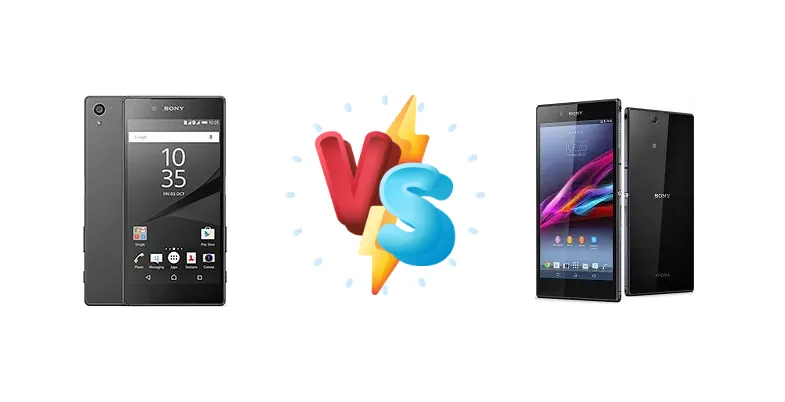
Sony's Xperia line has always been known for its unique design and premium features. The Z5 and Z Ultra, both flagship devices from their respective eras, offer compelling experiences. But which one holds up better today? Let's dive into a detailed comparison to help you decide.
🏆 Quick Verdict
The Xperia Z Ultra edges out the Z5 with slightly better battery life and a superior sunlight display. However, the Z5 boasts a more modern chipset and potentially better software support. Ultimately, the Z Ultra offers a more impressive display, while the Z5 provides a more contemporary processing experience.
| Network |
|---|
| 2G bands | GSM 850 / 900 / 1800 / 1900 | GSM 850 / 900 / 1800 / 1900 - all versions |
| 3G bands | HSDPA 850 / 900 / 1900 / 2100 - E6603, E6653 | HSDPA 850 / 900 / 1700 / 1900 / 2100 - all versions |
| 4G bands | 1, 2, 3, 4, 5, 7, 8, 12, 17, 20, 28, 38, 40 - E6603, E6653 | 1, 2, 4, 5, 7, 8, 17 - C6806 |
| Speed | HSPA 42.2/5.76 Mbps, LTE Cat4 150/50 Mbps (E6603), LTE Cat6 300/50 Mbps (E6653) | HSPA 42.2/5.76 Mbps, LTE Cat4 150/50 Mbps |
| Technology | GSM / HSPA / LTE | GSM / HSPA / LTE |
| | - | 1, 2, 3, 4, 5, 7, 8, 20 - C6833 |
| Launch |
|---|
| Announced | 2015, September 02. Released 2015, October 02 | 2013, June. Released 2013, July |
| Status | Discontinued | Discontinued |
| Body |
|---|
| Build | Glass front, glass back, aluminum frame | - |
| Dimensions | 146 x 72 x 7.3 mm (5.75 x 2.83 x 0.29 in) | 179.4 x 92.2 x 6.5 mm (7.06 x 3.63 x 0.26 in) |
| SIM | Nano-SIM | Micro-SIM |
| Weight | 154 g (5.43 oz) | 212 g (7.48 oz) |
| | IP68 dust/water resistant (up to 1.5m for 30 mins) | IP58 dust proof and water resistant over 1.5 meter and 30 minutes |
| Display |
|---|
| Protection | Scratch-resistant glass, oleophobic coating | Shatter proof glass |
| Resolution | 1080 x 1920 pixels, 16:9 ratio (~428 ppi density) | 1080 x 1920 pixels, 16:9 ratio (~344 ppi density) |
| Size | 5.2 inches, 73.2 cm2 (~69.6% screen-to-body ratio) | 6.4 inches, 112.9 cm2 (~68.3% screen-to-body ratio) |
| Type | IPS LCD | IPS LCD |
| | Triluminos display
X-Reality Engine | Triluminos display
X-Reality Engine |
| Platform |
|---|
| CPU | Octa-core (4x1.5 GHz Cortex-A53 & 4x2.0 GHz Cortex-A57) | Quad-core 2.2 GHz Krait 400 |
| Chipset | Qualcomm MSM8994 Snapdragon 810 (20 nm) | Qualcomm MSM8274 or MSM8974 Snapdragon 800 (28 nm) |
| GPU | Adreno 430 | Adreno 330 |
| OS | Android 5.1.1 (Lollipop), upgradable to 7.1.1 (Nougat) | Android 4.2 (Jelly Bean), upgradable to 5.1 (Lollipop) |
| Memory |
|---|
| Card slot | microSDXC (dedicated slot) | microSDXC (dedicated slot) |
| Internal | 32GB 3GB RAM | 16GB 2GB RAM |
| | eMMC 5.0 | eMMC 4.5 |
| Main Camera |
|---|
| Features | LED flash, HDR, panorama | HDR |
| Single | 23 MP, f/2.0, 24mm (wide), 1/2.3", PDAF | 8 MP, f/2.4, AF |
| Video | 4K@30fps, 1080p@60fps, 720p@120fps, HDR | 1080p@30fps, HDR |
| Selfie camera |
|---|
| Features | HDR | - |
| Single | 5.1 MP, f/2.4 | 2 MP |
| Video | 1080p@30fps | 1080p@30fps |
| Sound |
|---|
| 3.5mm jack | Yes | Yes |
| 35mm jack | Yes | Yes |
| Loudspeaker | Yes, with stereo speakers | Yes |
| | 24-bit/192kHz audio
| - |
| Comms |
|---|
| Bluetooth | 4.1, A2DP, aptX | 4.0, A2DP, aptX |
| NFC | Yes | Yes |
| Positioning | GPS, GLONASS/ BDS (market dependant) | GPS, GLONASS |
| Radio | FM radio, RDS | Stereo FM radio, RDS |
| USB | microUSB 2.0 (MHL 3 TV-out), OTG | microUSB 2.0 (MHL TV-out), OTG |
| WLAN | Wi-Fi 802.11 a/b/g/n/ac, dual-band, Wi-Fi Direct, DLNA, hotspot | Wi-Fi 802.11 a/b/g/n/ac, dual-band, Wi-Fi Direct, DLNA, hotspot |
| Features |
|---|
| Sensors | Fingerprint (side-mounted; EU model only), accelerometer, gyro, proximity, compass, barometer | Accelerometer, gyro, proximity, compass |
| | ANT+ | ANT+ |
| Battery |
|---|
| Charging | 18W wired, QC2 | - |
| Music play | Up to 87 h | Up to 120 h |
| Stand-by | Up to 520 h (2G) / Up to 540 h (3G) | Up to 790 h (2G) / Up to 820 h (3G) |
| Talk time | Up to 13 h 10 min (2G) / Up to 17 h (3G) | Up to 14 h (2G) / Up to 16 h (3G) |
| Type | Li-Ion 2900 mAh, non-removable | Li-Ion 3050 mAh, non-removable |
| Misc |
|---|
| Colors | White, Graphite Black, Gold, Green, Pink | Black, White, Purple |
| Models | E6653, SO-01H, SOV32, E6603, 501SO | C6833, C6802, C6806, C6806 |
| Price | About 150 EUR | About 280 EUR |
| SAR | 0.55 W/kg (head) 0.64 W/kg (body) | 1.01 W/kg (head) 1.54 W/kg (body) |
| SAR EU | 0.75 W/kg (head) 0.78 W/kg (body) | 0.34 W/kg (head) |
| Tests |
|---|
| Audio quality |
Noise -95.5dB / Crosstalk -94.8dB |
Noise -92.5dB / Crosstalk -90.7dB |
| Battery life |
Endurance rating 48h
|
Endurance rating 52h
|
| Camera |
Photo / Video |
Photo / Video |
| Display |
Contrast ratio: 986 (nominal), 2.88(sunlight) |
Contrast ratio: 1001:1 (nominal) / 1.578:1 (sunlight) |
| Loudspeaker |
Voice 65dB / Noise 62dB / Ring 66dB
|
Voice 63dB / Noise 60dB / Ring 59dB
|
| Performance |
Basemark OS II 2.0: 1580Basemark X: 24941 |
Basemark X: 11606 |
Sony Xperia Z5
- More powerful chipset
- Potentially better software support
- Faster autofocus camera
- Compact size
- Older design
- Sunlight readability not as good as Z Ultra
- Battery slightly smaller
Sony Xperia Z Ultra
- Larger, brighter display
- Excellent sunlight readability
- Slightly better battery life
- Unique design
- Older chipset
- Outdated software
- Larger size may be unwieldy
- Less powerful camera
Display Comparison
The Xperia Z Ultra takes the display crown. While both offer excellent contrast ratios (1001:1 for Z Ultra, 986:1 for Z5), the Z Ultra's sunlight readability is significantly better (1.578:1 vs 2.88:1). The Z Ultra also features a larger 6.4-inch display compared to the Z5's 5.2-inch screen, making it better for media consumption.
Camera Comparison
Both phones feature capable cameras, but the Z5 likely has an advantage due to advancements in camera technology during its production. The Z5's camera is known for its fast autofocus and detailed images. Specific camera specs are missing, but the Z5's later release suggests improvements in image processing and sensor technology.
Performance
The Z5's Snapdragon 810 chipset is more powerful than the Z Ultra's Snapdragon 800. The Z5's octa-core processor and 20nm manufacturing process provide a noticeable performance boost in demanding tasks and gaming. The Z Ultra's quad-core Krait processor, while capable, is showing its age.
Battery Life
The Xperia Z Ultra boasts a slightly better endurance rating (52h vs 48h). While both offer respectable battery life, the Z Ultra's larger battery capacity contributes to its longer runtime.
Buying Guide
The Sony Xperia Z5 is ideal for users prioritizing performance and a more recent Android experience. The Xperia Z Ultra is a good choice for those who value a large, bright display and extended battery life, and are comfortable with an older software version.
Frequently Asked Questions
❓ Is the Xperia Z5 still worth buying?
The Z5 can be a decent budget option if you find it at a low price, but be aware of its age and potential lack of software updates.
❓ What is the main difference between the Z5 and Z Ultra?
The Z Ultra prioritizes a large, bright display and battery life, while the Z5 focuses on performance and a more modern chipset.
❓ Which phone is better for gaming?
The Xperia Z5 is better for gaming due to its more powerful Snapdragon 810 chipset.