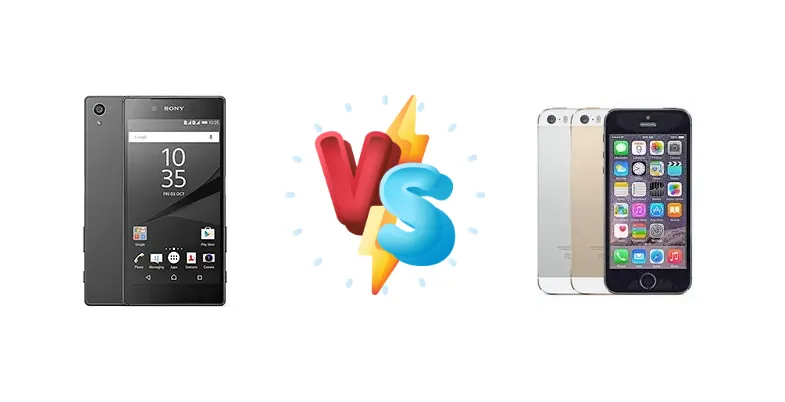
Nostalgia is a powerful force, and sometimes the best tech is the tech we remember fondly. Today, we're pitting two iconic smartphones from a bygone era against each other: the Sony Xperia Z5 and the Apple iPhone 5s. Let's see which one holds up best in a modern context.
🏆 Quick Verdict
The iPhone 5s edges out the Z5 thanks to its slightly better sunlight readability and overall iOS experience. While the Z5 boasts a more powerful chipset, the 5s's optimized software and longer-lasting battery give it a slight advantage for users prioritizing ease of use and longevity.
| Network |
|---|
| 2G bands | GSM 850 / 900 / 1800 / 1900 | GSM 850 / 900 / 1800 / 1900 - all models |
| 3G bands | HSDPA 850 / 900 / 1900 / 2100 - E6603, E6653 | HSDPA 850 / 900 / 1700 / 1900 / 2100 - A1533 (GSM), A1453 |
| 4G bands | 1, 2, 3, 4, 5, 7, 8, 12, 17, 20, 28, 38, 40 - E6603, E6653 | 1, 2, 3, 4, 5, 8, 13, 17, 19, 20, 25 - A1533 GSM, A1533 CDMA |
| Speed | HSPA 42.2/5.76 Mbps, LTE Cat4 150/50 Mbps (E6603), LTE Cat6 300/50 Mbps (E6653) | HSPA 42.2/5.76 Mbps, LTE Cat3 100/50 Mbps, EV-DO Rev.A 3.1 Mbps |
| Technology | GSM / HSPA / LTE | GSM / CDMA / HSPA / EVDO / LTE |
| | - | 1, 2, 3, 5, 7, 8, 20, 38, 39, 40 - A1530 |
| Launch |
|---|
| Announced | 2015, September 02. Released 2015, October 02 | 2013, September 10. Released 2013, September 20 |
| Status | Discontinued | Discontinued |
| Body |
|---|
| Build | Glass front, glass back, aluminum frame | Glass front (Corning-made glass), aluminum back, aluminum frame |
| Dimensions | 146 x 72 x 7.3 mm (5.75 x 2.83 x 0.29 in) | 123.8 x 58.6 x 7.6 mm (4.87 x 2.31 x 0.30 in) |
| SIM | Nano-SIM | Nano-SIM |
| Weight | 154 g (5.43 oz) | 112 g (3.95 oz) |
| | IP68 dust/water resistant (up to 1.5m for 30 mins) | - |
| Display |
|---|
| Protection | Scratch-resistant glass, oleophobic coating | Corning Gorilla Glass, oleophobic coating |
| Resolution | 1080 x 1920 pixels, 16:9 ratio (~428 ppi density) | 640 x 1136 pixels, 16:9 ratio (~326 ppi density) |
| Size | 5.2 inches, 73.2 cm2 (~69.6% screen-to-body ratio) | 4.0 inches, 44.1 cm2 (~60.8% screen-to-body ratio) |
| Type | IPS LCD | IPS LCD |
| | Triluminos display
X-Reality Engine | - |
| Platform |
|---|
| CPU | Octa-core (4x1.5 GHz Cortex-A53 & 4x2.0 GHz Cortex-A57) | Dual-core 1.3 GHz Cyclone (ARM v8-based) |
| Chipset | Qualcomm MSM8994 Snapdragon 810 (20 nm) | Apple A7 (28 nm) |
| GPU | Adreno 430 | PowerVR G6430 (quad-core graphics) |
| OS | Android 5.1.1 (Lollipop), upgradable to 7.1.1 (Nougat) | iOS 7, upgradable to iOS 12.5.7 |
| Memory |
|---|
| Card slot | microSDXC (dedicated slot) | No |
| Internal | 32GB 3GB RAM | 16GB 1GB RAM, 32GB 1GB RAM, 64GB 1GB RAM |
| | eMMC 5.0 | - |
| Main Camera |
|---|
| Features | LED flash, HDR, panorama | Dual-LED dual-tone flash, HDR |
| Single | 23 MP, f/2.0, 24mm (wide), 1/2.3", PDAF | 8 MP, f/2.2, 29mm (standard), 1/3.0", 1.5µm, AF |
| Video | 4K@30fps, 1080p@60fps, 720p@120fps, HDR | 1080p@30fps, 720p@120fps |
| Selfie camera |
|---|
| Features | HDR | face detection, HDR, FaceTime over Wi-Fi or Cellular |
| Single | 5.1 MP, f/2.4 | 1.2 MP, f/2.4, 31mm (standard) |
| Video | 1080p@30fps | 720p@30fps |
| Sound |
|---|
| 3.5mm jack | Yes | Yes |
| 35mm jack | Yes | Yes |
| Loudspeaker | Yes, with stereo speakers | Yes |
| | 24-bit/192kHz audio
| 16-bit/44.1kHz audio
|
| Comms |
|---|
| Bluetooth | 4.1, A2DP, aptX | 4.0, A2DP |
| NFC | Yes | No |
| Positioning | GPS, GLONASS/ BDS (market dependant) | GPS, GLONASS |
| Radio | FM radio, RDS | No |
| USB | microUSB 2.0 (MHL 3 TV-out), OTG | Lightning, USB 2.0 |
| WLAN | Wi-Fi 802.11 a/b/g/n/ac, dual-band, Wi-Fi Direct, DLNA, hotspot | Wi-Fi 802.11 a/b/g/n, dual-band, hotspot |
| Features |
|---|
| Sensors | Fingerprint (side-mounted; EU model only), accelerometer, gyro, proximity, compass, barometer | Fingerprint (front-mounted), accelerometer, gyro, proximity, compass |
| | ANT+ | - |
| Battery |
|---|
| Charging | 18W wired, QC2 | - |
| Music play | Up to 87 h | - |
| Stand-by | Up to 520 h (2G) / Up to 540 h (3G) | Up to 250 h (3G) |
| Talk time | Up to 13 h 10 min (2G) / Up to 17 h (3G) | Up to 10 h (3G) |
| Type | Li-Ion 2900 mAh, non-removable | Li-Po 1560 mAh, non-removable (5.92 Wh) |
| Misc |
|---|
| Colors | White, Graphite Black, Gold, Green, Pink | Space Gray, White/Silver, Gold |
| Models | E6653, SO-01H, SOV32, E6603, 501SO | A1453, A1457, A1518, A1528, A1530, A1533, iPhone6,1, iPhone6,2 |
| Price | About 150 EUR | About 330 EUR |
| SAR | 0.55 W/kg (head) 0.64 W/kg (body) | 1.12 W/kg (head) 1.18 W/kg (body) |
| SAR EU | 0.75 W/kg (head) 0.78 W/kg (body) | 1.00 W/kg (head) 0.80 W/kg (body) |
| Tests |
|---|
| Audio quality |
Noise -95.5dB / Crosstalk -94.8dB |
Noise -93.6dB / Crosstalk -90.3dB |
| Battery life |
Endurance rating 48h
|
Endurance rating 54h
|
| Camera |
Photo / Video |
Photo / Video |
| Display |
Contrast ratio: 986 (nominal), 2.88(sunlight) |
Contrast ratio: 1219:1 (nominal) / 3.565:1 (sunlight) |
| Loudspeaker |
Voice 65dB / Noise 62dB / Ring 66dB
|
Voice 68dB / Noise 66dB / Ring 69dB
|
| Performance |
Basemark OS II 2.0: 1580Basemark X: 24941 |
Basemark X: 14341 |
Sony Xperia Z5
- More powerful processor
- Better camera
- Water resistance
- Android customization
- Older chipset can throttle under load
- Sunlight readability could be better
- Android updates discontinued
Apple iPhone 5s
- Better sunlight readability
- Longer battery life
- iOS ecosystem
- More consistent software experience
- Less powerful processor
- Older camera
- Limited storage options
- iOS updates discontinued
Display Comparison
Both phones feature respectable displays for their time. The iPhone 5s wins with a slightly higher contrast ratio (1219:1 vs 986:1) and notably better sunlight readability (3.565:1 vs 2.88). The Z5's display is still good, but the 5s's visibility in bright conditions is a clear advantage.
Camera Comparison
The Z5's camera is generally considered superior, offering more detail and better low-light performance. While both phones capture decent photos and videos, the Z5's larger sensor and more advanced processing give it an edge. The iPhone 5s's camera is still capable, but it shows its age compared to the Z5.
Performance
The Xperia Z5's Snapdragon 810 chipset, with its octa-core processor, offers significantly more raw processing power than the iPhone 5s's dual-core A7 chip. However, iOS is known for its efficiency, and the 5s often feels surprisingly responsive despite the hardware difference. The Z5 can handle more demanding tasks, but the 5s's optimization keeps it competitive.
Battery Life
The iPhone 5s takes a slight lead in battery endurance, boasting a rated 54h compared to the Z5's 48h. Real-world usage will vary, but the 5s's power efficiency contributes to its longer battery life.
Buying Guide
The Sony Xperia Z5 is a good choice for those who appreciate Android's customization options and a more powerful processor, potentially for light gaming. The Apple iPhone 5s is ideal for users who prefer the simplicity and ecosystem of iOS, and value a reliable, long-lasting device.
Frequently Asked Questions
❓ Are these phones still safe to use?
Both phones are no longer receiving security updates, so using them for sensitive tasks like banking is not recommended. They can still be used for basic communication and media consumption, but be aware of the security risks.
❓ Which phone is easier to repair?
The iPhone 5s is generally considered easier to repair due to readily available parts and a larger community of independent repair shops. The Z5 can be more challenging to disassemble and repair.