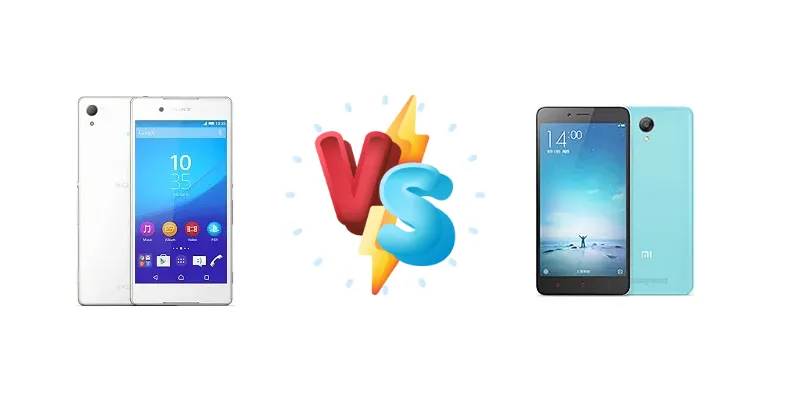
The Sony Xperia Z3+ and Xiaomi Redmi Note 2 were both popular mid-range contenders in their time. But with different strengths and weaknesses, which phone ultimately offers the better experience? We'll break down the key differences to help you decide.
🏆 Quick Verdict
The Xperia Z3+ boasts superior performance and a more premium build, while the Redmi Note 2 shines with exceptional battery life and a stunning display contrast. For power users, the Z3+ wins, but budget-conscious buyers prioritizing battery will favor the Redmi Note 2.
| Network |
|---|
| 2G bands | GSM 850 / 900 / 1800 / 1900 - SIM 1 & SIM 2 | GSM 900 / 1800 / 1900 - SIM 1 & SIM 2 |
| 3G bands | HSDPA 850 / 900 / 1700(AWS) / 1900 / 2100 | HSDPA 850 / 900 / 1900 / 2100 |
| 4G bands | 1, 2, 3, 4, 5, 7, 8, 12, 17, 20, 38, 39, 40, 41 | 1, 3, 7, 38, 39, 40, 41 |
| Speed | HSPA 42.2/5.76 Mbps, LTE Cat4 150/50 Mbps | HSPA, LTE Cat4 150/50 Mbps |
| Technology | GSM / HSPA / LTE | GSM / HSPA / LTE |
| | - | TD-SCDMA |
| Launch |
|---|
| Announced | 2015, May. Released 2015, June | 2015, August. Released 2015, August |
| Status | Discontinued | Discontinued |
| Body |
|---|
| Build | - | Glass front, plastic back, plastic frame |
| Dimensions | 146 x 72 x 6.9 mm (5.75 x 2.83 x 0.27 in) | 152 x 76 x 8.3 mm (5.98 x 2.99 x 0.33 in) |
| SIM | Nano-SIM + Nano-SIM | Dual SIM (Micro-SIM, dual stand-by) |
| Weight | 144 g (5.08 oz) | 160 g (5.64 oz) |
| | IP68 dust/water resistant (up to 1.5m for 30 min) | - |
| Display |
|---|
| Protection | Scratch-resistant glass, oleophobic coating | - |
| Resolution | 1080 x 1920 pixels, 16:9 ratio (~428 ppi density) | 1080 x 1920 pixels, 16:9 ratio (~403 ppi density) |
| Size | 5.2 inches, 73.2 cm2 (~69.6% screen-to-body ratio) | 5.5 inches, 82.6 cm2 (~71.5% screen-to-body ratio) |
| Type | IPS LCD | IPS LCD |
| | Triluminos display
X-Reality Engine | - |
| Platform |
|---|
| CPU | Octa-core (4x1.5 GHz Cortex-A53 & 4x2.0 GHz Cortex-A57) | Octa-core 2.0 GHz Cortex-A53 - Redmi Note 2Octa-core 2.2 GHz Cortex-A53 - Redmi Note 2 Prime |
| Chipset | Qualcomm MSM8994 Snapdragon 810 (20 nm) | Mediatek MT6795 Helio X10 (28 nm) |
| GPU | Adreno 430 | PowerVR G6200 |
| OS | Android 5.0 (Lollipop), upgradable to 6.0 (Marshmallow) | Android 5.0 (Lollipop), MIUI 7 |
| Memory |
|---|
| Card slot | microSDXC (dedicated slot) | microSDXC (dedicated slot) - Chinese version only |
| Internal | 32GB 3GB RAM | 16GB 2GB RAM (Standard), 32GB 2GB RAM (Prime) |
| | eMMC 5.0 | eMMC 5.0 |
| Main Camera |
|---|
| Features | LED flash, HDR, panorama | LED flash, HDR, panorama |
| Single | 20.7 MP, f/2.0, 25mm (wide), 1/2.3", 1.12µm, AF | 13 MP, f/2.2, PDAF |
| Video | 4K@30fps, 1080p@60fps, 720p@120fps, HDR | 1080p@30fps |
| Selfie camera |
|---|
| Features | HDR | - |
| Single | 5.1 MP, f/2.4 | 5 MP, f/2.0 |
| Video | 1080p@30fps | 720p |
| Sound |
|---|
| 3.5mm jack | Yes | Yes |
| 35mm jack | Yes | Yes |
| Loudspeaker | Yes, with stereo speakers | Yes |
| Comms |
|---|
| Bluetooth | 4.1, A2DP, aptX | 4.0, A2DP, LE |
| Infrared port | - | Yes |
| NFC | Yes | No |
| Positioning | GPS, GLONASS/ BDS (market dependant) | GPS, GLONASS, BDS |
| Radio | FM radio, RDS | Stereo FM radio |
| USB | microUSB 2.0 (MHL 3 TV-out), OTG | microUSB 2.0, OTG |
| WLAN | Wi-Fi 802.11 a/b/g/n/ac, dual-band, Wi-Fi Direct, DLNA, hotspot | Wi-Fi 802.11 a/b/g/n/ac, dual-band, Wi-Fi Direct, hotspot |
| Features |
|---|
| Sensors | Accelerometer, gyro, proximity, compass, barometer | Accelerometer, gyro, proximity, compass |
| | ANT+ | - |
| Battery |
|---|
| Charging | - | 10W wired |
| Music play | Up to 81 h | Up to 46 h |
| Stand-by | Up to 530 h (2G) / Up to 510 h (3G) | Up to 144 h (3G) |
| Talk time | Up to 12 h (2G) / Up to 21 h (3G) | Up to 11 h 30 min (3G) |
| Type | Li-Ion 2930 mAh, non-removable | Li-Po 3060 mAh, removable |
| Misc |
|---|
| Colors | White, black, copper, aqua green | White, blue, yellow, pink, mint green |
| Models | E6533 | 2015051 |
| Price | About 320 EUR | About 160 EUR |
| SAR | 0.59 W/kg (head) 1.12 W/kg (body) | 0.34 W/kg (head) 0.45 W/kg (body) |
| SAR EU | 0.43 W/kg (head) 0.36 W/kg (body) | - |
| Tests |
|---|
| Audio quality | - |
Noise -96.1dB / Crosstalk -94.8dB |
| Battery life | - | Endurance rating 49h |
| Camera | - |
Photo / Video |
| Display | - |
Contrast ratio: 953 (nominal), 2.166 (sunlight) |
| Loudspeaker | - |
Voice 66dB / Noise 66dB / Ring 76dB |
| Performance | - |
Basemark OS II 2.0: 1063Basemark X: 8518 |
Sony Xperia Z3+ dual
- Premium build quality
- Superior performance
- Water resistance
- Good camera
- Snapdragon 810 throttling issues
- Older software
- Higher price (when new)
Xiaomi Redmi Note 2
- Exceptional battery life
- Excellent display contrast
- Affordable price
- Good value
- Lower performance than Z3+
- Camera not as refined
- Plastic build
Display Comparison
Both phones feature a 5.5-inch display, but the Redmi Note 2's contrast ratio (953 nominal, 2.166 in sunlight) is remarkably impressive, offering excellent visibility even in bright conditions. The Z3+’s display is good, but doesn’t reach the same level of contrast. Color accuracy is generally good on both.
Camera Comparison
The Xperia Z3+ generally offers better image quality, particularly in low light, thanks to Sony's image processing and sensor technology. While both phones offer decent photo and video capabilities, the Z3+’s camera is more consistent and produces more detailed images. The Redmi Note 2's camera is acceptable, but lacks the Z3+'s refinement.
Performance
The Xperia Z3+’s Snapdragon 810 chipset provides a noticeable performance advantage over the Redmi Note 2's Helio X10. Expect smoother multitasking, faster app loading, and better gaming performance on the Z3+. The Z3+'s CPU architecture (Cortex-A53 and A57) offers a more balanced approach to performance.
Battery Life
The Redmi Note 2’s battery life is a standout feature, achieving an endurance rating of 49 hours. The Xperia Z3+’s battery life is respectable, but falls short of the Redmi Note 2's longevity. This makes the Redmi Note 2 a clear winner for users who need a phone that can last through multiple days of use.
Buying Guide
The Sony Xperia Z3+ dual is ideal for users who prioritize performance, a premium design, and water resistance. The Xiaomi Redmi Note 2 is a great choice for those seeking long battery life, a vibrant display, and excellent value for money.
Frequently Asked Questions
❓ Is the Snapdragon 810 in the Z3+ prone to overheating?
Yes, the Snapdragon 810 was known to experience thermal throttling under sustained load, which could impact performance during extended gaming sessions.
❓ Which phone is better for photography?
The Sony Xperia Z3+ generally produces better photos, especially in low light, due to its superior image processing and sensor.