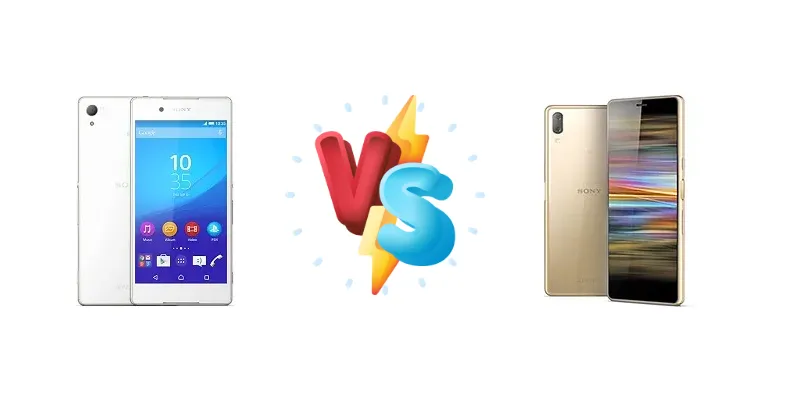
Sony has a diverse lineup of smartphones, catering to various budgets and needs. Today, we're pitting two distinct models against each other: the flagship Xperia Z3+ dual and the more budget-friendly Xperia L3. Let's dive into a comprehensive comparison to see which phone emerges as the winner.
🏆 Quick Verdict
The Xperia Z3+ dual offers significantly superior performance thanks to its Snapdragon 810 chipset and premium build. However, the Xperia L3 boasts impressive battery life and a high contrast ratio display. For power users, the Z3+ wins; for budget-conscious users prioritizing endurance, the L3 is a strong contender.
| Network |
|---|
| 2G bands | GSM 850 / 900 / 1800 / 1900 - SIM 1 & SIM 2 | GSM 850 / 900 / 1800 / 1900 |
| 3G bands | HSDPA 850 / 900 / 1700(AWS) / 1900 / 2100 | HSDPA 850 / 900 / 1900 / 2100 - I3312, I4312, I4332 |
| 4G bands | 1, 2, 3, 4, 5, 7, 8, 12, 17, 20, 38, 39, 40, 41 | 1, 2, 3, 5, 7, 8, 20, 38 - I3312, I4312 |
| Speed | HSPA 42.2/5.76 Mbps, LTE Cat4 150/50 Mbps | HSPA 42.2/5.76 Mbps, LTE (2CA) Cat6 300/50 Mbps |
| Technology | GSM / HSPA / LTE | GSM / HSPA / LTE |
| | - | 1, 2, 4, 5, 7, 8, 12, 13, 17, 28, 29 - I3322 |
| Launch |
|---|
| Announced | 2015, May. Released 2015, June | 2019, February. Released 2019, February |
| Status | Discontinued | Discontinued |
| Body |
|---|
| Build | - | Glass front (Gorilla Glass 5), plastic back, plastic frame |
| Dimensions | 146 x 72 x 6.9 mm (5.75 x 2.83 x 0.27 in) | 154 x 72 x 8.9 mm (6.06 x 2.83 x 0.35 in) |
| SIM | Nano-SIM + Nano-SIM | · Nano-SIM· Nano-SIM + Nano-SIM |
| Weight | 144 g (5.08 oz) | 156 g (5.50 oz) |
| | IP68 dust/water resistant (up to 1.5m for 30 min) | - |
| Display |
|---|
| Protection | Scratch-resistant glass, oleophobic coating | Corning Gorilla Glass 5 |
| Resolution | 1080 x 1920 pixels, 16:9 ratio (~428 ppi density) | 720 x 1440 pixels, 18:9 ratio (~282 ppi density) |
| Size | 5.2 inches, 73.2 cm2 (~69.6% screen-to-body ratio) | 5.7 inches, 83.8 cm2 (~75.6% screen-to-body ratio) |
| Type | IPS LCD | IPS LCD |
| | Triluminos display
X-Reality Engine | - |
| Platform |
|---|
| CPU | Octa-core (4x1.5 GHz Cortex-A53 & 4x2.0 GHz Cortex-A57) | Octa-core 2.0 GHz Cortex-A53 |
| Chipset | Qualcomm MSM8994 Snapdragon 810 (20 nm) | Mediatek MT6762 Helio P22 (12 nm) |
| GPU | Adreno 430 | PowerVR GE8320 |
| OS | Android 5.0 (Lollipop), upgradable to 6.0 (Marshmallow) | Android 8.0 (Oreo) |
| Memory |
|---|
| Card slot | microSDXC (dedicated slot) | microSDXC (uses shared SIM slot) |
| Internal | 32GB 3GB RAM | 32GB 3GB RAM |
| | eMMC 5.0 | eMMC 5.1 |
| Main Camera |
|---|
| Dual | - | 13 MP, f/2.2, 26mm (wide), 1/3.0", PDAF
Auxiliary lens |
| Features | LED flash, HDR, panorama | LED flash, HDR, panorama |
| Single | 20.7 MP, f/2.0, 25mm (wide), 1/2.3", 1.12µm, AF | - |
| Video | 4K@30fps, 1080p@60fps, 720p@120fps, HDR | 1080p@30fps |
| Selfie camera |
|---|
| Features | HDR | - |
| Single | 5.1 MP, f/2.4 | 8 MP, f/2.0, 24mm (wide), 1/4.0", 1.12µm |
| Video | 1080p@30fps | 1080p@30fps |
| Sound |
|---|
| 3.5mm jack | Yes | Yes |
| 35mm jack | Yes | Yes |
| Loudspeaker | Yes, with stereo speakers | Yes |
| Comms |
|---|
| Bluetooth | 4.1, A2DP, aptX | 5.0, A2DP, LE |
| NFC | Yes | Yes |
| Positioning | GPS, GLONASS/ BDS (market dependant) | GPS, GLONASS |
| Radio | FM radio, RDS | FM radio |
| USB | microUSB 2.0 (MHL 3 TV-out), OTG | USB Type-C 2.0 |
| WLAN | Wi-Fi 802.11 a/b/g/n/ac, dual-band, Wi-Fi Direct, DLNA, hotspot | Wi-Fi 802.11 a/b/g/n, dual-band, Wi-Fi Direct |
| Features |
|---|
| Sensors | Accelerometer, gyro, proximity, compass, barometer | Fingerprint (side-mounted), accelerometer, proximity, compass |
| | ANT+ | - |
| Battery |
|---|
| Charging | - | USB Power Delivery |
| Music play | Up to 81 h | - |
| Stand-by | Up to 530 h (2G) / Up to 510 h (3G) | - |
| Talk time | Up to 12 h (2G) / Up to 21 h (3G) | - |
| Type | Li-Ion 2930 mAh, non-removable | Li-Ion 3300 mAh, non-removable |
| Misc |
|---|
| Colors | White, black, copper, aqua green | Black, Gold, Silver |
| Models | E6533 | I3312, I4312, I4332, I3322 |
| Price | About 320 EUR | About 230 EUR |
| SAR | 0.59 W/kg (head) 1.12 W/kg (body) | - |
| SAR EU | 0.43 W/kg (head) 0.36 W/kg (body) | - |
| Tests |
|---|
| Audio quality | - |
Noise -91.9dB / Crosstalk -89.3dB |
| Battery life | - |
Endurance rating 80h
|
| Camera | - |
Photo / Video |
| Display | - |
Contrast ratio: 1818:1 (nominal) |
| Loudspeaker | - |
Voice 70dB / Noise 73dB / Ring 81dB
|
| Performance | - |
AnTuTu: 78894 (v7)
GFXBench: 5fps (ES 3.1 onscreen) |
Sony Xperia Z3+ dual
- Superior Performance
- Premium Build Quality
- Better Camera
- Water Resistance (IP68)
- More RAM (typically 3GB)
- Older Chipset (can throttle under sustained load)
- Larger Size/Weight
- Potentially Slower Software Updates
Sony Xperia L3
- Excellent Battery Life
- Large Display
- Affordable Price
- USB Power Delivery
- Lower Performance
- Less Premium Build
- Mediocre Camera
- Less RAM (typically 3GB)
Display Comparison
Both phones feature a respectable contrast ratio of 1818:1, indicating deep blacks and vibrant colors. However, the Z3+ dual likely has a higher resolution and potentially better color accuracy due to its flagship status. The L3's display is larger, which may be preferable for media consumption, but the Z3+ likely offers a sharper image.
Camera Comparison
The Z3+ dual generally has a better camera system. While specific megapixel counts are similar, the Z3+'s image processing and sensor technology were more advanced at the time of its release. Expect better low-light performance and more detailed photos from the Z3+. The L3's camera is adequate for casual snapshots.
Performance
This is where the Z3+ dual truly shines. The Snapdragon 810 chipset, while aging, still provides significantly more processing power than the Helio P22 in the L3. Expect smoother multitasking, faster app loading times, and better gaming performance on the Z3+ dual. The L3 will handle basic tasks adequately, but may struggle with demanding applications.
Battery Life
The Xperia L3 boasts an impressive endurance rating of 80 hours, suggesting exceptional battery life. While the Z3+ dual's battery is smaller, its power efficiency is still decent. The L3's larger battery and less demanding chipset likely contribute to its superior battery performance.
Buying Guide
The Sony Xperia Z3+ dual is ideal for users who demand high performance, a premium design, and a capable camera. It's a good choice for gamers and those who multitask heavily. The Xperia L3 is best suited for users on a tighter budget who prioritize long battery life and a large display for media consumption. It's a reliable daily driver for basic tasks.
Frequently Asked Questions
❓ Is the Xperia Z3+ dual still worth buying in 2023?
It can be a good value if you find it at a low price and prioritize performance. However, consider its age and potential lack of software updates.
❓ Which phone is better for gaming?
The Xperia Z3+ dual is significantly better for gaming due to its more powerful chipset.
❓ Does the Xperia L3 have NFC?
Yes, the Xperia L3 includes NFC for contactless payments.