
Sony Xperia XZ3 vs Xperia 5 II: A Head-to-Head Showdown
| Phones Images | |||||
|---|---|---|---|---|---|
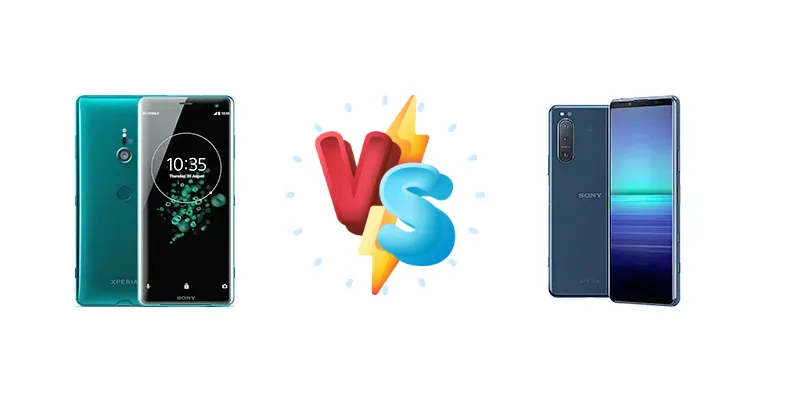
|
🏆 Quick Verdict
The Xperia 5 II is the clear winner, offering a more modern chipset (Snapdragon 865), faster charging, and a brighter display. While the XZ3 boasts impressive battery endurance, the 5 II's overall improvements in performance and features make it the superior choice for most users.
| PHONES | ||
|---|---|---|
| Phone Names | Sony Xperia XZ3 | Sony Xperia 5 II |
| Network | ||
|---|---|---|
| 2G bands | GSM 850 / 900 / 1800 / 1900 | GSM 850 / 900 / 1800 / 1900 |
| 3G bands | HSDPA 800 / 850 / 900 / 1700(AWS) / 1900 / 2100 - H8416, H9436, H9493 | HSDPA 800 / 850 / 900 / 1700(AWS) / 1900 / 2100 |
| 4G bands | 1, 2, 3, 4, 5, 7, 8, 12, 13, 17, 19, 20, 26, 28, 29, 32, 38, 39, 40, 41, 46, 66 - H8416, H9436, H9493 | 1, 2, 3, 4, 5, 7, 8, 12, 13, 17, 19, 20, 25, 26, 28, 29, 32, 34, 38, 39, 40, 41, 46, 48, 66 |
| 5G bands | - | 1, 3, 8, 28, 77, 78 SA/NSA |
| Speed | HSPA 42.2/5.76 Mbps, LTE (5CA) Cat18 1200/200 Mbps | HSPA 42.2/5.76 Mbps, LTE Cat18 1200/150 Mbps, 5G |
| Technology | GSM / HSPA / LTE | GSM / HSPA / LTE / 5G |
| Launch | ||
|---|---|---|
| Announced | 2018, August 30. Released 2018, October 05 | 2020, September 17 |
| Status | Discontinued | Available. Released 2020, October 12 |
| Body | ||
|---|---|---|
| Build | Glass front (Gorilla Glass 5), glass back (Gorilla Glass 5), aluminum frame | Glass front (Gorilla Glass 6), glass back (Gorilla Glass 6), aluminum frame |
| Dimensions | 158 x 73 x 9.9 mm (6.22 x 2.87 x 0.39 in) | 158 x 68 x 8 mm (6.22 x 2.68 x 0.31 in) |
| SIM | · Nano-SIM· Nano-SIM + Nano-SIM | · Nano-SIM· Nano-SIM + Nano-SIM |
| Weight | 193 g (6.81 oz) | 163 g (5.75 oz) |
| IP65/IP68 dust/water resistant (up to 1.5m for 30 mins) | IP65/IP68 dust/water resistant (up to 1.5m for 30 mins) | |
| Display | ||
|---|---|---|
| Protection | Corning Gorilla Glass 5 | Corning Gorilla Glass 6 |
| Resolution | 1440 x 2880 pixels, 18:9 ratio (~537 ppi density) | 1080 x 2520 pixels, 21:9 ratio (~449 ppi density) |
| Size | 6.0 inches, 92.9 cm2 (~80.5% screen-to-body ratio) | 6.1 inches, 86.9 cm2 (~80.9% screen-to-body ratio) |
| Type | P-OLED, HDR BT.2020 | OLED, 120Hz, HDR BT.2020 |
| Triluminos display X-Reality Engine | Triluminos display X-Reality Engine | |
| Platform | ||
|---|---|---|
| CPU | Octa-core (4x2.7 GHz Kryo 385 Gold & 4x1.7 GHz Kryo 385 Silver) | Octa-core (1x2.84 GHz Cortex-A77 & 3x2.42 GHz Cortex-A77 & 4x1.80 GHz Cortex-A55) |
| Chipset | Qualcomm SDM845 Snapdragon 845 (10 nm) | Qualcomm SM8250 Snapdragon 865 5G (7 nm+) |
| GPU | Adreno 630 | Adreno 650 |
| OS | Android 9.0 (Pie), upgradable to Android 10 | Android 10, upgradable to Android 12 |
| Memory | ||
|---|---|---|
| Card slot | microSDXC (uses shared SIM slot) - dual SIM model only | microSDXC (uses shared SIM slot) |
| Internal | 64GB 4GB RAM, 64GB 6GB RAM | 128GB 8GB RAM, 256GB 8GB RAM |
| UFS 2.1 | UFS 3.0 | |
| Main Camera | ||
|---|---|---|
| Features | Laser AF, color spectrum sensor, LED flash, panorama, HDR | Zeiss optics, color spectrum sensor, LED flash, panorama, HDR, eye tracking |
| Single | 19 MP, f/2.0, 25mm (wide), 1/2.3", 1.22µm, predictive PDAF | - |
| Triple | - | 12 MP, f/1.7, 24mm (wide), 1/1.7", 1.8µm, dual pixel PDAF, OIS 12 MP, f/2.4, 70mm (telephoto), 1/3.4", 1.0µm, PDAF, 3x optical zoom, OIS 12 MP, f/2.2, 124˚, 16mm (ultrawide), 1/2.55", dual pixel PDAF |
| Video | 4K@30fps, 1080p@60fps, 1080p@30fps (5-axis gyro-EIS), 1080p@960fps, HDR | 4K@24/30/60/120fps HDR, 1080p, 5-axis gyro-EIS, OIS |
| Selfie camera | ||
|---|---|---|
| Features | HDR | HDR |
| Single | 13 MP, f/1.9, 23mm (wide), 1/3.1", 1.12µm | 8 MP, f/2.0, 24mm (wide), 1/4.0", 1.12µm |
| Video | 1080p@30fps (5-axis gyro-EIS) | 1080p@30fps, 5-axis gyro-EIS |
| Sound | ||
|---|---|---|
| 3.5mm jack | No | Yes |
| 35mm jack | No | Yes |
| Loudspeaker | Yes, with stereo speakers | Yes, with stereo speakers |
| 24-bit/192kHz audio Dynamic vibration system | 24-bit/192kHz audio Dynamic vibration system | |
| Comms | ||
|---|---|---|
| Bluetooth | 5.0, A2DP, aptX HD, LE | 5.1, A2DP, aptX HD, LE |
| NFC | Yes | Yes |
| Positioning | GPS, GLONASS, BDS, GALILEO | GPS, GLONASS, BDS, GALILEO, QZSS |
| Radio | No | No |
| USB | USB Type-C 3.1, OTG | USB Type-C 3.1, OTG |
| WLAN | Wi-Fi 802.11 a/b/g/n/ac, dual-band, Wi-Fi Direct, DLNA | Wi-Fi 802.11 a/b/g/n/ac/6, dual-band, Wi-Fi Direct, DLNA |
| Features | ||
|---|---|---|
| Sensors | Fingerprint (rear-mounted), accelerometer, gyro, proximity, barometer, compass | Fingerprint (side-mounted), accelerometer, gyro, proximity, barometer, compass |
| Battery | ||
|---|---|---|
| Charging | 18W wired, PD2.0 Wireless (Qi) | 21W wired, PD3.0, 50% in 30 min |
| Type | Li-Ion 3300 mAh, non-removable | Li-Ion 4000 mAh |
| Misc | ||
|---|---|---|
| Colors | Black, Silver White, Forest Green, Bordeaux Red | Black, Grey, Blue, Pink |
| Models | H9436, H8416, H9493 | SO-52A, XQ-AS52, XQ-AS62, XQ-AS72, A002SO, SOG02 |
| Price | About 510 EUR | About 650 EUR |
| Pricing | ||
|---|---|---|
| 128GB 8GB RAM | - | $ 695.00 |
| RENEWED | - | £ 239.00 |
| Tests | ||
|---|---|---|
| Audio quality | Noise -91.2dB / Crosstalk -88.7dB | - |
| Battery life | Endurance rating 90h | Endurance rating 102h |
| Camera | Photo / Video | Photo / Video |
| Display | Contrast ratio: Infinite (nominal), 4.502 (sunlight) | Contrast ratio: Infinite (nominal) |
| Loudspeaker | Voice 71dB / Noise 75dB / Ring 82dB | -28.3 LUFS (Average) |
| Performance | AnTuTu: 284555 (v7), 295468 (v8) GeekBench: 8607 (v4.4), 2137 (v5.1) GFXBench: 19fps (ES 3.1 onscreen) | AnTuTu: 532655 (v8) GeekBench: 3301 (v5.1) GFXBench: 41fps (ES 3.1 onscreen) |
Sony Xperia XZ3
- Exceptional battery life (90h endurance rating)
- Compact and ergonomic design
- Excellent contrast ratio display
- Good value for money (used/refurbished)
- Older chipset (Snapdragon 845)
- Dimmer display compared to the 5 II
- Slower charging speed
- Lacks 5G connectivity
Sony Xperia 5 II
- Powerful Snapdragon 865 chipset
- Brighter display (600 nits)
- Faster charging (21W PD3.0)
- 5G connectivity
- Improved camera performance
- Higher price point
- Design can feel a bit utilitarian
- Some may find the smaller size less comfortable
Display Comparison
The Xperia 5 II features a noticeable upgrade with its 600 nits max brightness, making it significantly easier to view outdoors. Both phones have excellent contrast ratios (nominally infinite), but the XZ3's display can appear dimmer in direct sunlight. The 5 II's slightly smaller size also contributes to a more comfortable one-handed experience.
Camera Comparison
While both phones offer capable camera systems, the Xperia 5 II generally produces better results. The 5 II benefits from Sony's advancements in image processing and its newer sensor technology. Both offer excellent video recording capabilities, but the 5 II's improved image stabilization is a plus.
Performance
The Xperia 5 II's Snapdragon 865 chipset is a substantial leap over the XZ3's Snapdragon 845. The 865 offers significantly improved CPU and GPU performance, resulting in smoother multitasking, faster app loading times, and better gaming performance. The 5 II's newer Cortex-A77 cores provide a noticeable speed boost.
Battery Life
The XZ3 and 5 II share the same endurance rating of 102h, indicating comparable battery life in typical usage. However, the Xperia 5 II charges significantly faster with its 21W PD3.0 support, reaching 50% in just 30 minutes, compared to the XZ3's 18W PD2.0.
Buying Guide
The Sony Xperia XZ3 is a good option for budget-conscious users who prioritize exceptional battery life and don't need the latest features. The Xperia 5 II is ideal for those seeking a more powerful processor, a brighter screen, and a more modern camera system, especially if 5G connectivity is desired.