
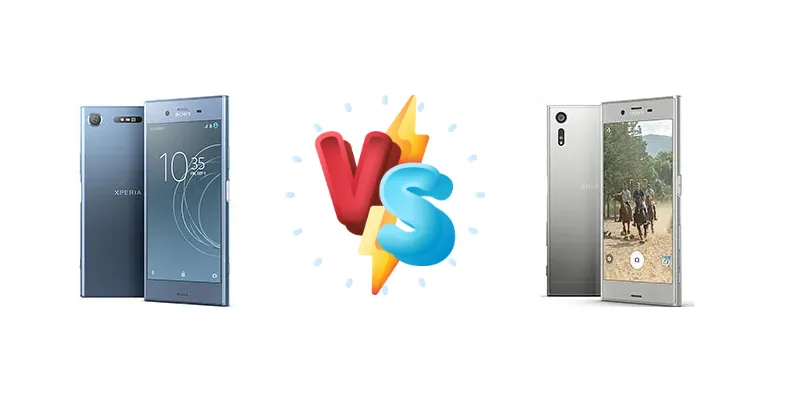
Sony Xperia XZ1 vs. Xperia XZ: Which Sony Flagship Reigns Supreme?
| Phones Images | |||||
|---|---|---|---|---|---|
|
🏆 Quick Verdict
For most users, the Sony Xperia XZ1 is the superior choice. The Snapdragon 835 delivers a noticeable performance boost over the 820, coupled with slightly improved battery endurance. While the display differences are minimal, the XZ1’s overall refinement makes it the better long-term investment.
| PHONES | ||
|---|---|---|
| Phone Names | Sony Xperia XZ1 | Sony Xperia XZ |
| Network | ||
|---|---|---|
| 2G bands | GSM 850 / 900 / 1800 / 1900 - SIM 1 & SIM 2 (dual-SIM model only) | GSM 850 / 900 / 1800 / 1900 - SIM 1 & SIM 2 (dual-SIM model only) |
| 3G bands | HSDPA 800 / 850 / 900 / 1700(AWS) / 1900 / 2100 - F8341, F8342 | HSDPA 800 / 850 / 900 / 1700(AWS) / 1900 / 2100 - F8331, F8332 |
| 4G bands | 1, 2, 3, 4, 5, 7, 8, 12, 13, 17, 19, 20, 25, 26, 28, 29, 32, 38, 39, 40, 41, 66 - G8341 | 1, 2, 3, 4, 5, 7, 8, 12, 13, 17, 19, 20, 26, 28, 29, 32, 38, 39, 40, 41 - F8331, F8332 |
| Speed | HSPA 42.2/5.76 Mbps, LTE (4CA) Cat16 1024/150 Mbps | HSPA 42.2/5.76 Mbps, LTE (3CA) Cat9 450/50 Mbps |
| Technology | GSM / HSPA / LTE | GSM / HSPA / LTE |
| 1, 2, 3, 4, 5, 7, 8, 12, 13, 17, 20, 25, 29, 38, 40, 41, 66 - G8343 | - | |
| Launch | ||
|---|---|---|
| Announced | 2017, August 31. Released 2017, September 19 | 2016, September 01. Released 2016, October 03 |
| Status | Discontinued | Discontinued |
| Body | ||
|---|---|---|
| Build | Glass front (Gorilla Glass 5), aluminum back, aluminum frame | Glass front (Gorilla Glass 4), aluminum back, aluminum frame |
| Dimensions | 148 x 73.4 x 7.4 mm (5.83 x 2.89 x 0.29 in) | 146 x 72 x 8.1 mm (5.75 x 2.83 x 0.32 in) |
| SIM | · Nano-SIM· Nano-SIM + Nano-SIM | · Nano-SIM· Nano-SIM + Nano-SIM |
| Weight | 155 g (5.47 oz) | 161 g (5.68 oz) |
| IP68 dust/water resistant (up to 1.5m for 30 min) | IP68 dust/water resistant (up to 1.5m for 30 mins) | |
| Display | ||
|---|---|---|
| Protection | Corning Gorilla Glass 5 | Corning Gorilla Glass 4 |
| Resolution | 1080 x 1920 pixels, 16:9 ratio (~424 ppi density) | 1080 x 1920 pixels, 16:9 ratio (~424 ppi density) |
| Size | 5.2 inches, 74.5 cm2 (~68.6% screen-to-body ratio) | 5.2 inches, 74.5 cm2 (~70.9% screen-to-body ratio) |
| Type | IPS LCD, HDR10 | IPS LCD |
| Triluminos display X-Reality Engine | Triluminos display X-Reality Engine | |
| Platform | ||
|---|---|---|
| CPU | Octa-core (4x2.45 GHz Kryo & 4x1.9 GHz Kryo) | Quad-core (2x2.15 GHz Kryo & 2x1.6 GHz Kryo) |
| Chipset | Qualcomm MSM8998 Snapdragon 835 (10 nm) | Qualcomm MSM8996 Snapdragon 820 (14 nm) |
| GPU | Adreno 540 | Adreno 530 |
| OS | Android 8.0 (Oreo), upgradable to Android 9.0 (Pie) | Android 6.0.1 (Marshmallow), upgradable to Android 8.0 (Oreo) |
| Memory | ||
|---|---|---|
| Card slot | microSDXC (uses shared SIM slot) - dual SIM model only | microSDXC (uses shared SIM slot) - dual SIM model only |
| Internal | 64GB 4GB RAM | 32GB 3GB RAM, 64GB 3GB RAM |
| UFS 2.1 | eMMC 5.1 | |
| Main Camera | ||
|---|---|---|
| Features | Laser AF, color spectrum sensor, LED flash, panorama, HDR | Laser AF, color spectrum sensor, LED flash, HDR, panorama |
| Single | 19 MP, f/2.0, 25mm (wide), 1/2.3", 1.22µm, predictive PDAF | 23 MP, f/2.0, 24mm (wide), 1/2.3", PDAF |
| Video | 4K@30fps, 1080p@60fps, 1080p@30fps (gyro-EIS), 720p@960fps | 4K@30fps, 1080p@60fps, 1080p@30fps (gyro-EIS) |
| Selfie camera | ||
|---|---|---|
| Features | - | HDR |
| Single | 13 MP, f/2.0, 22mm (wide), 1/3" | 13 MP, f/2.0, 22mm (wide), 1/3" |
| Video | 1080p@30fps (gyro-EIS) | 1080p@30fps |
| Sound | ||
|---|---|---|
| 3.5mm jack | Yes | Yes |
| 35mm jack | Yes | Yes |
| Loudspeaker | Yes, with stereo speakers | Yes, with stereo speakers |
| 24-bit/192kHz audio | 24-bit/192kHz audio | |
| Comms | ||
|---|---|---|
| Bluetooth | 5.0, A2DP, aptX HD, LE | 4.2, A2DP, aptX, LE |
| NFC | Yes | Yes |
| Positioning | GPS, GLONASS, BDS, GALILEO | GPS, GLONASS/ BDS (region dependent) |
| Radio | No | No |
| USB | USB Type-C 3.1, OTG | USB Type-C 2.0, OTG |
| WLAN | Wi-Fi 802.11 a/b/g/n/ac, dual-band, Wi-Fi Direct, DLNA | Wi-Fi 802.11 a/b/g/n/ac, dual-band, Wi-Fi Direct, DLNA |
| Features | ||
|---|---|---|
| Sensors | Fingerprint (side-mounted), accelerometer, gyro, proximity, barometer, compass | Fingerprint (side-mounted), accelerometer, gyro, proximity, barometer, compass |
| Battery | ||
|---|---|---|
| Charging | 18W wired, QC3 | 18W wired, QC3 |
| Stand-by | - | Up to 600 h (2G) / Up to 610 h (3G) |
| Talk time | - | Up to 11 h 40 min (2G) / Up to 17 h 30 min (3G) |
| Type | Li-Ion 2700 mAh, non-removable | Li-Ion 2900 mAh, non-removable |
| Misc | ||
|---|---|---|
| Colors | Black, Warm Silver, Venus Pink, Moonlit Blue | Mineral black, Platinum, Forest blue, Deep pink |
| Models | G8341, G8342, F8341, F8342, G8343, SOV36, SO-01K | F8331, F8332, SO-01J, SOV34, 601SO |
| Price | About 260 EUR | About 230 EUR |
| SAR | - | 0.81 W/kg (head) 0.35 W/kg (body) |
| SAR EU | - | 0.85 W/kg (head) 1.20 W/kg (body) |
| Tests | ||
|---|---|---|
| Audio quality | Noise -93.3dB / Crosstalk -90.2dB | Noise -93.0dB / Crosstalk -93.6dB |
| Battery life | Endurance rating 82h | Endurance rating 72h |
| Camera | Photo / Video | Photo / Video |
| Display | Contrast ratio: 1406 (nominal), 3.765 (sunlight) | Contrast ratio: 1349 (nominal), 3.795 (sunlight) |
| Loudspeaker | Voice 65dB / Noise 68dB / Ring 69dB | Voice 61dB / Noise 65dB / Ring 67dB |
| Performance | GeekBench: 6541 (v4.4), 1527 (v5.1) GFXBench: 25fps (ES 3.1 onscreen) | Basemark OS II 2.0: 2151Basemark X: 29548 |
Sony Xperia XZ1
- Faster processor for smoother performance
- Improved battery endurance (82h vs 72h)
- Slightly better display contrast ratio
- Potentially higher price point
- Refinements are incremental, not revolutionary
Sony Xperia XZ
- More affordable price (likely)
- Still a capable processor for everyday tasks
- Excellent outdoor display visibility
- Older processor with lower performance
- Shorter battery life
- May receive fewer software updates
Display Comparison
Both the Xperia XZ and XZ1 feature displays with comparable sunlight contrast ratios around 3.795, indicating excellent outdoor visibility. However, the XZ1 edges out the XZ with a nominal contrast ratio of 1406 versus 1349. While not a dramatic difference, this suggests slightly deeper blacks and a more vibrant image. Neither phone boasts high refresh rate panels, focusing instead on color accuracy and brightness. The lack of detailed panel specifications (like OLED vs IPS) means we can only assume both utilize Sony’s Triluminos display technology for enhanced color reproduction.
Camera Comparison
Both phones are listed as having 'Photo / Video' capabilities, lacking specific details. Given Sony’s expertise in imaging, both likely deliver strong image quality. However, without sensor size or aperture information, a direct comparison is difficult. The Snapdragon 835 in the XZ1 benefits from an improved image signal processor (ISP), potentially leading to faster image processing, better low-light performance, and more accurate color reproduction. The XZ1’s newer processor could also enable more advanced computational photography features, though specifics are unavailable. We can assume both phones offer similar video recording capabilities, given Sony’s focus on video quality.
Performance
The core difference between these two devices lies in their chipsets. The Xperia XZ1’s Qualcomm MSM8998 Snapdragon 835, built on a 10nm process, represents a significant leap over the XZ’s Snapdragon 820 (14nm). The 835’s octa-core CPU (4x2.45 GHz Kryo & 4x1.9 GHz Kryo) provides substantially more processing power than the XZ’s quad-core configuration (2x2.15 GHz Kryo & 2x1.6 GHz Kryo). This translates to faster app loading times, smoother multitasking, and improved gaming performance. The 10nm process also contributes to better thermal efficiency, potentially reducing throttling during sustained workloads. The XZ1’s architecture is simply more modern and capable.
Battery Life
The Xperia XZ1 boasts an endurance rating of 82 hours, a 10-hour improvement over the XZ’s 72-hour rating. This difference, while not massive, is attributable to the more efficient Snapdragon 835 processor. Both phones support 18W wired charging with Quick Charge 3.0, offering similar charging speeds. The XZ1’s improved efficiency means it can deliver longer usage times on a single charge, making it the better choice for users who prioritize battery life. The 10nm process of the Snapdragon 835 is key to this improvement.
Buying Guide
Buy the Sony Xperia XZ1 if you prioritize performance for demanding tasks like gaming or video editing, and want the longest possible software support lifespan. Buy the Sony Xperia XZ if you are on a tighter budget and value a proven, reliable experience with a still-capable processor, and don't require the absolute latest processing power.