
Samsung Galaxy A54 vs. Sony Xperia XZ1: A Battle of Battery and Modern Efficiency
| Phones Images | |||||
|---|---|---|---|---|---|
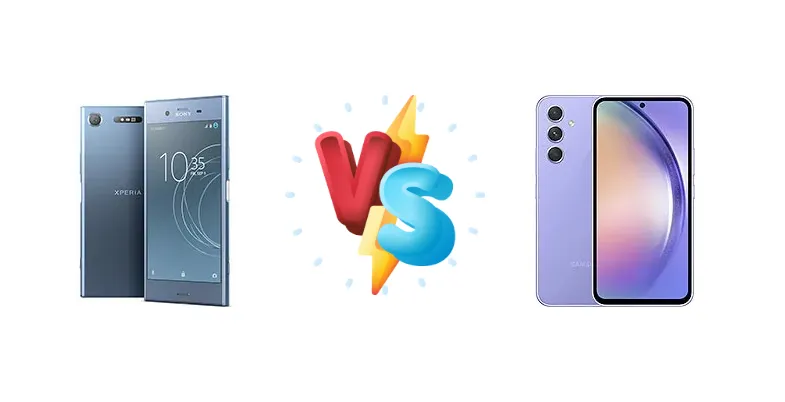
|
🏆 Quick Verdict
For the average user, the Samsung Galaxy A54 is the clear winner. Its significantly superior battery life (119h endurance vs 82h) and more efficient Exynos 1380 chipset outweigh the XZ1’s older Snapdragon 835. While the XZ1 offers a unique form factor, the A54 delivers a more modern and practical experience.
| PHONES | ||
|---|---|---|
| Phone Names | Sony Xperia XZ1 | Samsung Galaxy A54 |
| Network | ||
|---|---|---|
| 2G bands | GSM 850 / 900 / 1800 / 1900 - SIM 1 & SIM 2 (dual-SIM model only) | GSM 850 / 900 / 1800 / 1900 |
| 3G bands | HSDPA 800 / 850 / 900 / 1700(AWS) / 1900 / 2100 - F8341, F8342 | HSDPA 850 / 900 / 1700(AWS) / 1900 / 2100 |
| 4G bands | 1, 2, 3, 4, 5, 7, 8, 12, 13, 17, 19, 20, 25, 26, 28, 29, 32, 38, 39, 40, 41, 66 - G8341 | 1, 2, 3, 4, 5, 7, 8, 12, 17, 20, 26, 28, 32, 38, 40, 41, 66 - International |
| 5G bands | - | 1, 3, 7, 8, 20, 28, 38, 40, 41, 77, 78 SA/NSA/Sub6 - International |
| Speed | HSPA 42.2/5.76 Mbps, LTE (4CA) Cat16 1024/150 Mbps | HSPA, LTE, 5G |
| Technology | GSM / HSPA / LTE | GSM / HSPA / LTE / 5G |
| 1, 2, 3, 4, 5, 7, 8, 12, 13, 17, 20, 25, 29, 38, 40, 41, 66 - G8343 | 25, 41, 66, 71 SA/NSA/Sub6/mmWave - USA | |
| Launch | ||
|---|---|---|
| Announced | 2017, August 31. Released 2017, September 19 | 2023, March 15 |
| Status | Discontinued | Available. Released 2023, March 24 |
| Body | ||
|---|---|---|
| Build | Glass front (Gorilla Glass 5), aluminum back, aluminum frame | Glass front (Gorilla Glass 5), glass back (Gorilla Glass 5), plastic frame |
| Dimensions | 148 x 73.4 x 7.4 mm (5.83 x 2.89 x 0.29 in) | 158.2 x 76.7 x 8.2 mm (6.23 x 3.02 x 0.32 in) |
| SIM | · Nano-SIM· Nano-SIM + Nano-SIM | · Nano-SIM + eSIM· Nano-SIM + Nano-SIM |
| Weight | 155 g (5.47 oz) | 202 g (7.13 oz) |
| IP68 dust/water resistant (up to 1.5m for 30 min) | IP67 dust/water resistant (up to 1m for 30 min) | |
| Display | ||
|---|---|---|
| Protection | Corning Gorilla Glass 5 | Corning Gorilla Glass 5 |
| Resolution | 1080 x 1920 pixels, 16:9 ratio (~424 ppi density) | 1080 x 2340 pixels, 19.5:9 ratio (~403 ppi density) |
| Size | 5.2 inches, 74.5 cm2 (~68.6% screen-to-body ratio) | 6.4 inches, 100.5 cm2 (~82.9% screen-to-body ratio) |
| Type | IPS LCD, HDR10 | Super AMOLED, 120Hz, HDR10+, 1000 nits (HBM) |
| Triluminos display X-Reality Engine | - | |
| Platform | ||
|---|---|---|
| CPU | Octa-core (4x2.45 GHz Kryo & 4x1.9 GHz Kryo) | Octa-core (4x2.4 GHz Cortex-A78 & 4x2.0 GHz Cortex-A55) |
| Chipset | Qualcomm MSM8998 Snapdragon 835 (10 nm) | Exynos 1380 (5 nm) |
| GPU | Adreno 540 | Mali-G68 MP5 |
| OS | Android 8.0 (Oreo), upgradable to Android 9.0 (Pie) | Android 13, up to 4 major Android upgrades, One UI 7 |
| Memory | ||
|---|---|---|
| Card slot | microSDXC (uses shared SIM slot) - dual SIM model only | microSDXC (uses shared SIM slot) |
| Internal | 64GB 4GB RAM | 128GB 4GB RAM, 128GB 6GB RAM, 128GB 8GB RAM, 256GB 6GB RAM, 256GB 8GB RAM |
| UFS 2.1 | - | |
| Main Camera | ||
|---|---|---|
| Features | Laser AF, color spectrum sensor, LED flash, panorama, HDR | LED flash, panorama, HDR |
| Single | 19 MP, f/2.0, 25mm (wide), 1/2.3", 1.22µm, predictive PDAF | 32 MP, f/2.2, 26mm (wide), 1/2.8", 0.8µm |
| Triple | - | 50 MP, f/1.8, 23mm (wide), 1/1.56", 1.0µm, PDAF, OIS 12 MP, f/2.2, 13mm, 123˚ (ultrawide), 1/3.X", 1.12µm 5 MP (macro) |
| Video | 4K@30fps, 1080p@60fps, 1080p@30fps (gyro-EIS), 720p@960fps | 4K@30fps, 1080p@30/60fps, 720p@480fps, gyro-EIS |
| Selfie camera | ||
|---|---|---|
| Single | 13 MP, f/2.0, 22mm (wide), 1/3" | 32 MP, f/2.2, 26mm (wide), 1/2.8", 0.8µm |
| Video | 1080p@30fps (gyro-EIS) | 4K@30fps, 1080p@30/60fps |
| Sound | ||
|---|---|---|
| 3.5mm jack | Yes | No |
| 35mm jack | Yes | No |
| Loudspeaker | Yes, with stereo speakers | Yes, with stereo speakers |
| 24-bit/192kHz audio | - | |
| Comms | ||
|---|---|---|
| Bluetooth | 5.0, A2DP, aptX HD, LE | 5.3, A2DP, LE |
| NFC | Yes | Yes (market/region dependent) |
| Positioning | GPS, GLONASS, BDS, GALILEO | GPS, GLONASS, GALILEO, BDS |
| Radio | No | No |
| USB | USB Type-C 3.1, OTG | USB Type-C 2.0, OTG |
| WLAN | Wi-Fi 802.11 a/b/g/n/ac, dual-band, Wi-Fi Direct, DLNA | Wi-Fi 802.11 a/b/g/n/ac/6, dual-band, Wi-Fi Direct |
| Features | ||
|---|---|---|
| Sensors | Fingerprint (side-mounted), accelerometer, gyro, proximity, barometer, compass | Fingerprint (under display, optical), accelerometer, gyro, compass, barometer (USA only) |
| - | Virtual proximity sensing | |
| Battery | ||
|---|---|---|
| Charging | 18W wired, QC3 | 25W wired |
| Type | Li-Ion 2700 mAh, non-removable | 5000 mAh |
| Misc | ||
|---|---|---|
| Colors | Black, Warm Silver, Venus Pink, Moonlit Blue | Lime, Graphite, Violet, White |
| Models | G8341, G8342, F8341, F8342, G8343, SOV36, SO-01K | SM-A546V, SM-A546U, SM-A546U1, SM-A546B, SM-A546B/DS, SM-A546E, SM-A546E/DS, SM-A5460, SM-A546M, SM-A546M/DS, SM-A546W |
| Price | About 260 EUR | € 210.00 / $ 119.11 / £ 169.95 / ₹ 28,999 |
| SAR | - | 0.81 W/kg (head) 0.67 W/kg (body) |
| SAR EU | - | 0.69 W/kg (head) 1.34 W/kg (body) |
| Tests | ||
|---|---|---|
| Audio quality | Noise -93.3dB / Crosstalk -90.2dB | - |
| Battery life | Endurance rating 82h | Endurance rating 119h |
| Camera | Photo / Video | Photo / Video |
| Display | Contrast ratio: 1406 (nominal), 3.765 (sunlight) | Contrast ratio: Infinite (nominal) |
| Loudspeaker | Voice 65dB / Noise 68dB / Ring 69dB | -26.6 LUFS (Good) |
| Performance | GeekBench: 6541 (v4.4), 1527 (v5.1) GFXBench: 25fps (ES 3.1 onscreen) | AnTuTu: 506678 (v9) GeekBench: 2703 (v5.1), 2797 (v6) GFXBench: 25fps (ES 3.1 onscreen) |
Sony Xperia XZ1
- Compact and ergonomic design
- Premium build quality (for its time)
- Still capable Snapdragon 835 performance
- Significantly shorter battery life
- Older display technology
- Limited software support
Samsung Galaxy A54
- Exceptional battery life (119h endurance)
- Bright and vibrant display (980 nits)
- More efficient Exynos 1380 chipset
- Modern software features and support
- Larger form factor may not suit all users
- Plastic build (compared to XZ1's glass/metal)
- Exynos chip may not match Snapdragon 835 peak performance in short bursts
Display Comparison
The Samsung Galaxy A54’s display is a significant upgrade. While the XZ1 boasts a respectable contrast ratio of 1406 (nominal) and 3.765 in sunlight, the A54 achieves a peak brightness of 980 nits, making it far more visible outdoors. The A54’s ‘Infinite’ contrast ratio suggests a superior OLED panel, offering deeper blacks and more vibrant colors compared to the XZ1’s LCD. The XZ1’s sunlight contrast is good for its age, but the A54’s brightness advantage is undeniable for outdoor usability.
Camera Comparison
Both phones offer photo and video capabilities, but a detailed comparison requires sample images. However, we can infer advantages for the A54 based on modern camera technology. While sensor sizes aren’t specified, Samsung typically employs larger sensors in its A-series phones. The A54 likely benefits from improved image processing algorithms and computational photography features, resulting in better low-light performance and dynamic range. The XZ1’s camera, while capable for its time, lacks the advancements found in contemporary mid-range devices.
Performance
The chipset difference is substantial. The Samsung Galaxy A54’s Exynos 1380 (5nm) is built on a more efficient process node than the Sony Xperia XZ1’s Snapdragon 835 (10nm). This translates to better thermal management and improved power efficiency for the A54. While the Snapdragon 835’s Kryo cores (2.45GHz) are clocked slightly higher than the A54’s Cortex-A78 cores (2.4GHz), the Exynos 1380’s architectural improvements and 5nm process give it an edge in sustained performance and battery conservation. The A54’s CPU architecture is also more modern, with Cortex-A55 cores replacing the XZ1’s older Kryo cores.
Battery Life
Battery life is where the Galaxy A54 truly shines. Its endurance rating of 119 hours dwarfs the XZ1’s 82 hours. This is further supported by the A54’s active use score of 11:15h. The A54 also supports 25W wired charging, faster than the XZ1’s 18W QC3 charging. The Exynos 1380’s 5nm efficiency plays a crucial role, allowing the A54 to deliver significantly longer runtimes on a single charge. While the XZ1’s battery life was good for its era, the A54 sets a new standard for endurance in the mid-range segment.
Buying Guide
Buy the Sony Xperia XZ1 if you prioritize a compact flagship form factor and are comfortable with an older device. Its Snapdragon 835 still provides adequate performance for everyday tasks. Buy the Samsung Galaxy A54 if you value exceptional battery life, a brighter and more modern display, and the benefits of a newer chipset with ongoing software support. The A54 is ideal for users who stream video, game casually, and need a phone that lasts all day.