
Sony Xperia XA2 vs. Google Pixel 7a: A Battle of Battery Life and Modern Processing
| Phones Images | |||||
|---|---|---|---|---|---|
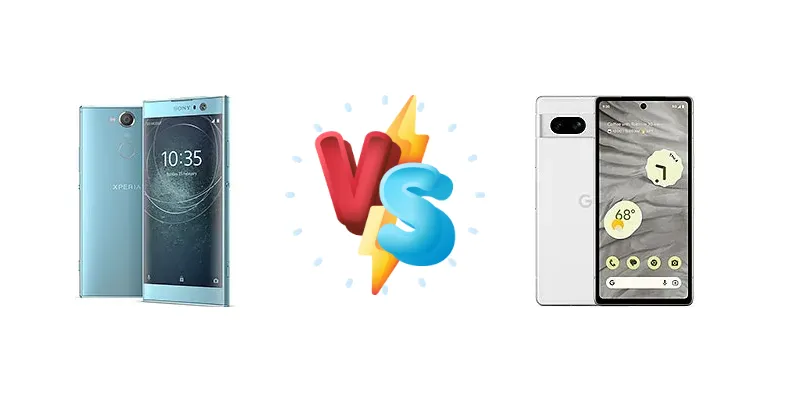
|
🏆 Quick Verdict
For the average user prioritizing camera quality, performance, and software support, the Google Pixel 7a is the clear winner. While the Xperia XA2’s 92-hour endurance rating is impressive, the Pixel 7a’s Tensor G2 offers a vastly superior user experience and future-proofing, despite a shorter battery life.
| PHONES | ||
|---|---|---|
| Phone Names | Sony Xperia XA2 | Google Pixel 7a |
| Network | ||
|---|---|---|
| 2G bands | GSM 850 / 900 / 1800 / 1900 - SIM 1 & SIM 2 (dual-SIM model only) | GSM 850 / 900 / 1800 / 1900 |
| 3G bands | HSDPA 850 / 900 / 1700(AWS) / 1900 / 2100 - H3123 | HSDPA 800 / 850 / 900 / 1700(AWS) / 1900 / 2100 |
| 4G bands | 1, 2, 4, 5, 7, 8, 12, 13, 17, 25, 28, 29, 66 - H3123 | 1, 2, 3, 4, 5, 7, 8, 12, 13, 14, 17, 20, 25, 26, 28, 29, 30, 38, 40, 41, 48, 66, 71 - GWKK3, G0DZQ |
| 5G bands | - | 1, 2, 3, 5, 7, 8, 12, 14, 20, 25, 28, 30, 38, 41, 48, 66, 71, 77, 78 SA/NSA/Sub6 - GWKK3 |
| Speed | HSPA 42.2/5.76 Mbps, LTE (3CA) Cat13 600/150 Mbps | HSPA, LTE, 5G |
| Technology | GSM / HSPA / LTE | GSM / HSPA / LTE / 5G |
| 1, 2, 3, 5, 7, 8, 28, 38, 39, 40, 41 - H3133, H4133 | 1, 2, 3, 5, 7, 8, 12, 20, 25, 28, 38, 40, 41, 66, 75, 76, 77, 78, 79 SA/NSA/Sub6 - GHL1X, G82U8 | |
| Launch | ||
|---|---|---|
| Announced | 2018, January. Released 2018, February | 2023, May 10 |
| Status | Discontinued | Available. Released 2023, May 10 |
| Body | ||
|---|---|---|
| Build | Glass front (Gorilla Glass 4), plastic back, aluminum frame | Glass front (Gorilla Glass 3), aluminum frame, plastic back |
| Dimensions | 142 x 70 x 9.7 mm (5.59 x 2.76 x 0.38 in) | 152 x 72.9 x 9 mm (5.98 x 2.87 x 0.35 in) |
| SIM | · Nano-SIM· Nano-SIM + Nano-SIM | Nano-SIM + eSIM |
| Weight | 171 g (6.03 oz) | 193.5 g (6.84 oz) |
| - | IP67 dust/water resistant (up to 1m for 30 min) | |
| Display | ||
|---|---|---|
| Protection | Corning Gorilla Glass 4 | Corning Gorilla Glass 3 |
| Resolution | 1080 x 1920 pixels, 16:9 ratio (~424 ppi density) | 1080 x 2400 pixels, 20:9 ratio (~429 ppi density) |
| Size | 5.2 inches, 74.5 cm2 (~75.0% screen-to-body ratio) | 6.1 inches, 90.7 cm2 (~81.8% screen-to-body ratio) |
| Type | IPS LCD | OLED, HDR, 90Hz |
| - | Always-on display | |
| Platform | ||
|---|---|---|
| CPU | Octa-core 2.2 GHz Cortex-A53 | Octa-core (2x2.85 GHz Cortex-X1 & 2x2.35 GHz Cortex-A78 & 4x1.80 GHz Cortex-A55) |
| Chipset | Qualcomm SDM630 Snapdragon 630 (14 nm) | Google Tensor G2 (5 nm) |
| GPU | Adreno 508 | Mali-G710 MP7 |
| OS | Android 8.0 (Oreo) | Android 13, upgradable to Android 15, up to 5 major Android upgrades |
| Memory | ||
|---|---|---|
| Card slot | microSDXC (uses shared SIM slot) | No |
| Internal | 32GB 3GB RAM | 128GB 8GB RAM |
| - | UFS 3.1 | |
| Main Camera | ||
|---|---|---|
| Dual | - | 64 MP, f/1.9, 26mm (wide), 1/1.73", 0.8µm, dual pixel PDAF, OIS 13 MP, f/2.2, 120˚ (ultrawide), 1.12µm |
| Features | LED flash, HDR, panorama | Dual-LED flash, Pixel Shift, Auto-HDR, panorama |
| Single | 23 MP, f/2.0, 24mm (wide), 1/2.3", PDAF | - |
| Video | 4K@30fps, 1080p@30fps, stereo sound rec., HDR | 4K@30/60fps, 1080p@30/60/120/240fps, OIS |
| Selfie camera | ||
|---|---|---|
| Features | - | HDR, panorama |
| Single | 8 MP, f/2.4, 1/4.0" | 13 MP, f/2.2, 20mm (ultrawide), 1.12µm |
| Video | 1080p@30fps | 4K@30fps, 1080p@30fps |
| Sound | ||
|---|---|---|
| 3.5mm jack | Yes | No |
| 35mm jack | Yes | No |
| Loudspeaker | Yes | Yes, with stereo speakers |
| 24-bit/192kHz audio | - | |
| Comms | ||
|---|---|---|
| Bluetooth | 5.0, A2DP, aptX HD, LE | 5.3, A2DP, LE |
| NFC | Yes | Yes |
| Positioning | GPS, GLONASS | GPS, GLONASS, GALILEO, BDS, QZSS, NavIC |
| Radio | FM radio | No |
| USB | USB Type-C 2.0, OTG | USB Type-C 3.2 |
| WLAN | Wi-Fi 802.11 a/b/g/n, dual-band, Wi-Fi Direct | Wi-Fi 802.11 a/b/g/n/ac/6e, tri-band |
| Features | ||
|---|---|---|
| Sensors | Fingerprint (rear-mounted), accelerometer, proximity, compass | Fingerprint (under display, optical), accelerometer, gyro, proximity, compass, barometer |
| Battery | ||
|---|---|---|
| Charging | 18W wired, QC3 | 18W wired, PD3.0 7.5W wireless |
| Type | Li-Ion 3300 mAh, non-removable | Li-Po 4385 mAh |
| Misc | ||
|---|---|---|
| Colors | Silver, Black, Blue, Pink | Charcoal, Snow, Sea, Coral |
| Models | H4113, H3113, H4133, H3123 | GWKK3, GHL1X, G0DZQ, G82U8 |
| Price | About 200 EUR | € 179.90 / $ 150.00 / £ 170.00 / ₹ 25,980 |
| Tests | ||
|---|---|---|
| Audio quality | Noise -92.8dB / Crosstalk -87.8dB | - |
| Battery life | Endurance rating 92h | - |
| Camera | Photo / Video | - |
| Display | Contrast ratio: 1327:1 (nominal), 2.938 (sunlight) | - |
| Loudspeaker | Voice 68dB / Noise 72dB / Ring 78dB | - |
| Performance | GeekBench: 4215 (v4.4) GFXBench: 6fps (ES 3.1 onscreen) | - |
Sony Xperia XA2
- Exceptional battery life (92h endurance)
- QC3 fast charging support
- Durable build quality (typical of Sony)
- Outdated processor (Snapdragon 630)
- Limited software support
- Inferior camera compared to modern phones
Google Pixel 7a
- Powerful Google Tensor G2 processor
- Excellent camera with Google’s image processing
- Guaranteed software updates and support
- Shorter battery life (76h endurance)
- Charging speed is not class-leading
- May experience some thermal throttling under heavy load
Display Comparison
The Xperia XA2’s display boasts a contrast ratio of 1327:1 (nominal) and 2.938 under sunlight, suggesting decent outdoor visibility. However, the Pixel 7a’s 1070 nits of peak brightness (measured) significantly surpasses this, offering a much more vibrant and readable experience in bright conditions. While the XA2’s contrast ratio is respectable, the Pixel 7a’s superior brightness and likely more accurate color reproduction (though not specified) provide a more immersive viewing experience. The XA2's panel technology is likely IPS LCD, while the Pixel 7a uses OLED, offering superior blacks and contrast.
Camera Comparison
Both phones offer photo and video capabilities, but the Pixel 7a’s camera system is expected to be far more advanced. While specific sensor details are missing for both, Google’s computational photography prowess, powered by the Tensor G2’s image signal processor, is a major advantage. The Pixel 7a likely features a larger main sensor and more sophisticated image processing algorithms, resulting in better low-light performance, dynamic range, and overall image quality. The XA2’s camera, while adequate for its time, will struggle to compete with the Pixel 7a’s modern capabilities. The absence of details on the XA2's camera suggests it lacks the advanced features found in the Pixel 7a.
Performance
The Qualcomm Snapdragon 630 in the Xperia XA2, built on a 14nm process, is a capable chip for basic tasks but pales in comparison to the Google Tensor G2 (5nm). The Tensor G2’s octa-core configuration – with 2x2.85 GHz Cortex-X1, 2x2.35 GHz Cortex-A78, and 4x1.80 GHz Cortex-A55 cores – delivers significantly faster processing speeds and improved efficiency. The XA2’s Cortex-A53 cores are older architecture and will struggle with demanding applications. The 5nm fabrication process of the Tensor G2 also contributes to better thermal management, reducing the likelihood of performance throttling during sustained use. This translates to a smoother experience for gaming, video editing, and multitasking on the Pixel 7a.
Battery Life
The Xperia XA2’s endurance rating of 92 hours is its standout feature. However, the Pixel 7a, despite a lower endurance rating of 76 hours, benefits from faster charging. Both support 18W wired charging, but the Pixel 7a adds PD3.0 and 7.5W wireless charging, offering greater convenience. The XA2’s QC3 support is still useful, but the Pixel 7a’s broader compatibility and wireless charging options are significant advantages. While the XA2 lasts longer on a single charge, the Pixel 7a’s faster charging can mitigate the difference for many users.
Buying Guide
Buy the Sony Xperia XA2 if you absolutely prioritize maximum battery life above all else and are comfortable with an older device lacking the latest software updates. It’s ideal for users who frequently find themselves away from a charger for extended periods. Buy the Google Pixel 7a if you value a modern camera system, smooth performance for everyday tasks and gaming, and guaranteed software support, even if it means sacrificing some battery endurance.