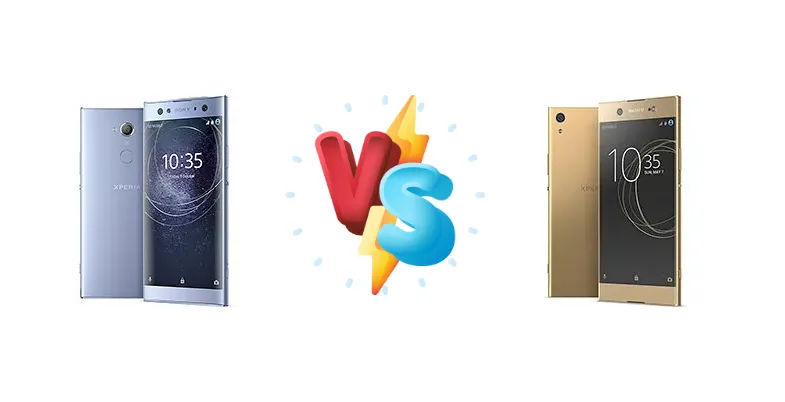
The Sony Xperia XA series offered a unique blend of features, particularly focusing on camera capabilities and battery life. The XA1 Ultra and XA2 Ultra were key contenders in this lineup. Let's dive into a head-to-head comparison to see which phone holds up best today.
🏆 Quick Verdict
The Xperia XA2 Ultra edges out the XA1 Ultra thanks to its significantly better battery life and slightly improved chipset. While both offer excellent displays, the XA2 Ultra's Snapdragon 630 provides a more responsive experience, making it the overall winner for most users.
| Network |
|---|
| 2G bands | GSM 850 / 900 / 1800 / 1900 - SIM 1 & SIM 2 (dual-SIM model only) | GSM 850 / 900 / 1800 / 1900 - SIM 1 & SIM 2 (G3212, G3226) |
| 3G bands | HSDPA 850 / 900 / 1900 / 2100 - H3213, H4213, H4233 | HSDPA 850 / 900 / 1900 / 2100 - G3221, G3212 |
| 4G bands | 1, 2, 3, 5, 7, 8, 20, 38 - H3213, H4213 | 1, 2, 3, 5, 7, 8, 20 - G3221, G3212 |
| Speed | HSPA 42.2/5.76 Mbps, LTE (3CA) Cat13 600/150 Mbps | HSPA 42.2/5.76 Mbps, LTE (2CA) Cat6 300/50 Mbps |
| Technology | GSM / HSPA / LTE | GSM / HSPA / LTE |
| | - | 1, 3, 5, 7, 8, 28, 38, 39, 40, 41 - G3226 |
| Launch |
|---|
| Announced | 2018, January. Released 2018, February | 2017, February. Released 2017, May |
| Status | Discontinued | Discontinued |
| Body |
|---|
| Build | Glass front (Gorilla Glass 4), plastic back, aluminum frame | Glass front (Gorilla Glass 4), plastic back, aluminum/plastic frame |
| Dimensions | 163 x 80 x 9.5 mm (6.42 x 3.15 x 0.37 in) | 165 x 79 x 8.1 mm (6.50 x 3.11 x 0.32 in) |
| SIM | · Nano-SIM· Nano-SIM + Nano-SIM | · Nano-SIM (G3221, G3223)· Nano-SIM + Nano-SIM (G3212, G3226) |
| Weight | 221 g (7.80 oz) | 188 g (6.63 oz) |
| Display |
|---|
| Protection | Corning Gorilla Glass 4 | Corning Gorilla Glass 4 |
| Resolution | 1080 x 1920 pixels, 16:9 ratio (~367 ppi density) | 1080 x 1920 pixels, 16:9 ratio (~367 ppi density) |
| Size | 6.0 inches, 99.2 cm2 (~76.1% screen-to-body ratio) | 6.0 inches, 99.2 cm2 (~76.1% screen-to-body ratio) |
| Type | IPS LCD | IPS LCD |
| Platform |
|---|
| CPU | Octa-core 2.2 GHz Cortex-A53 | Octa-core (4x2.3 GHz Cortex-A53 & 4x1.6 GHz Cortex-A53) |
| Chipset | Qualcomm SDM630 Snapdragon 630 (14 nm) | Mediatek MT6757 Helio P20 (16 nm) |
| GPU | Adreno 508 | Mali-T880MP2 |
| OS | Android 8.0 (Oreo), upgradable to Android 9.0 (Pie) | Android 7.0 (Nougat), upgradable to Android 8.0 (Oreo) |
| Memory |
|---|
| Card slot | microSDXC (dedicated slot) | microSDXC (dedicated slot) |
| Internal | 32GB 4GB RAM, 64GB 4GB RAM | 32GB 4GB RAM, 64GB 4GB RAM |
| Main Camera |
|---|
| Features | LED flash, HDR, panorama | LED flash, HDR, panorama |
| Single | 23 MP, f/2.0, 24mm (wide), 1/2.3", PDAF | 23 MP, f/2.0, 24mm (wide), 1/2.3", PDAF |
| Video | 4K@30fps, 1080p@30fps, stereo sound rec., HDR | 1080p@30fps, stereo sound rec., HDR |
| Selfie camera |
|---|
| Dual | 16 MP, f/2.0, 23mm (wide), 1/2.6", OIS, AF
8 MP, f/2.4, 1/4.0" | - |
| Features | - | LED flash |
| Single | - | 16 MP, f/2.0, 23mm (wide), 1/2.6", OIS, AF |
| Video | 1080p@30ps | 1080p@30fps |
| Sound |
|---|
| 3.5mm jack | Yes | Yes |
| 35mm jack | Yes | Yes |
| Loudspeaker | Yes | Yes |
| Comms |
|---|
| Bluetooth | 5.0, A2DP, aptX HD, LE | 4.2, A2DP, aptX, LE |
| NFC | Yes | Yes |
| Positioning | GPS, GLONASS | GPS, GLONASS |
| Radio | FM radio | FM radio |
| USB | USB Type-C 2.0, OTG | USB Type-C 2.0, OTG |
| WLAN | Wi-Fi 802.11 a/b/g/n/ac, dual-band, Wi-Fi Direct | Wi-Fi 802.11 a/b/g/n, dual-band, Wi-Fi Direct |
| Features |
|---|
| Sensors | Fingerprint (rear-mounted), accelerometer, proximity, compass | Accelerometer, proximity, compass |
| Battery |
|---|
| Charging | 18W wired, QC3 | 10W wired |
| Stand-by | - | Up to 658 h (2G) / Up to 708 h (3G) |
| Talk time | - | Up to 13 h (2G) / Up to 12 h (3G) |
| Type | Li-Ion 3580 mAh, non-removable | Li-Ion 2700 mAh, non-removable |
| Misc |
|---|
| Colors | Silver, Black, Blue, Gold | White, Black, Gold, Pink |
| Models | H4213, H4233, H3213, H3223 | G3226, G3221, G3212, G3223 |
| Price | About 260 EUR | About 250 EUR |
| Tests |
|---|
| Audio quality |
Noise -67.7dB / Crosstalk -92.7dB |
Noise -93.9dB / Crosstalk -91.3dB |
| Battery life | Endurance rating 100h |
Endurance rating 68h
|
| Camera |
Photo / Video |
Photo / Video |
| Display |
Contrast ratio: 1562:1 (nominal), 3.445 (sunlight) |
Contrast ratio: 1579 (nominal), 3.597 (sunlight) |
| Loudspeaker |
Voice 68dB / Noise 73dB / Ring 80dB |
Voice 68dB / Noise 71dB / Ring 81dB
|
| Performance |
AnTuTu: 89110 (v7)
GeekBench: 4198 (v4.4)
GFXBench: 6fps (ES 3.1 onscreen) |
GeekBench: 3807 (v4.4)
GFXBench: 4fps (ES 3.1 onscreen) |
Sony Xperia XA2 Ultra
- Significantly better battery life
- Slightly faster chipset (Snapdragon 630)
- Good display quality
- QC3 fast charging
- Older model, potentially harder to find new
- Camera performance may be dated compared to modern phones
Sony Xperia XA1 Ultra
- Slightly brighter display (marginally)
- Potentially more affordable on the used market
- Decent camera for its time
- Significantly shorter battery life
- Less powerful chipset (Helio P20)
- Slower charging (10W)
Display Comparison
Both phones feature vibrant OLED displays with excellent contrast ratios. The XA1 Ultra boasts a nominal contrast ratio of 1579:1 and a sunlight readability score of 3.597, slightly surpassing the XA2 Ultra's 1562:1 and 3.445. However, the difference is minimal and likely imperceptible in most real-world scenarios. Both offer crisp visuals and good color reproduction.
Camera Comparison
Both phones feature capable cameras for their time. Detailed camera specifications are missing, but both are marketed as 'Photo / Video' capable. The XA2 Ultra likely benefits from the slightly more modern chipset, potentially leading to marginally better image processing. However, both phones are expected to deliver decent image quality in good lighting conditions, with potential struggles in low light.
Performance
The XA2 Ultra utilizes a Qualcomm SDM630 Snapdragon 630 chipset, a step up from the XA1 Ultra's Mediatek MT6757 Helio P20. The Snapdragon 630 generally offers better overall performance and efficiency. While both have octa-core CPUs, the Snapdragon's architecture and Qualcomm's optimization often result in a smoother user experience, especially when multitasking or running demanding apps. The XA1 Ultra's CPU configuration (4x2.3 GHz & 4x1.6 GHz) is a decent attempt at balancing performance and power consumption, but it doesn't quite match the Snapdragon's capabilities.
Battery Life
This is where the XA2 Ultra truly shines. It boasts an impressive endurance rating of 100 hours, significantly exceeding the XA1 Ultra's 68 hours. This difference translates to considerably longer usage times between charges, making the XA2 Ultra a clear winner for battery-conscious users.
Buying Guide
Who should buy the Sony Xperia XA2 Ultra? Users prioritizing long battery life and a slightly smoother performance will appreciate the XA2 Ultra. Who should buy the Sony Xperia XA1 Ultra? Those seeking a slightly brighter display and a more budget-friendly option (if found used) might consider the XA1 Ultra, but be aware of the battery limitations.
Frequently Asked Questions
❓ Is the Xperia XA2 Ultra worth buying in 2024?
It depends. If you prioritize battery life and a decent performance for basic tasks, it can still be a viable option, especially if found at a low price. However, consider that it's an older device and won't receive the latest software updates.
❓ Which phone has the better camera?
While detailed camera specs are lacking, the Xperia XA2 Ultra likely has a slight edge due to its more modern chipset and image processing capabilities.