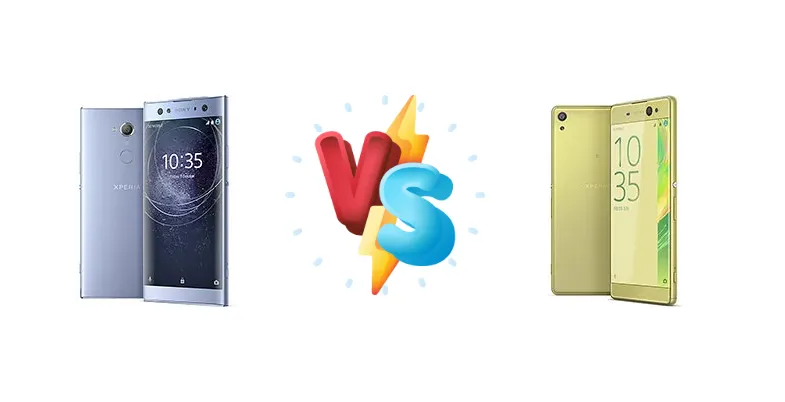
The Sony Xperia XA series offered a unique blend of features, particularly focusing on camera capabilities and impressive battery life. But which of these two models, the XA2 Ultra and the XA Ultra, stands out as the better choice? Let's dive into a comprehensive comparison to help you decide.
🏆 Quick Verdict
The Xperia XA2 Ultra clearly wins thanks to its significantly longer battery life (100h vs 55h), superior sunlight display performance (3.445 vs 2.906), and a more modern Snapdragon 630 chipset. While both offer solid camera performance, the XA2 Ultra's overall package is more compelling.
| Network |
|---|
| 2G bands | GSM 850 / 900 / 1800 / 1900 - SIM 1 & SIM 2 (dual-SIM model only) | GSM 850 / 900 / 1800 / 1900 - SIM 1 & SIM 2 (dual-SIM model only) |
| 3G bands | HSDPA 850 / 900 / 1900 / 2100 - H3213, H4213, H4233 | HSDPA 850 / 900 / 1900 / 2100 - F3211, F3215, F3212, F3216 |
| 4G bands | 1, 2, 3, 5, 7, 8, 20, 38 - H3213, H4213 | 1, 2, 3, 5, 7, 8, 20 - F3211, F3212 |
| Speed | HSPA 42.2/5.76 Mbps, LTE (3CA) Cat13 600/150 Mbps | HSPA 42.2/5.76 Mbps, LTE Cat4 150/50 Mbps |
| Technology | GSM / HSPA / LTE | GSM / HSPA / LTE |
| | - | 1, 3, 5, 7, 8, 28, 38, 39, 40, 41 - F3215, F3216 |
| Launch |
|---|
| Announced | 2018, January. Released 2018, February | 2016, May. Released 2016, July |
| Status | Discontinued | Discontinued |
| Body |
|---|
| Build | Glass front (Gorilla Glass 4), plastic back, aluminum frame | Glass front, plastic back, aluminum frame |
| Dimensions | 163 x 80 x 9.5 mm (6.42 x 3.15 x 0.37 in) | 164 x 79 x 8.4 mm (6.46 x 3.11 x 0.33 in) |
| SIM | · Nano-SIM· Nano-SIM + Nano-SIM | · Nano-SIM· Nano-SIM + Nano-SIM |
| Weight | 221 g (7.80 oz) | 202 g (7.13 oz) |
| Display |
|---|
| Protection | Corning Gorilla Glass 4 | Scratch-resistant glass |
| Resolution | 1080 x 1920 pixels, 16:9 ratio (~367 ppi density) | 1080 x 1920 pixels, 16:9 ratio (~367 ppi density) |
| Size | 6.0 inches, 99.2 cm2 (~76.1% screen-to-body ratio) | 6.0 inches, 99.2 cm2 (~76.6% screen-to-body ratio) |
| Type | IPS LCD | IPS LCD |
| Platform |
|---|
| CPU | Octa-core 2.2 GHz Cortex-A53 | Octa-core (4x2.0 GHz Cortex-A53 & 4x1.0 GHz Cortex-A53) |
| Chipset | Qualcomm SDM630 Snapdragon 630 (14 nm) | Mediatek MT6755 Helio P10 (28 nm) |
| GPU | Adreno 508 | Mali-T860MP2 |
| OS | Android 8.0 (Oreo), upgradable to Android 9.0 (Pie) | Android 6.0.1 (Marshmallow), upgradable to 7.0 (Nougat) |
| Memory |
|---|
| Card slot | microSDXC (dedicated slot) | microSDXC (dedicated slot) |
| Internal | 32GB 4GB RAM, 64GB 4GB RAM | 16GB 3GB RAM |
| | - | eMMC 5.1 |
| Main Camera |
|---|
| Features | LED flash, HDR, panorama | LED flash, HDR, panorama |
| Single | 23 MP, f/2.0, 24mm (wide), 1/2.3", PDAF | 21.5 MP, f/2.2, 1/2.4", 1/2.4", PDAF |
| Video | 4K@30fps, 1080p@30fps, stereo sound rec., HDR | 1080p@30fps, HDR |
| Selfie camera |
|---|
| Dual | 16 MP, f/2.0, 23mm (wide), 1/2.6", OIS, AF
8 MP, f/2.4, 1/4.0" | - |
| Features | - | LED flash |
| Single | - | 16 MP, f/2.0, 23mm (wide), 1/2.6", OIS |
| Video | 1080p@30ps | 1080p@30fps |
| Sound |
|---|
| 3.5mm jack | Yes | Yes |
| 35mm jack | Yes | Yes |
| Loudspeaker | Yes | Yes |
| Comms |
|---|
| Bluetooth | 5.0, A2DP, aptX HD, LE | 4.1, A2DP, LE, aptX |
| NFC | Yes | Yes |
| Positioning | GPS, GLONASS | GPS, GLONASS |
| Radio | FM radio | FM radio, RDS |
| USB | USB Type-C 2.0, OTG | microUSB 2.0, OTG |
| WLAN | Wi-Fi 802.11 a/b/g/n/ac, dual-band, Wi-Fi Direct | Wi-Fi 802.11 a/b/g/n, Wi-Fi Direct |
| Features |
|---|
| Sensors | Fingerprint (rear-mounted), accelerometer, proximity, compass | Accelerometer, proximity, compass |
| Battery |
|---|
| Charging | 18W wired, QC3 | - |
| Music play | - | Up to 65 h |
| Stand-by | - | Up to 558 h (2G) / Up to 708 h (3G) |
| Talk time | - | Up to 13 h (2G) / Up to 12 h (3G) |
| Type | Li-Ion 3580 mAh, non-removable | Li-Ion 2700 mAh, non-removable |
| Misc |
|---|
| Colors | Silver, Black, Blue, Gold | White, Graphite Black, Lime Gold |
| Models | H4213, H4233, H3213, H3223 | F3212, F3216, F3211, F3213, F3215 |
| Price | About 260 EUR | About 250 EUR |
| SAR | - | 1.27 W/kg (head) 0.37 W/kg (body) |
| SAR EU | - | 0.72 W/kg (head) 0.43 W/kg (body) |
| Tests |
|---|
| Audio quality |
Noise -67.7dB / Crosstalk -92.7dB |
Noise -92.9dB / Crosstalk -92.5dB |
| Battery life | Endurance rating 100h |
Endurance rating 55h
|
| Camera |
Photo / Video |
Photo / Video |
| Display |
Contrast ratio: 1562:1 (nominal), 3.445 (sunlight) |
Contrast ratio: 1071 (nominal), 2.906 (sunlight) |
| Loudspeaker |
Voice 68dB / Noise 73dB / Ring 80dB |
Voice 88dB / Noise 79dB / Ring 82dB
|
| Performance |
AnTuTu: 89110 (v7)
GeekBench: 4198 (v4.4)
GFXBench: 6fps (ES 3.1 onscreen) |
Basemark OS II 2.0: 987Basemark X: 6754 |
Sony Xperia XA2 Ultra
- Exceptional battery life (100h)
- Superior sunlight display performance
- More modern and efficient Snapdragon 630 chipset
- Good camera capabilities
- Potentially larger size
- Older model (limited software updates)
Sony Xperia XA Ultra
- Potentially more compact size
- Decent camera capabilities
- May be available at a lower price (used)
- Significantly shorter battery life (55h)
- Inferior sunlight display performance
- Older Mediatek chipset
- Less powerful processor
Display Comparison
The Xperia XA2 Ultra boasts a significantly better display, particularly in direct sunlight. Its contrast ratio of 1562:1 (nominal) and 3.445 (sunlight) outperform the XA Ultra's 1071:1 and 2.906 respectively. This translates to better visibility and more vibrant colors outdoors. Both phones feature similar screen sizes and resolutions, but the XA2 Ultra's superior contrast makes a noticeable difference.
Camera Comparison
Both phones feature capable cameras for their time, but detailed camera comparisons would require more in-depth testing. Generally, the XA2 Ultra's newer chipset and potentially improved image processing algorithms could result in slightly better image quality, especially in low-light conditions. Both offer Photo/Video capabilities.
Performance
The XA2 Ultra's Qualcomm SDM630 Snapdragon 630 chipset is a more modern and efficient processor compared to the XA Ultra's Mediatek MT6755 Helio P10. The Snapdragon 630 generally offers smoother performance and better power efficiency, leading to improved overall responsiveness and multitasking capabilities. While both have octa-core CPUs, the Snapdragon's architecture and manufacturing process give it an edge.
Battery Life
This is where the XA2 Ultra truly shines. Its endurance rating of 100h is double that of the XA Ultra's 55h. This represents a massive difference in real-world usage, allowing the XA2 Ultra to easily last for multiple days on a single charge.
Buying Guide
The Sony Xperia XA2 Ultra is ideal for users prioritizing exceptional battery life, excellent outdoor visibility, and a slightly more powerful processor. The Xperia XA Ultra might appeal to those seeking a slightly more compact device and a potentially lower price point (if found used), but compromises on battery and display.
Frequently Asked Questions
❓ Is the Xperia XA2 Ultra still worth buying in 2024?
If you prioritize battery life and a good display, and don't need the latest features, the XA2 Ultra can still be a viable option, especially if found at a low price. However, be aware that software updates are likely discontinued.
❓ What is the main difference between the XA Ultra and XA2 Ultra?
The primary differences are battery life (XA2 Ultra has significantly more), display performance in sunlight (XA2 Ultra is better), and the chipset (XA2 Ultra uses a more modern Snapdragon).