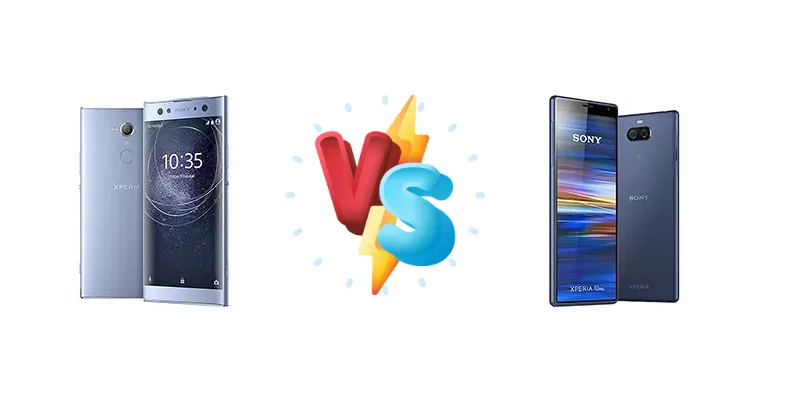
Sony's mid-range lineup has always offered compelling options. Today, we're pitting two popular models against each other: the Xperia XA2 Ultra and the Xperia 10 Plus. Both phones boast unique strengths, but which one ultimately comes out on top?
🏆 Quick Verdict
The Xperia XA2 Ultra edges out the Xperia 10 Plus thanks to its significantly longer battery life and impressive sunlight display performance. While the 10 Plus offers a larger screen, the XA2 Ultra's endurance and display brightness make it the more practical choice for many users.
| Network |
|---|
| 2G bands | GSM 850 / 900 / 1800 / 1900 - SIM 1 & SIM 2 (dual-SIM model only) | GSM 850 / 900 / 1800 / 1900 |
| 3G bands | HSDPA 850 / 900 / 1900 / 2100 - H3213, H4213, H4233 | HSDPA 850 / 900 / 1900 / 2100 - I3213, I4213, I4293 |
| 4G bands | 1, 2, 3, 5, 7, 8, 20, 38 - H3213, H4213 | 1, 2, 3, 5, 7, 8, 20, 28, 32, 38 - I3213, I4213 |
| Speed | HSPA 42.2/5.76 Mbps, LTE (3CA) Cat13 600/150 Mbps | HSPA 42.2/5.76 Mbps, LTE (2CA) Cat12 600/50 Mbps |
| Technology | GSM / HSPA / LTE | GSM / HSPA / LTE |
| | - | 1, 2, 3, 4, 5, 7, 8, 12, 13, 17, 25, 28, 29, 66 - I3223 |
| Launch |
|---|
| Announced | 2018, January. Released 2018, February | 2019, February 25. Released 2019, February 27 |
| Status | Discontinued | Discontinued |
| Body |
|---|
| Build | Glass front (Gorilla Glass 4), plastic back, aluminum frame | Glass front (Gorilla Glass 5), plastic back, plastic frame |
| Dimensions | 163 x 80 x 9.5 mm (6.42 x 3.15 x 0.37 in) | 167 x 73 x 8.3 mm (6.57 x 2.87 x 0.33 in) |
| SIM | · Nano-SIM· Nano-SIM + Nano-SIM | · Nano-SIM· Nano-SIM + Nano-SIM |
| Weight | 221 g (7.80 oz) | 180 g (6.35 oz) |
| Display |
|---|
| Protection | Corning Gorilla Glass 4 | Corning Gorilla Glass 5 |
| Resolution | 1080 x 1920 pixels, 16:9 ratio (~367 ppi density) | 1080 x 2520 pixels, 21:9 ratio (~422 ppi density) |
| Size | 6.0 inches, 99.2 cm2 (~76.1% screen-to-body ratio) | 6.5 inches, 98.7 cm2 (~81.0% screen-to-body ratio) |
| Type | IPS LCD | IPS LCD |
| Platform |
|---|
| CPU | Octa-core 2.2 GHz Cortex-A53 | Octa-core (4x1.8 GHz Kryo 260 Gold & 4x1.6 GHz Kryo 260 Silver) |
| Chipset | Qualcomm SDM630 Snapdragon 630 (14 nm) | Qualcomm SDM636 Snapdragon 636 (14 nm) |
| GPU | Adreno 508 | Adreno 509 |
| OS | Android 8.0 (Oreo), upgradable to Android 9.0 (Pie) | Android 9.0 (Pie) |
| Memory |
|---|
| Card slot | microSDXC (dedicated slot) | microSDXC (uses shared SIM slot) |
| Internal | 32GB 4GB RAM, 64GB 4GB RAM | 64GB 4GB RAM, 64GB 6GB RAM |
| | - | eMMC 5.1 |
| Main Camera |
|---|
| Dual | - | 12 MP, f/1.8, 27mm (wide), 1/2.8", 1.25µm, PDAF
8 MP, f/2.4, 53mm (telephoto), 1/4.0", 1.12µm, PDAF, 2x optical zoom |
| Features | LED flash, HDR, panorama | LED flash, HDR, panorama |
| Single | 23 MP, f/2.0, 24mm (wide), 1/2.3", PDAF | - |
| Video | 4K@30fps, 1080p@30fps, stereo sound rec., HDR | 4K@30fps, 1080p@30fps |
| Selfie camera |
|---|
| Dual | 16 MP, f/2.0, 23mm (wide), 1/2.6", OIS, AF
8 MP, f/2.4, 1/4.0" | - |
| Features | - | HDR |
| Single | - | 8 MP, f/2.0, 24mm (wide), 1/4.0", 1.12µm |
| Video | 1080p@30ps | 1080p@30fps |
| Sound |
|---|
| 3.5mm jack | Yes | Yes |
| 35mm jack | Yes | Yes |
| Loudspeaker | Yes | Yes |
| | - | 24-bit/192kHz audio
|
| Comms |
|---|
| Bluetooth | 5.0, A2DP, aptX HD, LE | 5.0, A2DP, LE, aptX HD |
| NFC | Yes | Yes |
| Positioning | GPS, GLONASS | GPS, GLONASS |
| Radio | FM radio | FM radio |
| USB | USB Type-C 2.0, OTG | USB Type-C 2.0, OTG |
| WLAN | Wi-Fi 802.11 a/b/g/n/ac, dual-band, Wi-Fi Direct | Wi-Fi 802.11 a/b/g/n/ac, dual-band, Wi-Fi Direct |
| Features |
|---|
| Sensors | Fingerprint (rear-mounted), accelerometer, proximity, compass | Fingerprint (side-mounted), accelerometer, proximity, compass |
| Battery |
|---|
| Charging | 18W wired, QC3 | 18W wired, PD, QC3 |
| Type | Li-Ion 3580 mAh, non-removable | Li-Ion 3000 mAh, non-removable |
| Misc |
|---|
| Colors | Silver, Black, Blue, Gold | Black, Navy, Silver, Gold |
| Models | H4213, H4233, H3213, H3223 | I3213, I4213, I4293, I3223 |
| Price | About 260 EUR | About 560 EUR |
| Tests |
|---|
| Audio quality |
Noise -67.7dB / Crosstalk -92.7dB |
Noise -92.4dB / Crosstalk -96.7dB |
| Battery life | Endurance rating 100h |
Endurance rating 78h
|
| Camera |
Photo / Video |
Photo / Video |
| Display |
Contrast ratio: 1562:1 (nominal), 3.445 (sunlight) |
Contrast ratio: 1530:1 (nominal) |
| Loudspeaker |
Voice 68dB / Noise 73dB / Ring 80dB |
-28.8 LUFS (Average)
|
| Performance |
AnTuTu: 89110 (v7)
GeekBench: 4198 (v4.4)
GFXBench: 6fps (ES 3.1 onscreen) |
AnTuTu: 120573 (v7), 147163 (v8)
GeekBench: 4780 (v4.4), 1238 (v5.1)
GFXBench: 5fps (ES 3.1 onscreen) |
Sony Xperia XA2 Ultra
- Exceptional battery life (100h)
- Excellent sunlight display performance
- Compact design
- Decent camera
- Older chipset
- Design can feel dated
- No NFC (in some regions)
Sony Xperia 10 Plus
- Larger 6.5-inch display
- Slightly newer chipset (SDM636)
- PD Charging Support
- Slim bezels
- Shorter battery life (78h)
- Sunlight display performance not as good as XA2 Ultra
- Design is somewhat bland
Display Comparison
Both phones feature LCD displays with a respectable contrast ratio (1562:1 for the XA2 Ultra, 1530:1 for the 10 Plus). However, the XA2 Ultra shines in direct sunlight with a reported 3.445 contrast ratio, making it far more usable outdoors. The Xperia 10 Plus has a larger 6.5-inch display compared to the XA2 Ultra's 6-inch screen, offering more immersive viewing.
Camera Comparison
Camera performance is comparable on both devices, offering standard photo and video capabilities. The XA2 Ultra's camera is known for its decent image quality in good lighting conditions. The Xperia 10 Plus's camera also delivers acceptable results, but may struggle slightly more in low light. Specific camera features and software optimizations differ between the two models.
Performance
The Xperia XA2 Ultra utilizes a Qualcomm SDM630 Snapdragon 630, an octa-core processor. The Xperia 10 Plus features a Qualcomm SDM636 Snapdragon 636, also an octa-core but with a slightly different core configuration (4x1.8 GHz Kryo 260 Gold & 4x1.6 GHz Kryo 260 Silver). While both are capable mid-range processors, the 636 generally offers a small performance boost, especially in graphics-intensive tasks. Real-world performance is generally smooth on both devices for everyday use.
Battery Life
This is where the XA2 Ultra truly stands out. It boasts an exceptional endurance rating of 100 hours, significantly surpassing the Xperia 10 Plus's 78 hours. This difference translates to noticeably longer battery life for the XA2 Ultra, making it a champion for users who need a phone that can last for days.
Buying Guide
The Sony Xperia XA2 Ultra is ideal for users prioritizing battery life and excellent outdoor visibility. It's a great choice for those who need a phone that can last through multiple days of moderate use. The Xperia 10 Plus is better suited for users who value a larger screen for media consumption and gaming, even if it means sacrificing some battery longevity.
Frequently Asked Questions
❓ Which phone has a better camera?
Both phones offer decent camera performance, but neither excels significantly. The Xperia XA2 Ultra and Xperia 10 Plus provide comparable image quality in good lighting conditions.
❓ Is the Xperia 10 Plus worth it for the larger screen?
If a larger screen is your top priority for media consumption or gaming, the Xperia 10 Plus is a viable option. However, be prepared for shorter battery life compared to the XA2 Ultra.