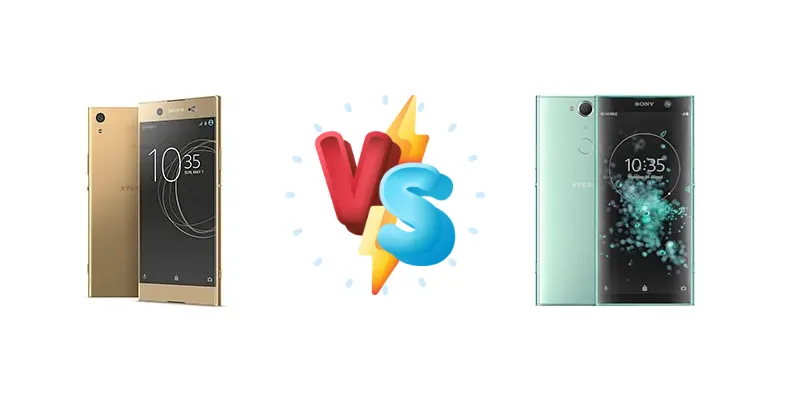
The Sony Xperia XA1 Ultra and XA2 Plus were both mid-range contenders offering a premium feel at a reasonable price. But which one reigns supreme? This comprehensive comparison dives deep into their specs, performance, and features to help you decide which phone is right for you.
🏆 Quick Verdict
The Xperia XA2 Plus emerges as the clear winner thanks to its significantly improved battery life, faster charging (QC3), and a more modern chipset. While the XA1 Ultra boasts a slightly better sunlight display contrast, the XA2 Plus's overall enhancements make it the better choice.
| Network |
|---|
| 2G bands | GSM 850 / 900 / 1800 / 1900 - SIM 1 & SIM 2 (G3212, G3226) | GSM 850 / 900 / 1800 / 1900 |
| 3G bands | HSDPA 850 / 900 / 1900 / 2100 - G3221, G3212 | HSDPA 850 / 900 / 1900 / 2100 |
| 4G bands | 1, 2, 3, 5, 7, 8, 20 - G3221, G3212 | 1, 2, 3, 5, 7, 8, 20, 38 - H3413, H4413 |
| Speed | HSPA 42.2/5.76 Mbps, LTE (2CA) Cat6 300/50 Mbps | HSPA 42.2/5.76 Mbps, LTE (3CA) Cat12 600/150 Mbps |
| Technology | GSM / HSPA / LTE | GSM / HSPA / LTE |
| | 1, 3, 5, 7, 8, 28, 38, 39, 40, 41 - G3226 | 1, 2, 3, 5, 7, 8, 28, 38, 39, 40, 41 - H4493 |
| Launch |
|---|
| Announced | 2017, February. Released 2017, May | 2018, July. Released 2018, September |
| Status | Discontinued | Discontinued |
| Body |
|---|
| Build | Glass front (Gorilla Glass 4), plastic back, aluminum/plastic frame | Glass front (Gorilla Glass 5), plastic back, aluminum frame |
| Dimensions | 165 x 79 x 8.1 mm (6.50 x 3.11 x 0.32 in) | 157 x 75 x 9.6 mm (6.18 x 2.95 x 0.38 in) |
| SIM | · Nano-SIM (G3221, G3223)· Nano-SIM + Nano-SIM (G3212, G3226) | · Nano-SIM· Nano-SIM + Nano-SIM |
| Weight | 188 g (6.63 oz) | 205 g (7.23 oz) |
| Display |
|---|
| Protection | Corning Gorilla Glass 4 | Corning Gorilla Glass 5 |
| Resolution | 1080 x 1920 pixels, 16:9 ratio (~367 ppi density) | 1080 x 2160 pixels, 18:9 ratio (~402 ppi density) |
| Size | 6.0 inches, 99.2 cm2 (~76.1% screen-to-body ratio) | 6.0 inches, 92.9 cm2 (~78.9% screen-to-body ratio) |
| Type | IPS LCD | IPS LCD |
| Platform |
|---|
| CPU | Octa-core (4x2.3 GHz Cortex-A53 & 4x1.6 GHz Cortex-A53) | Octa-core 2.2 GHz Cortex-A53 |
| Chipset | Mediatek MT6757 Helio P20 (16 nm) | Qualcomm SDM630 Snapdragon 630 (14 nm) |
| GPU | Mali-T880MP2 | Adreno 508 |
| OS | Android 7.0 (Nougat), upgradable to Android 8.0 (Oreo) | Android 8.0 (Oreo) |
| Memory |
|---|
| Card slot | microSDXC (dedicated slot) | microSDXC (uses shared SIM slot) |
| Internal | 32GB 4GB RAM, 64GB 4GB RAM | 32GB 4GB RAM, 64GB 6GB RAM |
| Main Camera |
|---|
| Features | LED flash, HDR, panorama | LED flash, HDR, panorama |
| Single | 23 MP, f/2.0, 24mm (wide), 1/2.3", PDAF | 23 MP, f/2.0, 24mm (wide), 1/2.3", PDAF |
| Video | 1080p@30fps, stereo sound rec., HDR | 4K@30fps, 1080p@30fps, stereo sound rec., HDR |
| Selfie camera |
|---|
| Features | LED flash | - |
| Single | 16 MP, f/2.0, 23mm (wide), 1/2.6", OIS, AF | 8 MP, f/2.4, 1/4.0" |
| Video | 1080p@30fps | 1080p@30fps |
| Sound |
|---|
| 3.5mm jack | Yes | Yes |
| 35mm jack | Yes | Yes |
| Loudspeaker | Yes | Yes |
| | - | 24-bit/192kHz audio
|
| Comms |
|---|
| Bluetooth | 4.2, A2DP, aptX, LE | 5.0, A2DP, aptX HD, LE |
| NFC | Yes | Yes |
| Positioning | GPS, GLONASS | GPS, GLONASS |
| Radio | FM radio | FM radio |
| USB | USB Type-C 2.0, OTG | USB Type-C 2.0, OTG |
| WLAN | Wi-Fi 802.11 a/b/g/n, dual-band, Wi-Fi Direct | Wi-Fi 802.11 a/b/g/n, Wi-Fi Direct |
| Features |
|---|
| Sensors | Accelerometer, proximity, compass | Fingerprint (rear-mounted), accelerometer, proximity, compass |
| Battery |
|---|
| Charging | 10W wired | 18W wired, QC3 |
| Stand-by | Up to 658 h (2G) / Up to 708 h (3G) | - |
| Talk time | Up to 13 h (2G) / Up to 12 h (3G) | - |
| Type | Li-Ion 2700 mAh, non-removable | Li-Ion 3580 mAh, non-removable |
| Misc |
|---|
| Colors | White, Black, Gold, Pink | Silver, Black, Gold, Green |
| Models | G3226, G3221, G3212, G3223 | H4413, H4493, H3413 |
| Price | About 250 EUR | About 240 EUR |
| Tests |
|---|
| Audio quality |
Noise -93.9dB / Crosstalk -91.3dB |
Noise -93.6dB / Crosstalk -93.1dB |
| Battery life |
Endurance rating 68h
|
Endurance rating 104h
|
| Camera |
Photo / Video |
Photo / Video |
| Display |
Contrast ratio: 1579 (nominal), 3.597 (sunlight) |
Contrast ratio: 1522:1 (nominal), 3.445 (sunlight) |
| Loudspeaker |
Voice 68dB / Noise 71dB / Ring 81dB
|
Voice 66dB / Noise 73dB / Ring 79dB
|
| Performance |
GeekBench: 3807 (v4.4)
GFXBench: 4fps (ES 3.1 onscreen) |
AnTuTu: 86374 (v7), 107537 (v8)
GeekBench: 4144 (v4.4), 1018 (v5.1)
GFXBench: 5.1fps (ES 3.1 onscreen) |
Sony Xperia XA1 Ultra
- Excellent sunlight display contrast
- Good build quality
- Decent camera (in good lighting)
- Older chipset
- Slower charging
- Shorter battery life
Sony Xperia XA2 Plus
- Significantly longer battery life
- Faster charging (QC3)
- More modern chipset (Snapdragon 630)
- Improved performance
- Slightly lower sunlight display contrast (though minimal)
Display Comparison
Both phones feature vibrant displays with excellent contrast ratios (1579:1 for XA1 Ultra, 1522:1 for XA2 Plus). The XA1 Ultra edges out the XA2 Plus slightly in sunlight readability (3.597 vs 3.445), making it marginally better for outdoor use. However, the difference is minimal and likely imperceptible to most users.
Camera Comparison
Camera performance is generally comparable between the two devices, both offering decent image quality in good lighting conditions. Low-light performance is a weakness for both. Specific camera specs are not detailed in the provided data, but reviews suggest the XA2 Plus has slightly improved image processing.
Performance
The XA2 Plus's Qualcomm Snapdragon 630 chipset is a noticeable upgrade over the XA1 Ultra's Mediatek Helio P20. The Snapdragon 630 offers better overall performance, smoother multitasking, and improved efficiency. Expect snappier app launches and a more fluid user experience on the XA2 Plus.
Battery Life
This is where the XA2 Plus truly shines. Its endurance rating of 104h significantly surpasses the XA1 Ultra's 68h. Coupled with 18W fast charging (QC3), the XA2 Plus offers a vastly superior battery experience.
Buying Guide
Who should buy the Sony Xperia XA1 Ultra? Users prioritizing exceptional sunlight readability and are comfortable with older hardware. Who should buy the Sony Xperia XA2 Plus? Anyone seeking longer battery life, faster charging, and a more responsive experience with a modern chipset.
Frequently Asked Questions
❓ Is the Xperia XA2 Plus worth the upgrade from the XA1 Ultra?
Yes, the XA2 Plus offers significant improvements in battery life and performance, making it a worthwhile upgrade for most users.
❓ Which phone has the better camera?
Both cameras are decent, but the XA2 Plus likely has slightly improved image processing. Neither excels in low-light conditions.