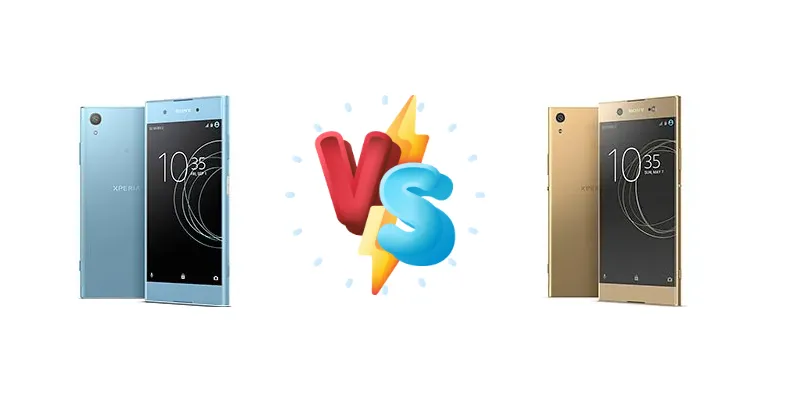
The Sony Xperia XA1 Plus and XA1 Ultra were compelling mid-range options when released, offering a blend of style and functionality. But with both devices now older, which one holds up better? This comprehensive comparison dives deep into their specs, performance, and features to help you decide.
🏆 Quick Verdict
The Xperia XA1 Plus takes the crown thanks to its significantly longer battery life (102h vs 68h). While both share the same chipset and CPU, the XA1 Plus's endurance advantage makes it the more practical choice for users prioritizing all-day power. The XA1 Ultra has a slightly better sunlight display.
| Network |
|---|
| 2G bands | GSM 850 / 900 / 1800 / 1900 - SIM 1 & SIM 2 (dual-SIM model only) | GSM 850 / 900 / 1800 / 1900 - SIM 1 & SIM 2 (G3212, G3226) |
| 3G bands | HSDPA 850 / 900 / 1900 / 2100 - G3421, G3412, G3416, G3426 | HSDPA 850 / 900 / 1900 / 2100 - G3221, G3212 |
| 4G bands | 1, 2, 3, 5, 7, 8, 20 - G3421, G3412 | 1, 2, 3, 5, 7, 8, 20 - G3221, G3212 |
| Speed | HSPA 42.2/5.76 Mbps, LTE Cat4 150/50 Mbps or LTE (2CA) Cat6 300/50 Mbps | HSPA 42.2/5.76 Mbps, LTE (2CA) Cat6 300/50 Mbps |
| Technology | GSM / HSPA / LTE | GSM / HSPA / LTE |
| | 1, 3, 5, 7, 8, 28, 38, 39, 40, 41 - G3416, G3426 | 1, 3, 5, 7, 8, 28, 38, 39, 40, 41 - G3226 |
| Launch |
|---|
| Announced | 2017, August. Released 2017, October | 2017, February. Released 2017, May |
| Status | Discontinued | Discontinued |
| Body |
|---|
| Build | Glass front (Gorilla Glass 4), plastic back, aluminum frame | Glass front (Gorilla Glass 4), plastic back, aluminum/plastic frame |
| Dimensions | 155 x 75 x 8.7 mm (6.10 x 2.95 x 0.34 in) | 165 x 79 x 8.1 mm (6.50 x 3.11 x 0.32 in) |
| SIM | · Nano-SIM· Nano-SIM + Nano-SIM | · Nano-SIM (G3221, G3223)· Nano-SIM + Nano-SIM (G3212, G3226) |
| Weight | 189 g (6.67 oz) | 188 g (6.63 oz) |
| Display |
|---|
| Protection | Corning Gorilla Glass 4 | Corning Gorilla Glass 4 |
| Resolution | 1080 x 1920 pixels, 16:9 ratio (~401 ppi density) | 1080 x 1920 pixels, 16:9 ratio (~367 ppi density) |
| Size | 5.5 inches, 83.4 cm2 (~71.7% screen-to-body ratio) | 6.0 inches, 99.2 cm2 (~76.1% screen-to-body ratio) |
| Type | IPS LCD | IPS LCD |
| Platform |
|---|
| CPU | Octa-core (4x2.3 GHz Cortex-A53 & 4x1.6 GHz Cortex-A53) | Octa-core (4x2.3 GHz Cortex-A53 & 4x1.6 GHz Cortex-A53) |
| Chipset | Mediatek MT6757 Helio P20 (16 nm) | Mediatek MT6757 Helio P20 (16 nm) |
| GPU | Mali-T880MP2 | Mali-T880MP2 |
| OS | Android 7.0 (Nougat), upgradable to Android 8.0 (Oreo) | Android 7.0 (Nougat), upgradable to Android 8.0 (Oreo) |
| Memory |
|---|
| Card slot | microSDXC (dedicated slot) | microSDXC (dedicated slot) |
| Internal | 32GB 3GB RAM, 32GB 4GB RAM | 32GB 4GB RAM, 64GB 4GB RAM |
| Main Camera |
|---|
| Features | LED flash, HDR, panorama | LED flash, HDR, panorama |
| Single | 23 MP, f/2.0, 24mm (wide), 1/2.3", PDAF | 23 MP, f/2.0, 24mm (wide), 1/2.3", PDAF |
| Video | 1080p@30fps, HDR | 1080p@30fps, stereo sound rec., HDR |
| Selfie camera |
|---|
| Features | - | LED flash |
| Single | 8 MP, f/2.0, 23mm (wide), 1/4.0", AF | 16 MP, f/2.0, 23mm (wide), 1/2.6", OIS, AF |
| Video | 1080p@30fps | 1080p@30fps |
| Sound |
|---|
| 3.5mm jack | Yes | Yes |
| 35mm jack | Yes | Yes |
| Loudspeaker | Yes | Yes |
| Comms |
|---|
| Bluetooth | 4.2, A2DP, aptX, LE | 4.2, A2DP, aptX, LE |
| NFC | Yes | Yes |
| Positioning | GPS, GLONASS | GPS, GLONASS |
| Radio | FM radio | FM radio |
| USB | USB Type-C 2.0, OTG | USB Type-C 2.0, OTG |
| WLAN | Wi-Fi 802.11 a/b/g/n, Wi-Fi Direct | Wi-Fi 802.11 a/b/g/n, dual-band, Wi-Fi Direct |
| Features |
|---|
| Sensors | Fingerprint (side-mounted), accelerometer, proximity, compass | Accelerometer, proximity, compass |
| Battery |
|---|
| Charging | 10W wired | 10W wired |
| Stand-by | - | Up to 658 h (2G) / Up to 708 h (3G) |
| Talk time | - | Up to 13 h (2G) / Up to 12 h (3G) |
| Type | Li-Ion 3430 mAh, non-removable | Li-Ion 2700 mAh, non-removable |
| Misc |
|---|
| Colors | Black, Blue, Pink, Gold | White, Black, Gold, Pink |
| Models | G3416, G3412, G3426, G3421, G3423 | G3226, G3221, G3212, G3223 |
| Price | About 150 EUR | About 250 EUR |
| Tests |
|---|
| Audio quality |
Noise -90.6dB / Crosstalk -83.5dB |
Noise -93.9dB / Crosstalk -91.3dB |
| Battery life |
Endurance rating 102h
|
Endurance rating 68h
|
| Camera |
Photo / Video |
Photo / Video |
| Display |
Contrast ratio: 1572 (nominal), 2.93 (sunlight) |
Contrast ratio: 1579 (nominal), 3.597 (sunlight) |
| Loudspeaker |
Voice 88dB / Noise 77dB / Ring 84dB
|
Voice 68dB / Noise 71dB / Ring 81dB
|
| Performance |
AnTuTu: 77232 (v7), 95157 (v8)
GeekBench: 3783 (v4.4), 915 (v5.1)
GFXBench: 4fps (ES 3.1 onscreen) |
GeekBench: 3807 (v4.4)
GFXBench: 4fps (ES 3.1 onscreen) |
Sony Xperia XA1 Plus
- Exceptional battery life (102h)
- Slightly weaker sunlight display compared to XA1 Ultra
- Older chipset
Sony Xperia XA1 Ultra
- Better sunlight display readability
- Potentially slightly better front-facing camera
- Significantly shorter battery life (68h)
- Older chipset
Display Comparison
Both phones feature similar displays with excellent contrast ratios (1572 for both nominal). However, the XA1 Ultra boasts a superior sunlight readability score (3.597 vs 2.93), making it easier to view in direct sunlight. The XA1 Plus's display is still good, but the Ultra has a noticeable edge in outdoor visibility.
Camera Comparison
Camera performance is likely comparable given the shared chipset. Both offer Photo/Video capabilities, but detailed image quality comparisons would require more in-depth testing. Expect decent results in good lighting conditions, but low-light performance will be average. The XA1 Ultra may have a slightly better front-facing camera.
Performance
Both devices are powered by the Mediatek Helio P20 chipset and an octa-core CPU. Performance will be largely similar for everyday tasks and moderate gaming. Don't expect flagship-level speeds, but they're capable enough for typical Android usage. RAM configurations (likely 3GB/4GB for XA1 Plus and 4GB for XA1 Ultra) will influence multitasking performance slightly, with the Ultra potentially having a small advantage.
Battery Life
This is where the XA1 Plus truly shines. Its endurance rating of 102 hours significantly surpasses the XA1 Ultra's 68 hours. This translates to considerably longer battery life, potentially lasting for 3-4 days on a single charge with moderate usage.
Buying Guide
The Sony Xperia XA1 Plus is ideal for users who prioritize battery life above all else and need a phone that can last for multiple days on a single charge. The Xperia XA1 Ultra might appeal to those who value a slightly better display in bright sunlight, but are willing to compromise on battery performance.
Frequently Asked Questions
❓ Are these phones still worth buying in 2024?
Given their age, finding them new is unlikely. Used, they can be a budget option, but consider the lack of software updates and potential battery degradation. The XA1 Plus's battery life remains a strong selling point.
❓ What is the difference in screen size?
The XA1 Plus has a 5.5-inch display, while the XA1 Ultra boasts a larger 6-inch screen. This difference contributes to the XA1 Ultra's slightly better sunlight readability.