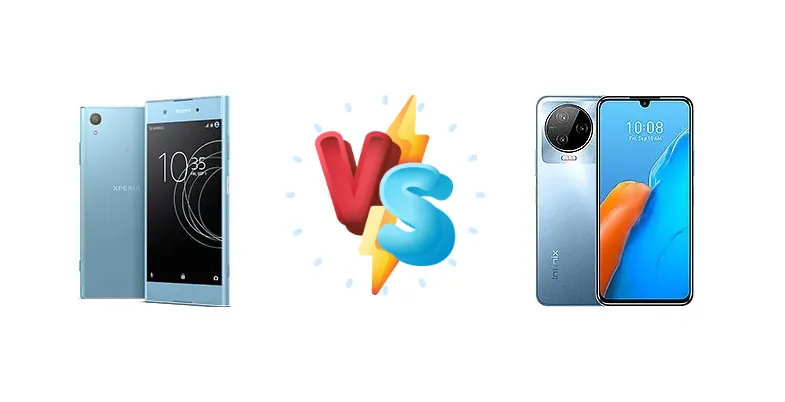
The budget smartphone market is fiercely competitive, offering incredible value for money. Today, we pit the aging but legendary Sony Xperia XA1 Plus against the newer Infinix Note 12 (2023) to see which device reigns supreme. Both promise affordability, but which delivers the better overall experience?
🏆 Quick Verdict
The Infinix Note 12 (2023) takes the crown thanks to its significantly faster processor, faster charging, and more modern features. While the XA1 Plus boasts exceptional battery life, the Note 12's improvements in performance and charging outweigh that advantage for most users.
| Network |
|---|
| 2G bands | GSM 850 / 900 / 1800 / 1900 - SIM 1 & SIM 2 (dual-SIM model only) | GSM 850 / 900 / 1800 / 1900 |
| 3G bands | HSDPA 850 / 900 / 1900 / 2100 - G3421, G3412, G3416, G3426 | HSDPA 850 / 900 / 1700(AWS) / 1900 / 2100 |
| 4G bands | 1, 2, 3, 5, 7, 8, 20 - G3421, G3412 | 1, 2, 3, 4, 5, 7, 8, 20, 28, 38, 40, 41 |
| Speed | HSPA 42.2/5.76 Mbps, LTE Cat4 150/50 Mbps or LTE (2CA) Cat6 300/50 Mbps | HSPA, LTE |
| Technology | GSM / HSPA / LTE | GSM / HSPA / LTE |
| | 1, 3, 5, 7, 8, 28, 38, 39, 40, 41 - G3416, G3426 | 1, 3, 5, 8, 38, 40, 41 |
| Launch |
|---|
| Announced | 2017, August. Released 2017, October | 2022, October 06 |
| Status | Discontinued | Available. Released 2022, October 06 |
| Body |
|---|
| Build | Glass front (Gorilla Glass 4), plastic back, aluminum frame | Glass front, plastic frame, plastic back |
| Dimensions | 155 x 75 x 8.7 mm (6.10 x 2.95 x 0.34 in) | 164.4 x 76.5 x 7.8 mm (6.47 x 3.01 x 0.31 in) |
| SIM | · Nano-SIM· Nano-SIM + Nano-SIM | Nano-SIM + Nano-SIM |
| Weight | 189 g (6.67 oz) | 195 g (6.88 oz) |
| Display |
|---|
| Protection | Corning Gorilla Glass 4 | - |
| Resolution | 1080 x 1920 pixels, 16:9 ratio (~401 ppi density) | 1080 x 2400 pixels, 20:9 ratio (~393 ppi density) |
| Size | 5.5 inches, 83.4 cm2 (~71.7% screen-to-body ratio) | 6.7 inches, 108.4 cm2 (~86.2% screen-to-body ratio) |
| Type | IPS LCD | AMOLED |
| Platform |
|---|
| CPU | Octa-core (4x2.3 GHz Cortex-A53 & 4x1.6 GHz Cortex-A53) | Octa-core (2x2.2 GHz Cortex-A76 & 6x2.0 GHz Cortex-A55) |
| Chipset | Mediatek MT6757 Helio P20 (16 nm) | Mediatek Helio G99 (6 nm) |
| GPU | Mali-T880MP2 | Mali-G57 MC2 |
| OS | Android 7.0 (Nougat), upgradable to Android 8.0 (Oreo) | Android 12, XOS 10.6 |
| Memory |
|---|
| Card slot | microSDXC (dedicated slot) | microSDXC (dedicated slot) |
| Internal | 32GB 3GB RAM, 32GB 4GB RAM | 128GB 8GB RAM, 256GB 8GB RAM |
| Main Camera |
|---|
| Features | LED flash, HDR, panorama | Quad-LED flash, HDR, panorama |
| Single | 23 MP, f/2.0, 24mm (wide), 1/2.3", PDAF | 16 MP, (wide) |
| Triple | - | 50 MP, f/1.6, (wide), PDAF
Auxiliary lenses |
| Video | 1080p@30fps, HDR | 1440p@30fps |
| Selfie camera |
|---|
| Single | 8 MP, f/2.0, 23mm (wide), 1/4.0", AF | 16 MP, (wide) |
| Video | 1080p@30fps | 1440p@30fps |
| Sound |
|---|
| 3.5mm jack | Yes | Yes |
| 35mm jack | Yes | Yes |
| Loudspeaker | Yes | Yes, with dual speakers |
| Comms |
|---|
| Bluetooth | 4.2, A2DP, aptX, LE | Yes |
| NFC | Yes | Yes |
| Positioning | GPS, GLONASS | GPS |
| Radio | FM radio | FM radio |
| USB | USB Type-C 2.0, OTG | USB Type-C 2.0, OTG |
| WLAN | Wi-Fi 802.11 a/b/g/n, Wi-Fi Direct | Wi-Fi 802.11 a/b/g/n/ac, dual-band |
| Features |
|---|
| Sensors | Fingerprint (side-mounted), accelerometer, proximity, compass | Fingerprint (side-mounted), accelerometer, gyro, proximity, compass |
| | - | 24-bit/192kHz audio |
| Battery |
|---|
| Charging | 10W wired | 33W wired |
| Type | Li-Ion 3430 mAh, non-removable | 5000 mAh |
| Misc |
|---|
| Colors | Black, Blue, Pink, Gold | Volcanic Grey, Tuscany Blue, Alpine White |
| Models | G3416, G3412, G3426, G3421, G3423 | X676C |
| Price | About 150 EUR | About 220 EUR |
| Tests |
|---|
| Audio quality |
Noise -90.6dB / Crosstalk -83.5dB | - |
| Battery life |
Endurance rating 102h
| - |
| Camera |
Photo / Video | - |
| Display |
Contrast ratio: 1572 (nominal), 2.93 (sunlight) | - |
| Loudspeaker |
Voice 88dB / Noise 77dB / Ring 84dB
| - |
| Performance |
AnTuTu: 77232 (v7), 95157 (v8)
GeekBench: 3783 (v4.4), 915 (v5.1)
GFXBench: 4fps (ES 3.1 onscreen) | - |
Sony Xperia XA1 Plus
- Exceptional battery life
- Compact and lightweight design
- Reliable performance for basic tasks
- Good contrast ratio display
- Outdated chipset
- Slow charging
- Lower resolution display compared to modern phones
- Limited camera capabilities
Infinix Note 12 (2023)
- Faster processor for smoother performance
- Vibrant AMOLED display
- Fast charging (33W)
- Improved camera capabilities
- Battery life not as exceptional as XA1 Plus
- Larger size may not suit everyone
- Potentially more expensive than XA1 Plus
Display Comparison
The Xperia XA1 Plus features a 5.5-inch display with a respectable contrast ratio (1572 nominal, 2.93 in sunlight). The Infinix Note 12 (2023) typically has a larger 6.7-inch AMOLED display, offering vibrant colors and deeper blacks. While the XA1 Plus's contrast is good, the Note 12's AMOLED technology provides a superior viewing experience, especially for media consumption. Resolution and refresh rate are also likely to favor the Note 12.
Camera Comparison
Camera capabilities are a bit harder to definitively declare a winner without detailed testing. The XA1 Plus has a decent camera for its time, but the Note 12 (2023) likely features a higher resolution main sensor and improved image processing. Expect better low-light performance and more detail from the Note 12. Both likely offer standard features like HDR and portrait modes.
Performance
Here's where the Infinix Note 12 truly shines. Its Mediatek Helio G99 chipset (6nm) is significantly more powerful than the XA1 Plus's Helio P20 (16nm). The Note 12's Cortex-A76 cores provide a substantial boost in CPU performance, resulting in smoother multitasking, faster app loading, and better gaming performance. The XA1 Plus is adequate for basic tasks, but struggles with demanding applications.
Battery Life
The Xperia XA1 Plus is the undisputed champion in battery life, boasting an incredible endurance rating of 102 hours. This is a remarkable achievement. The Infinix Note 12 (2023), while still offering good battery life, won't match this longevity. However, the Note 12 compensates with 33W fast charging, allowing it to recharge much quicker than the XA1 Plus's 10W charging.
Buying Guide
Who should buy the Sony Xperia XA1 Plus? Users prioritizing extreme battery life and a compact form factor, and who don't need the latest performance. Who should buy the Infinix Note 12 (2023)? Those seeking a smoother, faster experience with quicker charging and a more modern design, even at a slightly higher price point.
Frequently Asked Questions
❓ Is the Xperia XA1 Plus still worth buying in 2023?
Only if battery life is your absolute top priority and you're on a very tight budget. Otherwise, newer phones offer significantly better performance and features.
❓ How does the Infinix Note 12's display compare to other phones in its price range?
The Note 12's AMOLED display is a standout feature, offering vibrant colors and deep blacks that are typically found in more expensive phones.