
Sony Xperia Z LTE vs. Xperia 5 III: A Generational Showdown
| Phones Images | |||||
|---|---|---|---|---|---|
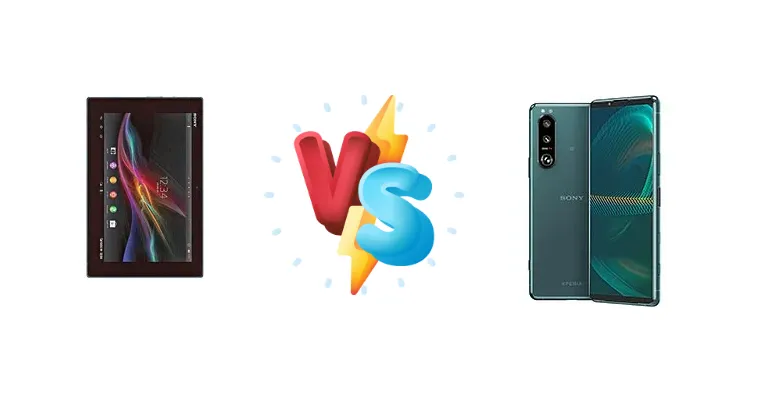
|
🏆 Quick Verdict
The Xperia 5 III is the clear winner. While the Z LTE boasts a large display, the 5 III's modern chipset, significantly improved camera, brighter display, and faster charging make it a far more compelling choice for most users. It's a substantial upgrade in almost every area.
| PHONES | ||
|---|---|---|
| Phone Names | Sony Xperia Tablet Z LTE | Sony Xperia 5 III |
| Network | ||
|---|---|---|
| 2G bands | GSM 850 / 900 / 1800 / 1900 | GSM 850 / 900 / 1800 / 1900 |
| 3G bands | HSDPA 850 / 900 / 2100 - SGP321 | HSDPA 800 / 850 / 900 / 1700(AWS) / 1900 / 2100 |
| 4G bands | 1, 3, 5, 7, 8, 20 - SGP321 | 1, 2, 3, 4, 5, 7, 8, 12, 13, 17, 19, 20, 25, 26, 28, 29, 32, 34, 38, 39, 40, 41, 46, 48, 66, 71 - USA |
| 5G bands | - | 1, 2, 3, 5, 7, 8, 20, 28, 38, 40, 41, 66, 71, 77, 78 SA/NSA/Sub6 - USA |
| Speed | HSPA 42.2/5.76 Mbps, LTE Cat3 100/50 Mbps | HSPA, LTE, 5G |
| Technology | GSM / HSPA / LTE | GSM / HSPA / LTE / 5G |
| 4 - SGP351 | 1, 3, 5, 7, 8, 28, 38, 40, 41, 77, 78, 79 SA/NSA/Sub6 - Asia | |
| Launch | ||
|---|---|---|
| Announced | 2013, February. Released 2013, May | 2021, April 14 |
| Status | Discontinued | Available. Released 2021, October 08 |
| Body | ||
|---|---|---|
| Build | - | Glass front (Gorilla Glass 6), glass back (Gorilla Glass 6), aluminum frame |
| Dimensions | 266 x 172 x 6.9 mm (10.47 x 6.77 x 0.27 in) | 157 x 68 x 8.2 mm (6.18 x 2.68 x 0.32 in) |
| SIM | Micro-SIM | · Nano-SIM· Nano-SIM + Nano-SIM |
| Weight | 495 g (1.09 lb) | 168 g (5.93 oz) |
| IP57 dust proof and water resistant | IP65/IP68 dust/water resistant (up to 1.5m for 30 min) | |
| Display | ||
|---|---|---|
| Protection | Shatter proof glass | Corning Gorilla Glass 6 |
| Resolution | 1200 x 1920 pixels, 16:10 ratio (~224 ppi density) | 1080 x 2520 pixels, 21:9 ratio (~449 ppi density) |
| Size | 10.1 inches, 295.8 cm2 (~64.7% screen-to-body ratio) | 6.1 inches, 86.9 cm2 (~81.4% screen-to-body ratio) |
| Type | LED-backlit LCD, | OLED, 1B colors, 120Hz, HDR BT.2020 |
| Platform | ||
|---|---|---|
| CPU | Quad-core 1.5 GHz Krait | Octa-core (1x2.84 GHz Cortex-X1 & 3x2.42 GHz Cortex-A78 & 4x1.80 GHz Cortex-A55) |
| Chipset | Qualcomm APQ8064 Snapdragon S4 Pro | Qualcomm SM8350 Snapdragon 888 5G (5 nm) |
| GPU | Adreno 320 | Adreno 660 |
| OS | Android 4.1.2 (Jelly Bean), upgradable to 5.1.1 (Lollipop) | Android 11, upgradable to Android 13 |
| Memory | ||
|---|---|---|
| Card slot | microSDXC (dedicated slot); microSDHC (SGP351) | microSDXC (uses shared SIM slot) |
| Internal | 16GB 2GB RAM | 128GB 8GB RAM, 256GB 8GB RAM |
| - | UFS 3.X | |
| Main Camera | ||
|---|---|---|
| Features | HDR, panorama | Zeiss optics, Zeiss T* lens coating, color spectrum sensor, LED flash, panorama, HDR, eye tracking |
| Single | 8.1 MP, AF | 8 MP, f/2.0, 24mm (wide), 1/4", 1.12µm |
| Triple | - | 12 MP, f/1.7, 24mm (wide), 1/1.7", 1.8µm, dual pixel PDAF, OIS 12 MP, f/2.3, 70mm (telephoto), f/2.8, 105mm (telephoto), 1/2.9", dual pixel PDAF, 3x/4.4x optical zoom, OIS 12 MP, f/2.2, 124˚, 16mm (ultrawide), 1/2.6", dual pixel PDAF |
| Video | 1080p@30fps, HDR | 4K@24/25/30/60/120fps HDR, 1080p@30/60/120fps; 5-axis gyro-EIS, OIS |
| Selfie camera | ||
|---|---|---|
| Features | - | HDR |
| Single | 2.2 MP | 8 MP, f/2.0, 24mm (wide), 1/4.0", 1.12µm |
| Video | 1080p@30fps | 1080p@30fps, 5-axis gyro-EIS |
| Sound | ||
|---|---|---|
| 3.5mm jack | Yes | Yes |
| 35mm jack | Yes | Yes |
| Loudspeaker | Yes, with stereo speakers | Yes, with stereo speakers |
| 3D surround sound | 24-bit/192kHz audio Dynamic vibration system | |
| Comms | ||
|---|---|---|
| Bluetooth | 4.0, A2DP | 5.2, A2DP, LE, aptX HD, aptX Adaptive |
| Infrared port | Yes | - |
| NFC | Yes | Yes |
| Positioning | GPS, GLONASS | GPS, GLONASS, BDS, GALILEO, QZSS |
| Radio | Stereo FM radio, RDS | No |
| USB | microUSB 2.0 (MHL TV-out) | USB Type-C 3.1, OTG, video output |
| WLAN | Wi-Fi 802.11 a/b/g/n, dual-band, Wi-Fi Direct, DLNA, hotspot | Wi-Fi 802.11 a/b/g/n/ac/6, dual-band, Wi-Fi Direct, DLNA |
| Features | ||
|---|---|---|
| Sensors | Accelerometer, gyro, compass | Fingerprint (side-mounted), accelerometer, gyro, proximity, barometer, compass |
| - | Native Sony Alpha camera support | |
| Battery | ||
|---|---|---|
| Charging | - | Wired, PD, 50% in 30 min |
| Music play | Up to 110 h | - |
| Stand-by | Up to 1230 h (2G) / Up to 1270 h (3G) | - |
| Talk time | Up to 10 h (multimedia) | - |
| Type | Li-Po 6000 mAh, non-removable | Li-Po 4500 mAh |
| Misc | ||
|---|---|---|
| Colors | Black, White | Black, Green, Pink |
| Models | SGP321, SO-03E, SGP351 | XQBQ62/G, XQBQ52G.UKCX, XQBQ52B.UKCX, XQ-BQ52, XQ-BQ72, XQ-BQ42, XQ-BQ62, SO-53B |
| Price | About 350 EUR | € 431.90 / £ 199.99 |
| SAR EU | 1.69 W/kg (body) | - |
| Tests | ||
|---|---|---|
| Audio quality | Noise -87.0dB / Crosstalk -87.8dB | - |
| Battery life | - | Endurance rating 100h |
| Camera | Photo / Video | Photo / Video |
| Display | Contrast ratio: 996:1 (nominal) | Contrast ratio: Infinite (nominal) |
| Loudspeaker | Voice 66dB / Noise 64dB / Ring 70dB | -26.7 LUFS (Good) |
| Performance | - | AnTuTu: 708394 (v9) GeekBench: 3549 (v5.1) GFXBench: 53fps (ES 3.1 onscreen) |
Sony Xperia Tablet Z LTE
- Large display
- LTE connectivity
- Relatively compact for a tablet
- Outdated chipset
- Poor performance
- Low brightness display
- No fast charging
- Limited camera capabilities
Sony Xperia 5 III
- Powerful Snapdragon 888 5G
- Bright and vibrant display
- Excellent camera
- Fast charging (PD)
- 5G connectivity
- Modern design
- Can be expensive
- Camera bump
Display Comparison
The Xperia 5 III's display is a significant upgrade. It boasts a measured 590 nits of brightness, making it far more usable outdoors. While the Z LTE's 996:1 contrast ratio is respectable, the 5 III's 'infinite' contrast (likely a marketing term, but indicative of superior panel technology) and higher brightness provide a much better viewing experience. The 5 III also likely has better color accuracy and HDR support.
Camera Comparison
Camera details are sparse for both devices, but the Xperia 5 III's Snapdragon 888 includes a much more advanced image signal processor (ISP) and likely features improved sensors. Expect better image quality, dynamic range, and low-light performance from the 5 III. The Z LTE's camera is likely adequate for basic photos and videos, but it won't compete with the 5 III.
Performance
The Xperia 5 III's Snapdragon 888 5G chipset is worlds ahead of the Z LTE's Snapdragon S4 Pro. The 5 III's octa-core CPU and 5nm manufacturing process deliver significantly faster performance for gaming, multitasking, and demanding applications. The Z LTE, while capable for its time, will struggle with modern apps and games.
Battery Life
Both devices are claimed to have 100h endurance ratings, but this is likely under very specific, light usage scenarios. The Xperia 5 III's modern power management and more efficient chipset will likely result in better real-world battery life. Furthermore, the 5 III supports PD fast charging, allowing for a 50% charge in just 30 minutes – a feature absent in the Z LTE.
Buying Guide
The Xperia Z LTE might appeal to those seeking a large-screen device for media consumption on a tight budget, or those nostalgic for older Sony hardware. However, the Xperia 5 III is the better buy for anyone prioritizing performance, camera quality, and modern features like 5G connectivity.