
Sony Xperia Pro vs OnePlus 11R: A Detailed Performance and Feature Comparison
| Phones Images | |||||
|---|---|---|---|---|---|
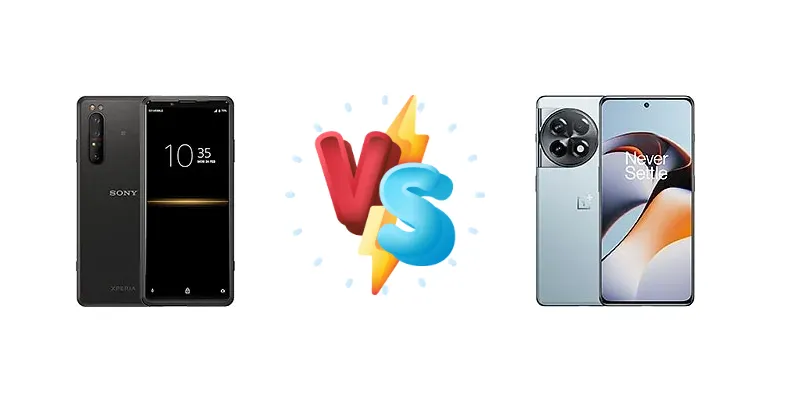
|
🏆 Quick Verdict
For the average user prioritizing performance and value, the OnePlus 11R is the clear winner. Its Snapdragon 8+ Gen 1 chipset, coupled with 100W charging, offers a substantial upgrade over the Xperia Pro’s older Snapdragon 865 and slower 21W charging. However, the Xperia Pro retains appeal for professionals needing specific connectivity features.
| PHONES | ||
|---|---|---|
| Phone Names | Sony Xperia Pro | OnePlus 11R |
| Network | ||
|---|---|---|
| 2G bands | GSM 850 / 900 / 1800 / 1900 | GSM 850 / 900 / 1800 / 1900 |
| 3G bands | HSDPA 850 / 900 / 1700(AWS) / 1900 / 2100 | HSDPA 850 / 900 / 1700(AWS) / 2100 |
| 4G bands | 1, 2, 3, 4, 5, 7, 8, 11, 12, 13, 17, 18, 19, 20, 21, 25, 26, 28, 29, 32, 34, 38, 39, 40, 41, 42, 46, 48, 66 | 1, 3, 4, 5, 8, 28, 34, 38, 39, 40, 41 |
| 5G bands | 2, 5, 66, 260, 261 Sub6, mmWave | 1, 3, 5, 8, 28, 40, 41, 77, 78 SA/NSA |
| Speed | HSPA, LTE, 5G | HSPA, LTE (3CA), 5G |
| Technology | GSM / HSPA / LTE / 5G | GSM / CDMA / HSPA / LTE / 5G |
| - | CDMA 800 | |
| Launch | ||
|---|---|---|
| Announced | 2020, February 24. Released 2021, January 27 | 2023, February 07 |
| Status | Discontinued | Available. Released 2023, February 21 |
| Body | ||
|---|---|---|
| Build | Glass front (Gorilla Glass 6), plastic back, plastic frame | Glass front, glass back (Gorilla Glass 5), plastic frame |
| Dimensions | 170.2 x 76.2 x 10.2 mm (6.70 x 3.00 x 0.40 in) | 163.4 x 74.3 x 8.7 mm (6.43 x 2.93 x 0.34 in) |
| SIM | Nano-SIM + Nano-SIM | Nano-SIM + Nano-SIM |
| Weight | 225.1 g (7.94 oz) | 204 g (7.20 oz) |
| IP65/IP68 dust/water resistant (up to 1.5m for 30 mins) | - | |
| Display | ||
|---|---|---|
| Protection | Corning Gorilla Glass 6 | - |
| Resolution | 1644 x 3840 pixels, 21:9 ratio (~643 ppi density) | 1240 x 2772 pixels, 20:9 ratio (~451 ppi density) |
| Size | 6.5 inches, 98.6 cm2 (~76.0% screen-to-body ratio) | 6.74 inches, 109.2 cm2 (~90.0% screen-to-body ratio) |
| Type | OLED, 1B colors, HDR BT.2020 | Fluid AMOLED, 1B colors, 120Hz, HDR10+, 1450 nits (peak) |
| Runs at 1096 x 2560 pixels except for select use cases | - | |
| Platform | ||
|---|---|---|
| CPU | Octa-core (1x2.84 GHz Cortex-A77 & 3x2.42 GHz Cortex-A77 & 4x1.80 GHz Cortex-A55) | Octa-core (1x3.0 GHz Cortex-X2 & 3x2.5 GHz Cortex-A710 & 4x1.80 GHz Cortex-A510) |
| Chipset | Qualcomm SM8250 Snapdragon 865 5G (7 nm+) | Qualcomm SM8475 Snapdragon 8+ Gen 1 (4 nm) |
| GPU | Adreno 650 | Adreno 730 |
| OS | Android 10, upgradable to Android 12 | Android 13, upgradable to Android 15, OxygenOS 15 |
| Memory | ||
|---|---|---|
| Card slot | microSDXC (uses shared SIM slot) | No |
| Internal | 512GB 12GB RAM | 128GB 8GB RAM, 256GB 16GB RAM, 512GB 18GB RAM |
| UFS 3.X | UFS 3.1 | |
| Main Camera | ||
|---|---|---|
| Features | Zeiss optics, color spectrum sensor, LED flash, panorama, HDR, eye tracking | Color spectrum sensor, LED flash, HDR, panorama |
| Single | - | 16 MP, f/2.4, 24mm (wide), 1/3.09", 1.0µm |
| Triple | 12 MP, f/1.7, 24mm (wide), 1/1.7", 1.8µm, dual pixel PDAF, OIS 12 MP, f/2.4, 70mm (telephoto), 1/3.4", 1.0µm, PDAF, 3x optical zoom, OIS 12 MP, f/2.2, 124˚, 16mm (ultrawide), 1/2.55", dual pixel PDAF 0.3 MP, TOF 3D, (depth) | 50 MP, f/1.8, 24mm (wide), 1/1.56", 1.0µm, multi-directional PDAF, OIS 8 MP, f/2.2, 120˚ (ultrawide), 1/4.0", 1.12µm 2 MP (macro) |
| Video | 4K@24/25/30/60fps HDR, 1080p@30/60/120fps; 5-axis gyro-EIS, OIS | 4K@30/60fps, 1080p@30/60/240fps, gyro-EIS |
| Selfie camera | ||
|---|---|---|
| Features | HDR | HDR |
| Single | 8 MP, f/2.0, 24mm (wide), 1/4.0", 1.12µm | 16 MP, f/2.4, 24mm (wide), 1/3.09", 1.0µm |
| Video | 1080p@30fps, 5-axis gyro-EIS | 1080p@30fps |
| Sound | ||
|---|---|---|
| 3.5mm jack | Yes | No |
| 35mm jack | Yes | No |
| Loudspeaker | Yes, with stereo speakers | Yes, with stereo speakers |
| 24-bit/192kHz audio | 24-bit/192kHz audio | |
| Comms | ||
|---|---|---|
| Bluetooth | 5.1, A2DP, aptX HD, LE | 5.3, A2DP, LE, aptX HD |
| Infrared port | - | Yes |
| NFC | Yes | Yes |
| Positioning | GPS, GLONASS | GPS (L1+L5), GLONASS (G1), BDS (B1I+B1c+B2a), GALILEO (E1+E5a), QZSS (L1+L5) |
| Radio | No | No |
| USB | USB Type-C 3.1, OTG, micro HDMI | USB Type-C 2.0 |
| WLAN | Wi-Fi 802.11 a/b/g/n/ac/6, dual-band, Wi-Fi Direct, DLNA | Wi-Fi 802.11 a/b/g/n/ac/6, dual-band |
| Features | ||
|---|---|---|
| Sensors | Fingerprint (side-mounted), accelerometer, gyro, proximity, barometer, compass | Fingerprint (under display, optical), accelerometer, gyro, proximity, compass |
| Native Sony Alpha camera support | - | |
| Battery | ||
|---|---|---|
| Charging | 21W wired, PD | 100W wired |
| Type | Li-Po 4000 mAh | Li-Po 5000 mAh |
| Misc | ||
|---|---|---|
| Colors | Black | Galactic Silver, Sonic Black, Solar Red |
| Models | - | CPH2487 |
| Price | About 2000 EUR | About 600 EUR |
| SAR | - | 1.16 W/kg (head) 0.61 W/kg (body) |
Sony Xperia Pro
- HDMI Input for external monitoring
- 5G mmWave support (depending on region)
- Potentially more rugged build quality
- Outdated Snapdragon 865 chipset
- Slow 21W charging
- Likely higher price point
OnePlus 11R
- Snapdragon 8+ Gen 1 for superior performance
- 100W SuperVOOC charging for rapid refueling
- Vibrant AMOLED display
- Lacks HDMI input
- No mmWave 5G support
- Build quality may not be as robust
Display Comparison
While specific display specs for the Xperia Pro beyond its size are limited, the OnePlus 11R boasts a 6.72-inch 120Hz AMOLED display. The Snapdragon 8+ Gen 1’s ISP supports higher refresh rates and more efficient display driving. The Xperia Pro, utilizing the older Snapdragon 865, likely has a less efficient panel. The 11R’s AMOLED technology provides superior contrast and color accuracy compared to the likely LCD panel on the Xperia Pro, benefiting media consumers and gamers.
Camera Comparison
Detailed camera specs for the Xperia Pro are scarce, but its focus was on video recording capabilities. The OnePlus 11R features a 50MP main sensor with OIS, a 8MP ultrawide, and a 2MP macro lens. While the 2MP macro is largely a marketing feature, the 50MP main sensor, combined with the Snapdragon 8+ Gen 1’s image signal processor, delivers excellent image quality in various lighting conditions. The Xperia Pro likely relies on older image processing algorithms, potentially resulting in less dynamic range and detail compared to the 11R. The 11R’s superior processing power allows for faster image capture and more advanced computational photography features.
Performance
The core difference lies in the chipsets. The OnePlus 11R’s Snapdragon 8+ Gen 1 (4nm) is a significant leap over the Xperia Pro’s Snapdragon 865 (7nm+). The 8+ Gen 1 features the newer Cortex-X2 prime core clocked at 3.0 GHz, offering substantial single-core performance gains. The 11R also benefits from a more efficient manufacturing process, resulting in better thermal management and sustained performance during demanding tasks. The Xperia Pro’s Cortex-A77 cores, while capable, are outperformed by the 11R’s Cortex-A710 cores. This translates to faster app loading, smoother multitasking, and a more responsive user experience on the OnePlus 11R.
Battery Life
The OnePlus 11R’s 100W SuperVOOC charging is a game-changer, capable of charging the 5000mAh battery from 0-100% in around 25 minutes. The Xperia Pro’s 21W charging is comparatively slow, taking significantly longer to fully charge its battery. While the Xperia Pro’s battery capacity is unknown, the 11R’s larger battery combined with the more efficient Snapdragon 8+ Gen 1 chipset provides all-day battery life for most users. The 11R’s charging speed minimizes downtime, a crucial advantage for power users.
Buying Guide
Buy the Sony Xperia Pro if you require dedicated HDMI input for external monitoring, 5G mmWave support, or prioritize a more rugged build quality for professional video workflows. Buy the OnePlus 11R if you prioritize raw performance for gaming and everyday tasks, incredibly fast charging, and a vibrant display, all at a significantly lower cost.