
Sony Xperia Pro vs. Google Pixel 8 Pro: A Deep Dive for Professionals and Enthusiasts
| Phones Images | |||||
|---|---|---|---|---|---|
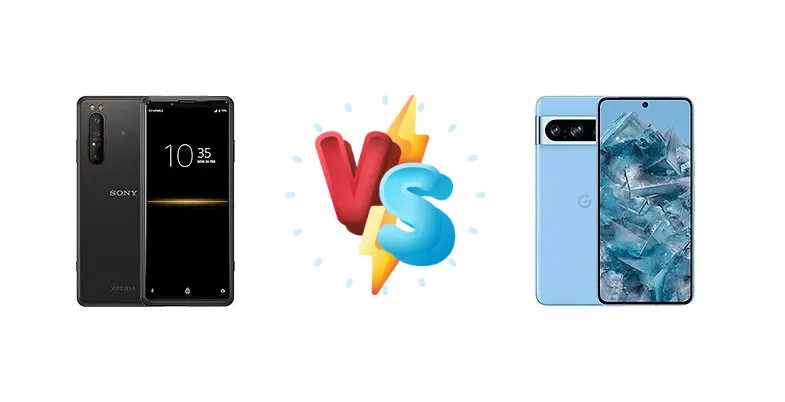
|
🏆 Quick Verdict
For the average user, the Google Pixel 8 Pro is the superior choice. Its significantly more powerful Tensor G3 chipset, exceptional camera capabilities, and long-term software support outweigh the Xperia Pro’s niche professional features. However, professionals needing direct HDMI input and external monitor support will still find value in the Xperia Pro.
| PHONES | ||
|---|---|---|
| Phone Names | Sony Xperia Pro | Google Pixel 8 Pro |
| Network | ||
|---|---|---|
| 2G bands | GSM 850 / 900 / 1800 / 1900 | GSM 850 / 900 / 1800 / 1900 |
| 3G bands | HSDPA 850 / 900 / 1700(AWS) / 1900 / 2100 | HSDPA 800 / 850 / 900 / 1700(AWS) / 1900 / 2100 |
| 4G bands | 1, 2, 3, 4, 5, 7, 8, 11, 12, 13, 17, 18, 19, 20, 21, 25, 26, 28, 29, 32, 34, 38, 39, 40, 41, 42, 46, 48, 66 | 1, 2, 3, 4, 5, 7, 8, 12, 13, 14, 17, 18, 19, 20, 25, 26, 28, 29, 30, 38, 39, 40, 41, 46, 48, 66, 71 - G1MNW |
| 5G bands | 2, 5, 66, 260, 261 Sub6, mmWave | 1, 2, 3, 5, 7, 8, 12, 20, 25, 26, 28, 29, 30, 38, 40, 41, 48, 66, 70, 71, 77, 78, 257, 258, 260, 261 SA/NSA/Sub6/mmWave - G1MNW |
| Speed | HSPA, LTE, 5G | HSPA, LTE, 5G |
| Technology | GSM / HSPA / LTE / 5G | GSM / HSPA / LTE / 5G |
| Launch | ||
|---|---|---|
| Announced | 2020, February 24. Released 2021, January 27 | 2023, October 04 |
| Status | Discontinued | Available. Released 2023, October 12 |
| Body | ||
|---|---|---|
| Build | Glass front (Gorilla Glass 6), plastic back, plastic frame | Glass front (Gorilla Glass Victus 2), glass back (Gorilla Glass Victus 2), aluminum frame |
| Dimensions | 170.2 x 76.2 x 10.2 mm (6.70 x 3.00 x 0.40 in) | 162.6 x 76.5 x 8.8 mm (6.40 x 3.01 x 0.35 in) |
| SIM | Nano-SIM + Nano-SIM | Nano-SIM + eSIM |
| Weight | 225.1 g (7.94 oz) | 213 g (7.51 oz) |
| IP65/IP68 dust/water resistant (up to 1.5m for 30 mins) | - | |
| Display | ||
|---|---|---|
| Protection | Corning Gorilla Glass 6 | Corning Gorilla Glass Victus 2 |
| Resolution | 1644 x 3840 pixels, 21:9 ratio (~643 ppi density) | 1344 x 2992 pixels, 20:9 ratio (~489 ppi density) |
| Size | 6.5 inches, 98.6 cm2 (~76.0% screen-to-body ratio) | 6.7 inches, 108.7 cm2 (~87.4% screen-to-body ratio) |
| Type | OLED, 1B colors, HDR BT.2020 | LTPO OLED, 120Hz, HDR10+, 1600 nits (HBM), 2400 nits (peak) |
| Runs at 1096 x 2560 pixels except for select use cases | - | |
| Platform | ||
|---|---|---|
| CPU | Octa-core (1x2.84 GHz Cortex-A77 & 3x2.42 GHz Cortex-A77 & 4x1.80 GHz Cortex-A55) | Nona-core (1x3.0 GHz Cortex-X3 & 4x2.45 GHz Cortex-A715 & 4x2.15 GHz Cortex-A510) |
| Chipset | Qualcomm SM8250 Snapdragon 865 5G (7 nm+) | Google Tensor G3 (4 nm) |
| GPU | Adreno 650 | Immortalis-G715s MC10 |
| OS | Android 10, upgradable to Android 12 | Android 14, upgradable to Android 16, up to 7 major Android upgrades |
| Memory | ||
|---|---|---|
| Card slot | microSDXC (uses shared SIM slot) | No |
| Internal | 512GB 12GB RAM | 128GB 12GB RAM, 256GB 12GB RAM, 512GB 12GB RAM, 1TB 12GB RAM |
| UFS 3.X | - | |
| Main Camera | ||
|---|---|---|
| Features | Zeiss optics, color spectrum sensor, LED flash, panorama, HDR, eye tracking | Multi-zone Laser AF, Dual-LED flash, Pixel Shift, Ultra-HDR, panorama, Best Take, Zoom Enhance |
| Triple | 12 MP, f/1.7, 24mm (wide), 1/1.7", 1.8µm, dual pixel PDAF, OIS 12 MP, f/2.4, 70mm (telephoto), 1/3.4", 1.0µm, PDAF, 3x optical zoom, OIS 12 MP, f/2.2, 124˚, 16mm (ultrawide), 1/2.55", dual pixel PDAF 0.3 MP, TOF 3D, (depth) | 50 MP, f/1.7, 25mm (wide), 1/1.31", 1.2µm, dual pixel PDAF, OIS 48 MP, f/2.8, 113mm (periscope telephoto), 1/2.55", 0.7µm, dual pixel PDAF, OIS, 5x optical zoom 48 MP, f/2.0, 126˚ (ultrawide), 1/2.0", 0.8µm, dual pixel PDAF |
| Video | 4K@24/25/30/60fps HDR, 1080p@30/60/120fps; 5-axis gyro-EIS, OIS | 4K@30/60fps, 1080p@24/30/60/120/240fps; gyro-EIS, OIS, 10-bit HDR |
| Selfie camera | ||
|---|---|---|
| Features | HDR | HDR, panorama |
| Single | 8 MP, f/2.0, 24mm (wide), 1/4.0", 1.12µm | 10.5 MP, f/2.2, 20mm (ultrawide), 1/3.1", 1.22µm, PDAF |
| Video | 1080p@30fps, 5-axis gyro-EIS | 4K@24/30/60fps, 1080p@30/60fps |
| Sound | ||
|---|---|---|
| 3.5mm jack | Yes | - |
| 35mm jack | Yes | No |
| Loudspeaker | Yes, with stereo speakers | Yes, with stereo speakers |
| 24-bit/192kHz audio | - | |
| Comms | ||
|---|---|---|
| Bluetooth | 5.1, A2DP, aptX HD, LE | 5.3, A2DP, LE, aptX HD |
| NFC | Yes | Yes |
| Positioning | GPS, GLONASS | GPS (L1+L5), GLONASS (G1), GALILEO (E1+E5a), QZSS (L1+L5) |
| Radio | No | No |
| USB | USB Type-C 3.1, OTG, micro HDMI | USB Type-C 3.2 |
| WLAN | Wi-Fi 802.11 a/b/g/n/ac/6, dual-band, Wi-Fi Direct, DLNA | Wi-Fi 802.11 a/b/g/n/ac/6e/7, tri-band, Wi-Fi Direct |
| Features | ||
|---|---|---|
| Sensors | Fingerprint (side-mounted), accelerometer, gyro, proximity, barometer, compass | Fingerprint (under display, optical), accelerometer, gyro, proximity, compass, barometer, thermometer (skin temperature) |
| Native Sony Alpha camera support | - | |
| Battery | ||
|---|---|---|
| Charging | 21W wired, PD | 30W wired, PD3.0, PPS, 50% in 30 min 23W wireless Reverse wireless Bypass charging |
| Type | Li-Po 4000 mAh | Li-Ion 5050 mAh |
| Misc | ||
|---|---|---|
| Colors | Black | Obsidian, Porcelain, Bay, Mint |
| Models | - | GC3VE, G1MNW |
| Price | About 2000 EUR | € 362.00 / $ 289.97 / £ 329.95 / ₹ 54,999 |
Sony Xperia Pro
- Dedicated HDMI input for professional workflows
- Robust build quality and durability
- 5G connectivity for fast data transfer
- Outdated chipset and performance
- Limited software support
- Lower display brightness and efficiency
Google Pixel 8 Pro
- Powerful Google Tensor G3 chipset
- Exceptional camera with AI features
- Long-term software and security updates
- No HDMI input for external monitors
- May not appeal to users needing specific professional connectivity
- Price point is higher
Display Comparison
The Google Pixel 8 Pro boasts a significantly brighter display, reaching a measured 1600 nits peak brightness, compared to the Xperia Pro’s undisclosed peak brightness (likely lower given its age). While the Xperia Pro’s display quality is good, the Pixel 8 Pro’s superior brightness enhances outdoor visibility. The Pixel 8 Pro likely utilizes an LTPO panel for variable refresh rates, contributing to battery efficiency, a feature not confirmed on the Xperia Pro. The Pixel 8 Pro’s display is a clear advantage for media consumption and outdoor use.
Camera Comparison
The Pixel 8 Pro’s camera system is a significant upgrade. While specific sensor details are not provided, Google’s computational photography prowess, powered by the Tensor G3’s image signal processor, delivers superior image quality, especially in low-light conditions. The Pixel 8 Pro excels in both photo and video capture, leveraging AI for features like Magic Eraser and Best Take. The Xperia Pro’s camera, while competent, lacks the advanced AI capabilities and image processing of the Pixel 8 Pro. The focus is on providing a clean signal for professional post-processing, rather than in-camera enhancements.
Performance
The Google Pixel 8 Pro’s Google Tensor G3, built on a 4nm process, represents a substantial leap in performance and efficiency over the Sony Xperia Pro’s Qualcomm Snapdragon 865 5G (7nm+). The Tensor G3’s nona-core CPU configuration (1x3.0 GHz Cortex-X3, 4x2.45 GHz Cortex-A715, 4x2.15 GHz Cortex-A510) offers improved single-core and multi-core performance compared to the Xperia Pro’s octa-core setup (1x2.84 GHz Cortex-A77, 3x2.42 GHz Cortex-A77, 4x1.80 GHz Cortex-A55). The newer CPU architecture and smaller process node translate to better thermal management and sustained performance, particularly in demanding tasks. The Xperia Pro, while capable, will show its age in graphically intensive applications.
Battery Life
The Google Pixel 8 Pro demonstrates impressive battery life, achieving an active use score of 11:14 hours and an endurance rating of 90 hours. This is likely due to the efficient Tensor G3 chipset and optimized software. The Xperia Pro’s battery capacity is undisclosed, but its older chipset and less efficient process node suggest shorter battery life. The Pixel 8 Pro also offers faster charging at 30W wired (PD3.0, PPS, 50% in 30 min) and 23W wireless, along with reverse wireless charging and bypass charging, features absent on the Xperia Pro’s 21W wired charging.
Buying Guide
Buy the Sony Xperia Pro if you are a professional videographer or live streamer who *requires* direct HDMI input for external monitors and a dedicated workflow integration. Buy the Google Pixel 8 Pro if you prioritize a best-in-class camera experience, AI-powered features, long-term software updates, and overall performance for everyday tasks and content consumption.