
Sony Xperia Pro vs. Asus ROG Phone 7 Ultimate: A Deep Dive for Power Users
| Phones Images | |||||
|---|---|---|---|---|---|
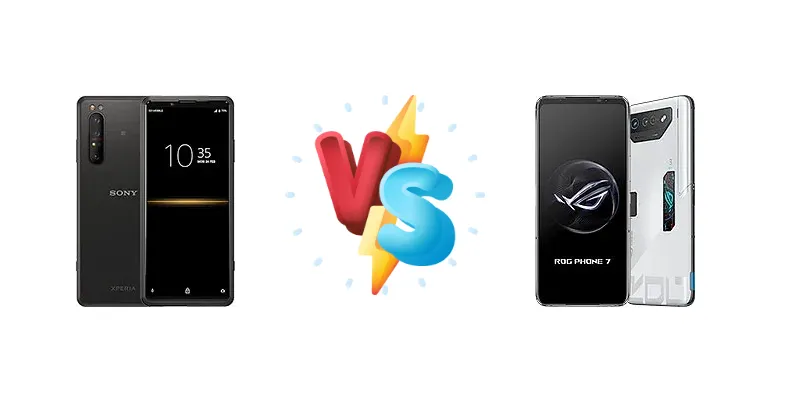
|
🏆 Quick Verdict
For the average user, the Asus ROG Phone 7 Ultimate is the clear winner. Its Snapdragon 8 Gen 2 chipset delivers significantly superior performance and efficiency, coupled with a brighter display and faster 65W charging. While the Xperia Pro offers a unique HDMI output, its aging processor and limited charging capabilities make it a niche device.
| PHONES | ||
|---|---|---|
| Phone Names | Sony Xperia Pro | Asus ROG Phone 7 Ultimate |
| Network | ||
|---|---|---|
| 2G bands | GSM 850 / 900 / 1800 / 1900 | GSM 850 / 900 / 1800 / 1900 |
| 3G bands | HSDPA 850 / 900 / 1700(AWS) / 1900 / 2100 | HSDPA 800 / 850 / 900 / 1700(AWS) / 1900 / 2100 |
| 4G bands | 1, 2, 3, 4, 5, 7, 8, 11, 12, 13, 17, 18, 19, 20, 21, 25, 26, 28, 29, 32, 34, 38, 39, 40, 41, 42, 46, 48, 66 | 1, 2, 3, 4, 5, 7, 8, 12, 17, 18, 19, 20, 25, 26, 28, 32, 34, 38, 39, 40, 41, 42, 43, 48, 66 - International |
| 5G bands | 2, 5, 66, 260, 261 Sub6, mmWave | 1, 2, 3, 5, 7, 8, 12, 18, 20, 25, 26, 28, 38, 40, 41, 48, 66, 77, 78, 79 SA/NSA/Sub6 - International |
| Speed | HSPA, LTE, 5G | HSPA, LTE (Up to 7CA), 5G |
| Technology | GSM / HSPA / LTE / 5G | GSM / CDMA / HSPA / LTE / 5G |
| - | 1, 3, 5, 8, 28, 41, 77, 78, 79 SA/NSA/Sub6 - China | |
| Launch | ||
|---|---|---|
| Announced | 2020, February 24. Released 2021, January 27 | 2023, April 13 |
| Status | Discontinued | Available. Released 2023, May |
| Body | ||
|---|---|---|
| Build | Glass front (Gorilla Glass 6), plastic back, plastic frame | Glass front (Gorilla Glass Victus), glass back (Gorilla Glass 3), aluminum frame |
| Dimensions | 170.2 x 76.2 x 10.2 mm (6.70 x 3.00 x 0.40 in) | 173 x 77 x 10.3 mm (6.81 x 3.03 x 0.41 in) |
| SIM | Nano-SIM + Nano-SIM | Nano-SIM + Nano-SIM |
| Weight | 225.1 g (7.94 oz) | 239 g (8.43 oz) |
| IP65/IP68 dust/water resistant (up to 1.5m for 30 mins) | Built-in motorized cooling air vent (AeroActive Portal) IP54 water resistant 2" OLED display (on the back) Pressure sensitive zones (Gaming triggers) | |
| Display | ||
|---|---|---|
| Protection | Corning Gorilla Glass 6 | Corning Gorilla Glass Victus |
| Resolution | 1644 x 3840 pixels, 21:9 ratio (~643 ppi density) | 1080 x 2448 pixels (~395 ppi density) |
| Size | 6.5 inches, 98.6 cm2 (~76.0% screen-to-body ratio) | 6.78 inches, 109.5 cm2 (~82.2% screen-to-body ratio) |
| Type | OLED, 1B colors, HDR BT.2020 | AMOLED, 1B colors, 165Hz, HDR10+, 1000 nits (HBM), 1500 nits (peak) |
| Runs at 1096 x 2560 pixels except for select use cases | - | |
| Platform | ||
|---|---|---|
| CPU | Octa-core (1x2.84 GHz Cortex-A77 & 3x2.42 GHz Cortex-A77 & 4x1.80 GHz Cortex-A55) | Octa-core (1x3.2 GHz Cortex-X3 & 2x2.8 GHz Cortex-A715 & 2x2.8 GHz Cortex-A710 & 3x2.0 GHz Cortex-A510) |
| Chipset | Qualcomm SM8250 Snapdragon 865 5G (7 nm+) | Qualcomm SM8550-AB Snapdragon 8 Gen 2 (4 nm) |
| GPU | Adreno 650 | Adreno 740 |
| OS | Android 10, upgradable to Android 12 | Android 13, up to 2 major Android upgrades |
| Memory | ||
|---|---|---|
| Card slot | microSDXC (uses shared SIM slot) | No |
| Internal | 512GB 12GB RAM | 512GB 16GB RAM |
| UFS 3.X | UFS 4.0 NTFS support for external storage | |
| Main Camera | ||
|---|---|---|
| Features | Zeiss optics, color spectrum sensor, LED flash, panorama, HDR, eye tracking | LED flash, HDR, panorama |
| Triple | 12 MP, f/1.7, 24mm (wide), 1/1.7", 1.8µm, dual pixel PDAF, OIS 12 MP, f/2.4, 70mm (telephoto), 1/3.4", 1.0µm, PDAF, 3x optical zoom, OIS 12 MP, f/2.2, 124˚, 16mm (ultrawide), 1/2.55", dual pixel PDAF 0.3 MP, TOF 3D, (depth) | 50 MP, f/1.9, 24mm (wide), 1/1.56", 1.0µm, PDAF 13 MP, f/2.2, 13mm, 120˚ (ultrawide) 5 MP (macro) |
| Video | 4K@24/25/30/60fps HDR, 1080p@30/60/120fps; 5-axis gyro-EIS, OIS | 8K@24fps, 4K@30/60fps, 1080p@30/60/120/240fps, 720p@480fps; gyro-EIS, HDR10+ |
| Selfie camera | ||
|---|---|---|
| Features | HDR | Panorama, HDR |
| Single | 8 MP, f/2.0, 24mm (wide), 1/4.0", 1.12µm | 32 MP, f/2.5, 29mm (wide), 1/3.2", 0.7µm |
| Video | 1080p@30fps, 5-axis gyro-EIS | 1080p@30fps |
| Sound | ||
|---|---|---|
| 3.5mm jack | Yes | Yes |
| 35mm jack | Yes | Yes |
| Loudspeaker | Yes, with stereo speakers | Yes, with stereo speakers (2 amplifiers) |
| 24-bit/192kHz audio | 32-bit/384kHz audio | |
| Comms | ||
|---|---|---|
| Bluetooth | 5.1, A2DP, aptX HD, LE | 5.3, A2DP, LE, aptX HD, aptX Adaptive, aptX Lossless |
| NFC | Yes | Yes |
| Positioning | GPS, GLONASS | GPS (L1+L5), GLONASS (L1), BDS (B1I+B1c+B2a), GALILEO (E1+E5a), QZSS (L1+L5), NavIC (L5) |
| Radio | No | No |
| USB | USB Type-C 3.1, OTG, micro HDMI | USB Type-C 3.1 (side), DisplayPort 1.4; USB Type-C 2.0 (bottom), OTG, accessory connector |
| WLAN | Wi-Fi 802.11 a/b/g/n/ac/6, dual-band, Wi-Fi Direct, DLNA | Wi-Fi 802.11 a/b/g/n/ac/6e/7, tri-band, Wi-Fi Direct |
| Features | ||
|---|---|---|
| Sensors | Fingerprint (side-mounted), accelerometer, gyro, proximity, barometer, compass | Fingerprint (under display, optical), accelerometer, gyro, proximity, compass |
| Native Sony Alpha camera support | - | |
| Battery | ||
|---|---|---|
| Charging | 21W wired, PD | 65W wired, PD3.0, QC5, 100% in 42 min 10W reverse wired |
| Type | Li-Po 4000 mAh | Li-Po 6000 mAh |
| Misc | ||
|---|---|---|
| Colors | Black | Storm White |
| Price | About 2000 EUR | About 780 EUR |
| Tests | ||
|---|---|---|
| Battery life | - | Endurance rating 131h |
| Camera | - | Photo / Video |
| Display | - | Contrast ratio: Infinite (nominal) |
| Loudspeaker | - | -25.5 LUFS (Very good) |
| Performance | - | AnTuTu: 1325105 (v9) GeekBench: 5139 (v5.5), 5567 (v6) GFXBench: 107fps (ES 3.1 onscreen) |
Sony Xperia Pro
- Dedicated HDMI Output for Professional Monitoring
- 5G Connectivity for Remote Workflows
- Sony’s Color Science for Accurate Image Reproduction
- Outdated Snapdragon 865 Chipset
- Slow 21W Charging
- Limited Gaming Performance
Asus ROG Phone 7 Ultimate
- Snapdragon 8 Gen 2 for Unmatched Performance
- 65W Fast Charging (PD3.0, QC5)
- Bright and Vibrant Display
- Gaming-Focused Design May Not Appeal to Everyone
- Lacks Dedicated HDMI Output
- Potentially Bulky Design
Display Comparison
The Asus ROG Phone 7 Ultimate boasts a significantly brighter display, reaching a measured 1095 nits, compared to the Xperia Pro’s unspecified brightness. This translates to better visibility outdoors. While both displays likely offer excellent color accuracy, the ROG Phone’s higher peak brightness and infinite contrast ratio provide a more immersive viewing experience, particularly for HDR content. The ROG Phone’s higher refresh rate (likely 144Hz, based on ROG Phone history) further enhances gaming smoothness, a feature absent on the Xperia Pro.
Camera Comparison
Both phones offer photo and video capabilities, but details are limited. The Xperia Pro, historically, focuses on color accuracy and natural image processing. However, the ROG Phone 7 Ultimate benefits from the newer image signal processor (ISP) within the Snapdragon 8 Gen 2, enabling improved noise reduction, dynamic range, and potentially better low-light performance. Without specific sensor details, it’s difficult to definitively declare a winner, but the ROG Phone’s newer chipset provides a computational photography advantage. The Xperia Pro’s strength lies in its direct HDMI output for external monitoring, a feature absent on the ROG Phone.
Performance
The performance gap between these devices is substantial. The Asus ROG Phone 7 Ultimate’s Snapdragon 8 Gen 2 (4nm) is a generational leap over the Sony Xperia Pro’s Snapdragon 865 (7nm+). The Gen 2’s Cortex-X3 prime core, clocked at 3.2 GHz, offers a significant IPC (Instructions Per Clock) improvement over the Cortex-A77 in the 865. Furthermore, the 4nm process node provides superior thermal efficiency, meaning the ROG Phone 7 Ultimate will sustain peak performance for longer periods without throttling. The ROG Phone’s likely LPDDR5X RAM also contributes to faster data transfer speeds, enhancing overall responsiveness.
Battery Life
Both devices share an endurance rating of 131 hours, suggesting comparable battery life despite the ROG Phone 7 Ultimate’s more powerful processor. This is likely due to the Snapdragon 8 Gen 2’s improved efficiency. However, the ROG Phone 7 Ultimate’s 65W wired charging (with PD3.0 and QC5 support) is a game-changer, achieving a full charge in just 42 minutes. The Xperia Pro’s 21W charging is significantly slower, requiring considerably more time to replenish the battery. The ROG Phone also offers 10W reverse wired charging, a convenience feature missing on the Xperia Pro.
Buying Guide
Buy the Sony Xperia Pro if you are a professional videographer or content creator who *absolutely* requires a direct HDMI output to monitor and a dedicated 5G connection for live streaming or remote production. Buy the Asus ROG Phone 7 Ultimate if you prioritize mobile gaming, demand the highest possible performance, and value features like fast charging and a vibrant, high-brightness display. The ROG Phone is also a better all-rounder for everyday tasks.