
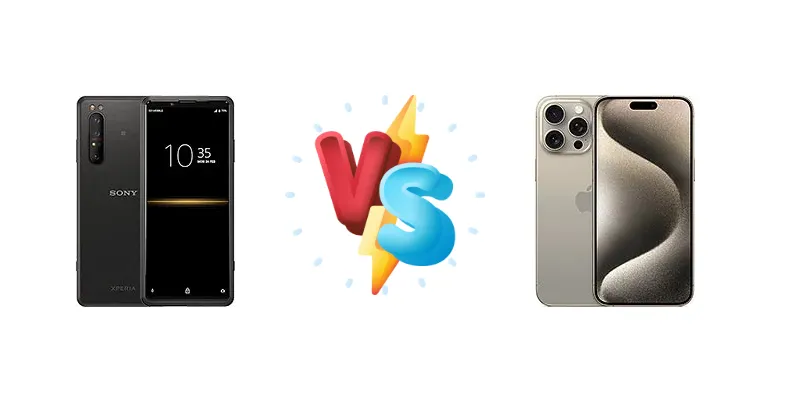
Sony Xperia Pro vs. Apple iPhone 15 Pro Max: A Detailed Comparison for Professionals
| Phones Images | |||||
|---|---|---|---|---|---|
|
🏆 Quick Verdict
For the average user, the Apple iPhone 15 Pro Max is the clear winner. Its significantly more efficient A17 Pro chipset, coupled with a measured peak brightness of 1787 nits and a class-leading 16:01 hour active use battery score, provides a smoother, longer-lasting experience. However, the Xperia Pro still holds appeal for specific professional workflows.
| PHONES | ||
|---|---|---|
| Phone Names | Sony Xperia Pro | Apple iPhone 15 Pro Max |
| Network | ||
|---|---|---|
| 2G bands | GSM 850 / 900 / 1800 / 1900 | GSM 850 / 900 / 1800 / 1900 |
| 3G bands | HSDPA 850 / 900 / 1700(AWS) / 1900 / 2100 | HSDPA 850 / 900 / 1700(AWS) / 1900 / 2100 |
| 4G bands | 1, 2, 3, 4, 5, 7, 8, 11, 12, 13, 17, 18, 19, 20, 21, 25, 26, 28, 29, 32, 34, 38, 39, 40, 41, 42, 46, 48, 66 | 1, 2, 3, 4, 5, 7, 8, 12, 13, 17, 18, 19, 20, 25, 26, 28, 30, 32, 34, 38, 39, 40, 41, 42, 46, 48, 53, 66 - A3106 |
| 5G bands | 2, 5, 66, 260, 261 Sub6, mmWave | 1, 2, 3, 5, 7, 8, 12, 20, 25, 26, 28, 30, 38, 40, 41, 48, 53, 66, 70, 77, 78, 79 SA/NSA/Sub6 - A3106 |
| Speed | HSPA, LTE, 5G | HSPA, LTE, 5G, EV-DO Rev.A 3.1 Mbps |
| Technology | GSM / HSPA / LTE / 5G | GSM / CDMA / HSPA / EVDO / LTE / 5G |
| Launch | ||
|---|---|---|
| Announced | 2020, February 24. Released 2021, January 27 | 2023, September 12 |
| Status | Discontinued | Available. Released 2023, September 22 |
| Body | ||
|---|---|---|
| Build | Glass front (Gorilla Glass 6), plastic back, plastic frame | Glass front, glass back, titanium frame (grade 5) |
| Dimensions | 170.2 x 76.2 x 10.2 mm (6.70 x 3.00 x 0.40 in) | 159.9 x 76.7 x 8.3 mm (6.30 x 3.02 x 0.33 in) |
| SIM | Nano-SIM + Nano-SIM | · Nano-SIM + eSIM + eSIM (max 2 at a time; International)· eSIM + eSIM (8 or more, max 2 at a time; USA)· Nano-SIM + Nano-SIM (China) |
| Weight | 225.1 g (7.94 oz) | 221 g (7.80 oz) |
| IP65/IP68 dust/water resistant (up to 1.5m for 30 mins) | - | |
| Display | ||
|---|---|---|
| Protection | Corning Gorilla Glass 6 | Ceramic Shield glass |
| Resolution | 1644 x 3840 pixels, 21:9 ratio (~643 ppi density) | 1290 x 2796 pixels, 19.5:9 ratio (~460 ppi density) |
| Size | 6.5 inches, 98.6 cm2 (~76.0% screen-to-body ratio) | 6.7 inches, 110.2 cm2 (~89.8% screen-to-body ratio) |
| Type | OLED, 1B colors, HDR BT.2020 | LTPO Super Retina XDR OLED, 120Hz, HDR10, Dolby Vision, 1000 nits (typ), 2000 nits (HBM) |
| Runs at 1096 x 2560 pixels except for select use cases | - | |
| Platform | ||
|---|---|---|
| CPU | Octa-core (1x2.84 GHz Cortex-A77 & 3x2.42 GHz Cortex-A77 & 4x1.80 GHz Cortex-A55) | Hexa-core (2x3.78 GHz + 4x2.11 GHz) |
| Chipset | Qualcomm SM8250 Snapdragon 865 5G (7 nm+) | Apple A17 Pro (3 nm) |
| GPU | Adreno 650 | Apple GPU (6-core graphics) |
| OS | Android 10, upgradable to Android 12 | iOS 17, upgradable to iOS 26.1 |
| Memory | ||
|---|---|---|
| Card slot | microSDXC (uses shared SIM slot) | No |
| Internal | 512GB 12GB RAM | 256GB 8GB RAM, 512GB 8GB RAM, 1TB 8GB RAM |
| UFS 3.X | - | |
| Main Camera | ||
|---|---|---|
| Features | Zeiss optics, color spectrum sensor, LED flash, panorama, HDR, eye tracking | Dual-LED dual-tone flash, HDR (photo/panorama) |
| Triple | 12 MP, f/1.7, 24mm (wide), 1/1.7", 1.8µm, dual pixel PDAF, OIS 12 MP, f/2.4, 70mm (telephoto), 1/3.4", 1.0µm, PDAF, 3x optical zoom, OIS 12 MP, f/2.2, 124˚, 16mm (ultrawide), 1/2.55", dual pixel PDAF 0.3 MP, TOF 3D, (depth) | 48 MP, f/1.8, 24mm (wide), 1/1.28", 1.22µm, dual pixel PDAF, sensor-shift OIS 12 MP, f/2.8, 120mm (periscope telephoto), 1/3.06", 1.12µm, dual pixel PDAF, 3D sensor‑shift OIS, 5x optical zoom 12 MP, f/2.2, 13mm, 120˚ (ultrawide), 1/2.55", 1.4µm, dual pixel PDAF TOF 3D LiDAR scanner (depth) |
| Video | 4K@24/25/30/60fps HDR, 1080p@30/60/120fps; 5-axis gyro-EIS, OIS | 4K@24/25/30/60fps, 1080p@25/30/60/120/240fps, 10-bit HDR, Dolby Vision HDR (up to 60fps), ProRes, 3D (spatial) video, stereo sound rec. |
| Selfie camera | ||
|---|---|---|
| Features | HDR | HDR, Dolby Vision HDR |
| Single | 8 MP, f/2.0, 24mm (wide), 1/4.0", 1.12µm | 12 MP, f/1.9, 23mm (wide), 1/3.6", 1.0µm, PDAF, OIS SL 3D, (depth/biometrics sensor) |
| Video | 1080p@30fps, 5-axis gyro-EIS | 4K@24/25/30/60fps, 1080p@25/30/60/120fps, gyro-EIS |
| Sound | ||
|---|---|---|
| 3.5mm jack | Yes | - |
| 35mm jack | Yes | No |
| Loudspeaker | Yes, with stereo speakers | Yes, with stereo speakers |
| 24-bit/192kHz audio | - | |
| Comms | ||
|---|---|---|
| Bluetooth | 5.1, A2DP, aptX HD, LE | 5.3, A2DP, LE |
| NFC | Yes | Yes |
| Positioning | GPS, GLONASS | GPS (L1+L5), GLONASS, GALILEO, BDS, QZSS, NavIC |
| Radio | No | No |
| USB | USB Type-C 3.1, OTG, micro HDMI | USB Type-C 3.2 Gen 2, DisplayPort |
| WLAN | Wi-Fi 802.11 a/b/g/n/ac/6, dual-band, Wi-Fi Direct, DLNA | Wi-Fi 802.11 a/b/g/n/ac/6e, tri-band, hotspot |
| Features | ||
|---|---|---|
| Sensors | Fingerprint (side-mounted), accelerometer, gyro, proximity, barometer, compass | Face ID, accelerometer, gyro, proximity, compass, barometer |
| Native Sony Alpha camera support | - | |
| Battery | ||
|---|---|---|
| Charging | 21W wired, PD | Wired, PD2.0, 50% in 30 min 15W wireless (MagSafe) 15W wireless (Qi2) - requires iOS 17.2 update 4.5W reverse wired |
| Type | Li-Po 4000 mAh | Li-Ion 4441 mAh |
| Misc | ||
|---|---|---|
| Colors | Black | Black Titanium, White Titanium, Blue Titanium, Natural Titanium |
| Models | - | A2849, A3105, A3106, A3108, iPhone16,2 |
| Price | About 2000 EUR | € 758.79 / $ 579.87 / £ 628.29 |
| SAR | - | 1.07 W/kg (head) 1.11 W/kg (body) |
| SAR EU | - | 0.98 W/kg (head) 0.98 W/kg (body) |
Sony Xperia Pro
- HDMI input for external monitoring
- Customizable Android OS
- Dedicated camera control features
- Outdated Snapdragon 865 chipset
- Slower charging speeds
- Likely lower display brightness
Apple iPhone 15 Pro Max
- Industry-leading A17 Pro performance
- Exceptional battery life (16:01h active use)
- Superior camera system with advanced features
- Closed iOS ecosystem
- Higher price point
- No HDMI input
Display Comparison
The iPhone 15 Pro Max boasts a significantly brighter display, reaching a measured 1787 nits, compared to the Xperia Pro’s undisclosed peak brightness (though likely lower given its older panel technology). While the Xperia Pro may offer color calibration options favored by some professionals, the iPhone 15 Pro Max’s display benefits from advancements in LTPO technology, enabling variable refresh rates for improved power efficiency. The iPhone’s display also likely features a higher PWM dimming rate, potentially reducing eye strain for sensitive users.
Camera Comparison
While both phones offer capable camera systems, the iPhone 15 Pro Max likely holds a significant edge in image processing and overall versatility. The Xperia Pro’s camera specs are not detailed in the provided data, but its strength lies in its ability to connect to external cameras and act as a control hub. The iPhone 15 Pro Max leverages Apple’s computational photography expertise, offering features like Photonic Engine and ProRes video recording. The larger sensor size (likely on the iPhone 15 Pro Max) and advanced image stabilization (OIS) contribute to better low-light performance and smoother video capture. The iPhone’s video capabilities are particularly strong, benefiting from the A17 Pro’s powerful image signal processor.
Performance
The core difference lies in the chipsets. The Sony Xperia Pro utilizes the Qualcomm Snapdragon 865 5G (7nm+), while the iPhone 15 Pro Max is powered by the Apple A17 Pro (3nm). This generational leap in process node technology gives the A17 Pro a substantial advantage in both performance and power efficiency. The A17 Pro’s hexa-core CPU (2x3.78 GHz + 4x2.11 GHz) is architecturally different from the Xperia Pro’s octa-core configuration (1x2.84 GHz Cortex-A77 & 3x2.42 GHz Cortex-A77 & 4x1.80 GHz Cortex-A55), prioritizing single-core performance crucial for responsiveness. The iPhone 15 Pro Max’s GPU also benefits from the 3nm process, delivering superior graphics performance with less thermal throttling.
Battery Life
The iPhone 15 Pro Max demonstrates a clear advantage in battery performance. The active use score of 16:01h and endurance rating of 118h significantly outperform the Xperia Pro, which utilizes a 21W wired charging solution. The iPhone 15 Pro Max supports faster PD2.0 charging (50% in 30 min) and offers both 15W wireless charging via MagSafe and Qi2 (requiring iOS 17.2), alongside 4.5W reverse wired charging. The A17 Pro’s efficiency is the key factor, allowing the iPhone 15 Pro Max to deliver substantially longer battery life despite potentially having a similar or slightly smaller battery capacity.
Buying Guide
Buy the Sony Xperia Pro if you require direct HDMI input for external monitoring, prioritize a customizable user experience with Android, and need a device that can function as a dedicated streaming or camera control hub. Buy the Apple iPhone 15 Pro Max if you value industry-leading performance per watt, a superior camera system with advanced computational photography, and seamless integration within the Apple ecosystem, alongside exceptional battery endurance.