
Sony Xperia Pro-I vs. Xiaomi 13 Pro: A Detailed Comparison of Flagship Android Phones
| Phones Images | |||||
|---|---|---|---|---|---|
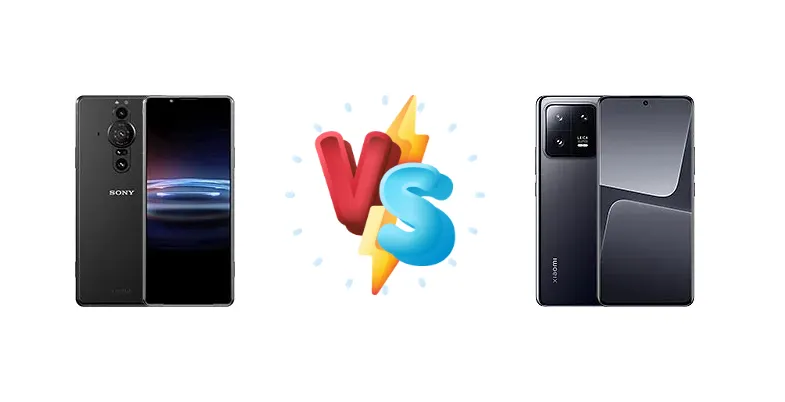
|
🏆 Quick Verdict
For the average user, the Xiaomi 13 Pro is the clear winner. Its Snapdragon 8 Gen 2 chipset provides a substantial performance boost over the Xperia Pro-I’s Snapdragon 888, coupled with significantly faster charging and a brighter, more vibrant display. While the Pro-I has its strengths, the 13 Pro offers a more modern and versatile package.
| PHONES | ||
|---|---|---|
| Phone Names | Sony Xperia Pro-I | Xiaomi 13 Pro |
| Network | ||
|---|---|---|
| 2G bands | GSM 850 / 900 / 1800 / 1900 | GSM 850 / 900 / 1800 / 1900 |
| 3G bands | HSDPA 800 / 850 / 900 / 1700(AWS) / 1900 / 2100 | HSDPA 800 / 850 / 900 / 1700(AWS) / 1900 / 2100 |
| 4G bands | 1, 2, 3, 4, 5, 7, 8, 12, 13, 17, 19, 20, 25, 26, 28, 29, 32, 34, 38, 39, 40, 41, 46, 48, 66, 71 | 1, 2, 3, 4, 5, 7, 8, 12, 13, 17, 18, 19, 20, 25, 26, 28, 32, 38, 39, 40, 41, 42, 48, 66 - International |
| 5G bands | 1, 2, 3, 5, 7, 8, 20, 28, 38, 40, 41, 66, 71, 77, 78 SA/NSA/Sub6 | 1, 3, 5, 7, 8, 20, 28, 38, 40, 41, 66, 71, 75, 77, 78 SA/NSA - International |
| Speed | HSPA, LTE, 5G | HSPA, LTE, 5G |
| Technology | GSM / HSPA / LTE / 5G | GSM / CDMA / HSPA / CDMA2000 / LTE / 5G |
| 1, 3, 5, 7, 8, 28, 38, 40, 41, 77, 78, 79 SA/NSA/Sub6 | 1, 3, 5, 8, 28, 38, 40, 41, 77, 78, 79 SA/NSA - China | |
| Launch | ||
|---|---|---|
| Announced | 2021, October 26 | 2022, December 11 |
| Status | Available. Released 2021, December 02 | Available. Released 2022, December 14 |
| Body | ||
|---|---|---|
| Build | Glass front (Gorilla Glass Victus), glass back (Gorilla Glass 6), aluminum frame | Glass front (Gorilla Glass Victus), ceramic back or silicone polymer back, aluminum frame |
| Dimensions | 166 x 72 x 8.9 mm (6.54 x 2.83 x 0.35 in) | 162.9 x 74.6 x 8.4 mm or 8.7 mm |
| SIM | Nano-SIM + Nano-SIM | · Nano-SIM + eSIM· Nano-SIM + Nano-SIM |
| Weight | 211 g (7.44 oz) | 210 g or 229 g (7.41 oz) |
| IP65/IP68 dust/water resistant (up to 1.5m for 30 min) Built-in strap-hole | IP68 dust/water resistant (up to 1.5m for 30 min) | |
| Display | ||
|---|---|---|
| Protection | Corning Gorilla Glass Victus | Corning Gorilla Glass Victus |
| Resolution | 1644 x 3840 pixels, 21:9 ratio (~643 ppi density) | 1440 x 3200 pixels, 20:9 ratio (~522 ppi density) |
| Size | 6.5 inches, 98.6 cm2 (~82.5% screen-to-body ratio) | 6.73 inches, 108.9 cm2 (~89.6% screen-to-body ratio) |
| Type | OLED, 1B colors, 120Hz, HDR BT.2020 | LTPO AMOLED, 1B colors, 120Hz, Dolby Vision, HDR10+, 1200 nits (HBM), 1900 nits (peak) |
| Runs at 1096 x 2560 pixels except for select use cases | - | |
| Platform | ||
|---|---|---|
| CPU | Octa-core (1x2.84 GHz Cortex-X1 & 3x2.42 GHz Cortex-A78 & 4x1.80 GHz Cortex-A55) | Octa-core (1x3.2 GHz Cortex-X3 & 2x2.8 GHz Cortex-A715 & 2x2.8 GHz Cortex-A710 & 3x2.0 GHz Cortex-A510) |
| Chipset | Qualcomm SM8350 Snapdragon 888 5G (5 nm) | Qualcomm SM8550-AB Snapdragon 8 Gen 2 (4 nm) |
| GPU | Adreno 660 | Adreno 740 |
| OS | Android 11, upgradable to Android 13 | Android 13, upgradable to Android 14, HyperOS |
| Memory | ||
|---|---|---|
| Card slot | microSDXC (uses shared SIM slot) | No |
| Internal | 512GB 12GB RAM | 128GB 8GB RAM, 256GB 8GB RAM, 256GB 12GB RAM, 512GB 12GB RAM |
| UFS 3.X | UFS 3.1 - 128GB UFS 4.0 - 256/512GB | |
| Main Camera | ||
|---|---|---|
| Features | Zeiss optics, Zeiss T* lens coating, color spectrum sensor, LED flash, panorama, 12-bit RAW, HDR, eye tracking | Laser AF, color spectrum sensor, Leica lens, Dual-LED dual-tone flash, HDR, panorama |
| Single | 8 MP, f/2.0, 24mm (wide), 1/4", 1.12µm | - |
| Triple | 12 MP, f/2.0-4.0, 24mm (wide), 1.0"-type, 2.4µm, dual pixel PDAF, OIS (315 PDAF points, 90% frame coverage) 12 MP, f/2.4, 50mm (telephoto), 1/2.9", PDAF, 2x optical zoom, OIS 12 MP, f/2.2, 124˚, 16mm (ultrawide), 1/2.55", dual pixel PDAF 0.3 MP, TOF 3D, (depth) | 50.3 MP, f/1.9, 23mm (wide), 1.0"-type, 1.6µm, dual pixel PDAF, OIS 50 MP, f/2.0, 75mm (telephoto), PDAF (10cm - ∞), 3.2x optical zoom 50 MP, f/2.2, 14mm, 115˚ (ultrawide), AF |
| Video | 4K@24/25/30/60/120fps HDR, 1080p@30/60/120fps; 5-axis gyro-EIS, OIS | 8K@24fps (HDR), 4K@24/30/60fps (HDR10+, 10-bit Dolby Vision HDR, 10-bit LOG), 1080p@30/120/240/960fps, 1080p@1920fps, gyro-EIS |
| Selfie camera | ||
|---|---|---|
| Features | HDR | HDR, panorama |
| Single | 8 MP, f/2.0, 24mm (wide), 1/4.0", 1.12µm | 32 MP, f/2.0, 22mm (wide), 1/3.14", 0.7µm |
| Video | 1080p@30fps, 5-axis gyro-EIS | 1080p@30fps |
| Sound | ||
|---|---|---|
| 3.5mm jack | Yes | No |
| 35mm jack | Yes | No |
| Loudspeaker | Yes, with stereo speakers | Yes, with stereo speakers |
| 24-bit/192kHz audio Dynamic vibration system | 24-bit/192kHz audio | |
| Comms | ||
|---|---|---|
| Bluetooth | 5.2, A2DP, LE, aptX HD, aptX Adaptive | 5.3, A2DP, aptX HD, aptX Adaptive |
| Infrared port | - | Yes |
| NFC | Yes | Yes |
| Positioning | GPS, GLONASS, BDS, GALILEO, QZSS | GPS (L1+L5), GLONASS (G1), BDS (B1I+B1c+B2a), GALILEO (E1+E5a), QZSS (L1+L5), NavIC (L5) |
| Radio | No | No |
| USB | USB Type-C 3.2, OTG, DisplayPort | USB Type-C 2.0, OTG |
| WLAN | Wi-Fi 802.11 a/b/g/n/ac/6, dual-band, Wi-Fi Direct, DLNA | Wi-Fi 802.11 a/b/g/n/ac/6e, dual-band, Wi-Fi Direct |
| Features | ||
|---|---|---|
| Sensors | Fingerprint (side-mounted), accelerometer, gyro, proximity, barometer, compass | Fingerprint (under display, optical), accelerometer, proximity, gyro, compass, barometer |
| Native Sony Alpha camera support | - | |
| Battery | ||
|---|---|---|
| Charging | 30W wired, PD, 50% in 30 min | 120W wired, PD3.0, QC4, 100% in 19 min 50W wireless, 100% in 36 min 10W reverse wireless |
| Type | Li-Po 4500 mAh | Li-Po 4820 mAh |
| Misc | ||
|---|---|---|
| Colors | Frosted Black | Ceramic White, Ceramic Black, Ceramic Flora Green, Mountain Blue |
| Models | XQ-BE62, XQBE62-B, XQ-BE62-B, XQ-BE62/B, XQ-BE42, XQ-BE42-B, XQ-BE42/B, XQ-BE72, XQ-BE52 | 2210132G, 2210132C |
| Price | About 930 EUR | About 750 EUR |
| Tests | ||
|---|---|---|
| Battery life | Endurance rating 87h | Endurance rating 115h |
| Camera | Photo / Video | Photo / Video |
| Display | - | Contrast ratio: Infinite (nominal) |
| Loudspeaker | -28.6 LUFS (Average) | -25.6 LUFS (Very good) |
| Performance | AnTuTu: 725839 (v9) GeekBench: 3540 (v5.1) GFXBench: 51fps (ES 3.1 onscreen) | AnTuTu: 1281666 (v9) GeekBench: 5087 (v5.1), 5323 (v6) GFXBench: 64fps (ES 3.1 onscreen) |
Sony Xperia Pro-I
- Dedicated shutter button for photography
- HDMI input for external monitoring
- Respectable battery endurance (87h)
- Older Snapdragon 888 chipset
- Slower 30W charging
- Dimmer display compared to competitors
Xiaomi 13 Pro
- Powerful Snapdragon 8 Gen 2 chipset
- Ultra-fast 120W wired charging
- Bright and vibrant display (1253 nits)
- May lack niche professional features of the Pro-I
- Software experience may differ from Sony's
Display Comparison
The Xiaomi 13 Pro boasts a significantly brighter display, reaching 1253 nits compared to the Xperia Pro-I’s 644 nits. This translates to superior visibility in direct sunlight. While both displays offer excellent quality, the Xiaomi’s higher peak brightness and infinite contrast ratio provide a more immersive viewing experience. The Pro-I’s display, while still good, feels dated in comparison. We lack PWM frequency data for both, but the Pro-I's older panel tech may be more prone to flicker.
Camera Comparison
Both phones are equipped with capable camera systems, but details are limited in the provided data. We know both support photo and video. The Xiaomi 13 Pro likely benefits from the newer image signal processor (ISP) within the Snapdragon 8 Gen 2, enabling improved image processing and noise reduction. Without sensor size or aperture information, it’s difficult to make a definitive judgment, but Xiaomi’s recent flagship cameras have consistently impressed. The Pro-I’s focus on professional video features, like HDMI input, remains a unique advantage for specific workflows.
Performance
The core difference lies in the chipsets. The Xiaomi 13 Pro’s Snapdragon 8 Gen 2 (4nm) is a generational leap over the Xperia Pro-I’s Snapdragon 888 (5nm). The Gen 2 features a Cortex-X3 prime core clocked at 3.2 GHz, alongside newer Cortex-A715 and A710 performance cores, resulting in demonstrably faster CPU and GPU performance. The 4nm process also contributes to improved thermal efficiency, meaning the Xiaomi 13 Pro is less likely to throttle under sustained load. The Pro-I’s Snapdragon 888, while still capable, struggles to compete in demanding tasks.
Battery Life
The Xiaomi 13 Pro dominates in battery and charging. Its endurance rating of 115 hours significantly exceeds the Xperia Pro-I’s 87 hours. More importantly, the 13 Pro supports 120W wired charging, achieving a full charge in just 19 minutes, a stark contrast to the Pro-I’s 30W charging which takes 30 minutes to reach 50%. The addition of 50W wireless charging and 10W reverse wireless charging further enhances the 13 Pro’s versatility. While the Pro-I’s battery life is adequate, the 13 Pro offers a much more convenient and faster charging experience.
Buying Guide
Buy the Sony Xperia Pro-I if you are a professional videographer or photographer who prioritizes direct HDMI input for external monitoring and a dedicated shutter button. Its endurance rating is respectable, but its age shows. Buy the Xiaomi 13 Pro if you prioritize raw performance, fast charging, a stunning display, and a more well-rounded flagship experience. It’s the better choice for gamers, power users, and those seeking the latest technology.