
Sony Xperia Pro-I vs OnePlus 11R: A Detailed Comparison of Flagship Power and Value
| Phones Images | |||||
|---|---|---|---|---|---|
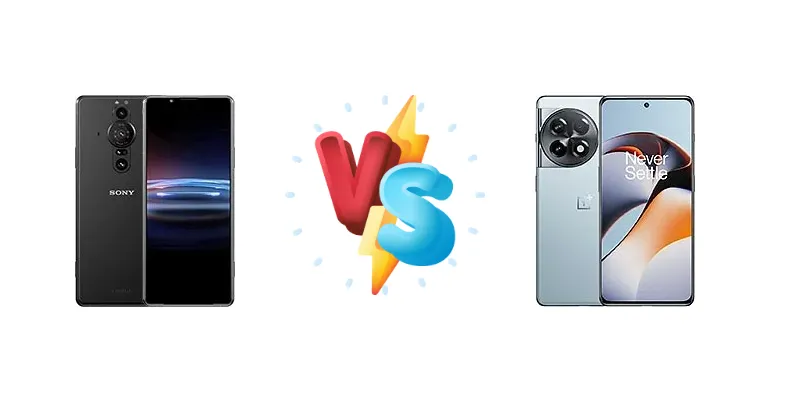
|
🏆 Quick Verdict
For most users, the OnePlus 11R emerges as the better buy. Its Snapdragon 8+ Gen 1 chipset delivers superior performance and efficiency, coupled with blazing-fast 100W charging. While the Xperia Pro-I offers a unique form factor and a focus on photography, the 11R provides a more compelling overall package at a potentially similar price point.
| PHONES | ||
|---|---|---|
| Phone Names | Sony Xperia Pro-I | OnePlus 11R |
| Network | ||
|---|---|---|
| 2G bands | GSM 850 / 900 / 1800 / 1900 | GSM 850 / 900 / 1800 / 1900 |
| 3G bands | HSDPA 800 / 850 / 900 / 1700(AWS) / 1900 / 2100 | HSDPA 850 / 900 / 1700(AWS) / 2100 |
| 4G bands | 1, 2, 3, 4, 5, 7, 8, 12, 13, 17, 19, 20, 25, 26, 28, 29, 32, 34, 38, 39, 40, 41, 46, 48, 66, 71 | 1, 3, 4, 5, 8, 28, 34, 38, 39, 40, 41 |
| 5G bands | 1, 2, 3, 5, 7, 8, 20, 28, 38, 40, 41, 66, 71, 77, 78 SA/NSA/Sub6 | 1, 3, 5, 8, 28, 40, 41, 77, 78 SA/NSA |
| Speed | HSPA, LTE, 5G | HSPA, LTE (3CA), 5G |
| Technology | GSM / HSPA / LTE / 5G | GSM / CDMA / HSPA / LTE / 5G |
| 1, 3, 5, 7, 8, 28, 38, 40, 41, 77, 78, 79 SA/NSA/Sub6 | CDMA 800 | |
| Launch | ||
|---|---|---|
| Announced | 2021, October 26 | 2023, February 07 |
| Status | Available. Released 2021, December 02 | Available. Released 2023, February 21 |
| Body | ||
|---|---|---|
| Build | Glass front (Gorilla Glass Victus), glass back (Gorilla Glass 6), aluminum frame | Glass front, glass back (Gorilla Glass 5), plastic frame |
| Dimensions | 166 x 72 x 8.9 mm (6.54 x 2.83 x 0.35 in) | 163.4 x 74.3 x 8.7 mm (6.43 x 2.93 x 0.34 in) |
| SIM | Nano-SIM + Nano-SIM | Nano-SIM + Nano-SIM |
| Weight | 211 g (7.44 oz) | 204 g (7.20 oz) |
| IP65/IP68 dust/water resistant (up to 1.5m for 30 min) Built-in strap-hole | - | |
| Display | ||
|---|---|---|
| Protection | Corning Gorilla Glass Victus | - |
| Resolution | 1644 x 3840 pixels, 21:9 ratio (~643 ppi density) | 1240 x 2772 pixels, 20:9 ratio (~451 ppi density) |
| Size | 6.5 inches, 98.6 cm2 (~82.5% screen-to-body ratio) | 6.74 inches, 109.2 cm2 (~90.0% screen-to-body ratio) |
| Type | OLED, 1B colors, 120Hz, HDR BT.2020 | Fluid AMOLED, 1B colors, 120Hz, HDR10+, 1450 nits (peak) |
| Runs at 1096 x 2560 pixels except for select use cases | - | |
| Platform | ||
|---|---|---|
| CPU | Octa-core (1x2.84 GHz Cortex-X1 & 3x2.42 GHz Cortex-A78 & 4x1.80 GHz Cortex-A55) | Octa-core (1x3.0 GHz Cortex-X2 & 3x2.5 GHz Cortex-A710 & 4x1.80 GHz Cortex-A510) |
| Chipset | Qualcomm SM8350 Snapdragon 888 5G (5 nm) | Qualcomm SM8475 Snapdragon 8+ Gen 1 (4 nm) |
| GPU | Adreno 660 | Adreno 730 |
| OS | Android 11, upgradable to Android 13 | Android 13, upgradable to Android 15, OxygenOS 15 |
| Memory | ||
|---|---|---|
| Card slot | microSDXC (uses shared SIM slot) | No |
| Internal | 512GB 12GB RAM | 128GB 8GB RAM, 256GB 16GB RAM, 512GB 18GB RAM |
| UFS 3.X | UFS 3.1 | |
| Main Camera | ||
|---|---|---|
| Features | Zeiss optics, Zeiss T* lens coating, color spectrum sensor, LED flash, panorama, 12-bit RAW, HDR, eye tracking | Color spectrum sensor, LED flash, HDR, panorama |
| Single | 8 MP, f/2.0, 24mm (wide), 1/4", 1.12µm | 16 MP, f/2.4, 24mm (wide), 1/3.09", 1.0µm |
| Triple | 12 MP, f/2.0-4.0, 24mm (wide), 1.0"-type, 2.4µm, dual pixel PDAF, OIS (315 PDAF points, 90% frame coverage) 12 MP, f/2.4, 50mm (telephoto), 1/2.9", PDAF, 2x optical zoom, OIS 12 MP, f/2.2, 124˚, 16mm (ultrawide), 1/2.55", dual pixel PDAF 0.3 MP, TOF 3D, (depth) | 50 MP, f/1.8, 24mm (wide), 1/1.56", 1.0µm, multi-directional PDAF, OIS 8 MP, f/2.2, 120˚ (ultrawide), 1/4.0", 1.12µm 2 MP (macro) |
| Video | 4K@24/25/30/60/120fps HDR, 1080p@30/60/120fps; 5-axis gyro-EIS, OIS | 4K@30/60fps, 1080p@30/60/240fps, gyro-EIS |
| Selfie camera | ||
|---|---|---|
| Features | HDR | HDR |
| Single | 8 MP, f/2.0, 24mm (wide), 1/4.0", 1.12µm | 16 MP, f/2.4, 24mm (wide), 1/3.09", 1.0µm |
| Video | 1080p@30fps, 5-axis gyro-EIS | 1080p@30fps |
| Sound | ||
|---|---|---|
| 3.5mm jack | Yes | No |
| 35mm jack | Yes | No |
| Loudspeaker | Yes, with stereo speakers | Yes, with stereo speakers |
| 24-bit/192kHz audio Dynamic vibration system | 24-bit/192kHz audio | |
| Comms | ||
|---|---|---|
| Bluetooth | 5.2, A2DP, LE, aptX HD, aptX Adaptive | 5.3, A2DP, LE, aptX HD |
| Infrared port | - | Yes |
| NFC | Yes | Yes |
| Positioning | GPS, GLONASS, BDS, GALILEO, QZSS | GPS (L1+L5), GLONASS (G1), BDS (B1I+B1c+B2a), GALILEO (E1+E5a), QZSS (L1+L5) |
| Radio | No | No |
| USB | USB Type-C 3.2, OTG, DisplayPort | USB Type-C 2.0 |
| WLAN | Wi-Fi 802.11 a/b/g/n/ac/6, dual-band, Wi-Fi Direct, DLNA | Wi-Fi 802.11 a/b/g/n/ac/6, dual-band |
| Features | ||
|---|---|---|
| Sensors | Fingerprint (side-mounted), accelerometer, gyro, proximity, barometer, compass | Fingerprint (under display, optical), accelerometer, gyro, proximity, compass |
| Native Sony Alpha camera support | - | |
| Battery | ||
|---|---|---|
| Charging | 30W wired, PD, 50% in 30 min | 100W wired |
| Type | Li-Po 4500 mAh | Li-Po 5000 mAh |
| Misc | ||
|---|---|---|
| Colors | Frosted Black | Galactic Silver, Sonic Black, Solar Red |
| Models | XQ-BE62, XQBE62-B, XQ-BE62-B, XQ-BE62/B, XQ-BE42, XQ-BE42-B, XQ-BE42/B, XQ-BE72, XQ-BE52 | CPH2487 |
| Price | About 930 EUR | About 600 EUR |
| SAR | - | 1.16 W/kg (head) 0.61 W/kg (body) |
| Tests | ||
|---|---|---|
| Battery life | Endurance rating 87h | - |
| Camera | Photo / Video | - |
| Loudspeaker | -28.6 LUFS (Average) | - |
| Performance | AnTuTu: 725839 (v9) GeekBench: 3540 (v5.1) GFXBench: 51fps (ES 3.1 onscreen) | - |
Sony Xperia Pro-I
- Compact and ergonomic design
- Professional video features (HDMI input)
- Sony’s established camera processing
- Older Snapdragon 888 chipset
- Slower 30W charging
- Potentially higher price for older hardware
OnePlus 11R
- Faster Snapdragon 8+ Gen 1 chipset
- Blazing-fast 100W charging
- Excellent value for money
- Larger form factor
- Less emphasis on professional video features
- Potentially less refined camera processing
Display Comparison
The Sony Xperia Pro-I features a 6.5-inch display capable of reaching 644 nits of peak brightness. While respectable, this is likely outshone by the OnePlus 11R’s display, which, while lacking specific brightness data, typically achieves higher peak brightness levels in OnePlus’ flagship and near-flagship devices. Both phones likely utilize OLED panels, but the Pro-I’s focus on professional use suggests a potentially wider color gamut and more accurate color calibration. The 11R, with its larger target audience, may prioritize vibrant colors over absolute accuracy. The absence of LTPO technology in either device suggests standard refresh rate management, impacting battery efficiency during dynamic content.
Camera Comparison
Both devices are marketed with strong camera capabilities, but their approaches differ. The Xperia Pro-I’s strength lies in its professional-grade features, including real-time eye autofocus and 4K 120fps video recording. However, the context data lacks specific sensor details beyond 'Photo / Video' for both. Given Sony’s expertise in image sensors, the Pro-I likely employs a larger sensor and more sophisticated image processing algorithms. The OnePlus 11R, while capable, likely focuses on a more consumer-friendly, vibrant image profile. The absence of details on OIS and lens apertures makes a definitive comparison difficult, but the Pro-I’s positioning suggests a greater emphasis on image quality and control.
Performance
The OnePlus 11R’s Snapdragon 8+ Gen 1 (4nm) represents a significant leap over the Xperia Pro-I’s Snapdragon 888 (5nm). The 8+ Gen 1’s smaller node allows for greater transistor density and improved power efficiency, resulting in sustained performance and reduced thermal throttling. The 11R’s CPU configuration – a Cortex-X2 prime core clocked at 3.0 GHz alongside three Cortex-A710 performance cores at 2.5 GHz – provides a noticeable advantage over the Pro-I’s Cortex-X1 (2.84 GHz) and A78 cores (2.42 GHz). While both phones utilize octa-core architectures, the newer generation cores and process node give the 11R a clear edge in CPU-intensive tasks and gaming.
Battery Life
The Xperia Pro-I boasts an impressive endurance rating of 87 hours, suggesting excellent battery optimization despite its older chipset. However, the OnePlus 11R compensates for any potential battery capacity difference with its 100W SuperVOOC charging. This allows for a full charge in a fraction of the time compared to the Pro-I’s 30W wired charging, which takes 30 minutes to reach 50%. While the Pro-I excels in longevity, the 11R’s rapid charging mitigates range anxiety and provides greater convenience for users who frequently need to top up their battery.
Buying Guide
Buy the Sony Xperia Pro-I if you prioritize a compact form factor, require direct HDMI input for professional video workflows, and value Sony’s established camera processing style. Buy the OnePlus 11R if you prioritize raw performance for gaming and demanding applications, need incredibly fast charging, and seek a more modern Android experience with a larger display.