
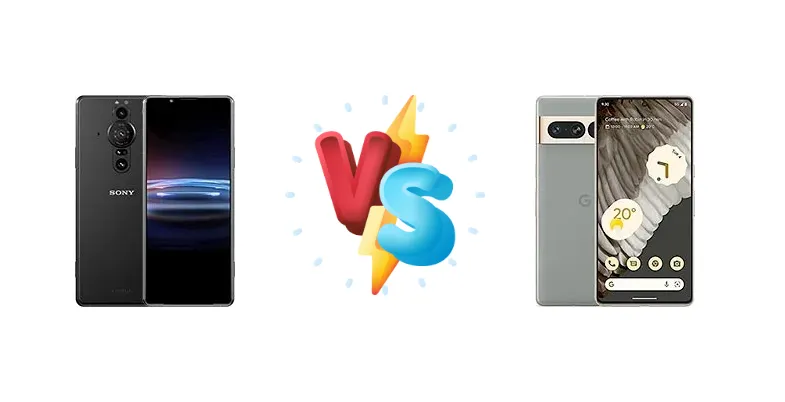
Sony Xperia Pro-I vs. Google Pixel 7 Pro: A Deep Dive for Power Users
| Phones Images | |||||
|---|---|---|---|---|---|
|
🏆 Quick Verdict
For the average user, the Google Pixel 7 Pro emerges as the more compelling choice. Its superior display brightness, advanced computational photography, and broader feature set offer a more polished and accessible experience. However, professional videographers and photographers will find the Xperia Pro-I’s external monitor support and direct HDMI input invaluable.
| PHONES | ||
|---|---|---|
| Phone Names | Sony Xperia Pro-I | Google Pixel 7 Pro |
| Network | ||
|---|---|---|
| 2G bands | GSM 850 / 900 / 1800 / 1900 | GSM 850 / 900 / 1800 / 1900 |
| 3G bands | HSDPA 800 / 850 / 900 / 1700(AWS) / 1900 / 2100 | HSDPA 800 / 850 / 900 / 1700(AWS) / 1900 / 2100 |
| 4G bands | 1, 2, 3, 4, 5, 7, 8, 12, 13, 17, 19, 20, 25, 26, 28, 29, 32, 34, 38, 39, 40, 41, 46, 48, 66, 71 | 1, 2, 3, 4, 5, 7, 8, 12, 13, 14, 17, 18, 19, 20, 25, 26, 28, 29, 30, 38, 39, 40, 41, 42, 46, 48, 66, 71 - GE2AE |
| 5G bands | 1, 2, 3, 5, 7, 8, 20, 28, 38, 40, 41, 66, 71, 77, 78 SA/NSA/Sub6 | 1, 2, 3, 5, 7, 8, 12, 14, 20, 25, 28, 30, 38, 40, 41, 48, 66, 71, 77, 78, 257, 258, 260, 261 SA/NSA/Sub6/mmWave - GE2AE |
| Speed | HSPA, LTE, 5G | HSPA, LTE, 5G |
| Technology | GSM / HSPA / LTE / 5G | GSM / CDMA / HSPA / EVDO / LTE / 5G |
| 1, 3, 5, 7, 8, 28, 38, 40, 41, 77, 78, 79 SA/NSA/Sub6 | 1, 2, 3, 5, 7, 8, 12, 14, 20, 25, 28, 30, 38, 40, 41, 48, 66, 71, 75, 76, 77, 78 SA/NSA/Sub6 - GP4BC | |
| Launch | ||
|---|---|---|
| Announced | 2021, October 26 | 2022, October 06 |
| Status | Available. Released 2021, December 02 | Available. Released 2022, October 13 |
| Body | ||
|---|---|---|
| Build | Glass front (Gorilla Glass Victus), glass back (Gorilla Glass 6), aluminum frame | Glass front (Gorilla Glass Victus), glass back (Gorilla Glass Victus), aluminum frame |
| Dimensions | 166 x 72 x 8.9 mm (6.54 x 2.83 x 0.35 in) | 162.9 x 76.6 x 8.9 mm (6.41 x 3.02 x 0.35 in) |
| SIM | Nano-SIM + Nano-SIM | Nano-SIM + eSIM |
| Weight | 211 g (7.44 oz) | 212 g (7.48 oz) |
| IP65/IP68 dust/water resistant (up to 1.5m for 30 min) Built-in strap-hole | IP68 dust/water resistant (up to 1.5m for 30 min) | |
| Display | ||
|---|---|---|
| Protection | Corning Gorilla Glass Victus | Corning Gorilla Glass Victus |
| Resolution | 1644 x 3840 pixels, 21:9 ratio (~643 ppi density) | 1440 x 3120 pixels, 19.5:9 ratio (~512 ppi density) |
| Size | 6.5 inches, 98.6 cm2 (~82.5% screen-to-body ratio) | 6.7 inches, 110.6 cm2 (~88.7% screen-to-body ratio) |
| Type | OLED, 1B colors, 120Hz, HDR BT.2020 | LTPO AMOLED, 120Hz, HDR10+, 1000 nits (HBM), 1500 nits (peak) |
| Runs at 1096 x 2560 pixels except for select use cases | Always-on display | |
| Platform | ||
|---|---|---|
| CPU | Octa-core (1x2.84 GHz Cortex-X1 & 3x2.42 GHz Cortex-A78 & 4x1.80 GHz Cortex-A55) | Octa-core (2x2.85 GHz Cortex-X1 & 2x2.35 GHz Cortex-A78 & 4x1.80 GHz Cortex-A55) |
| Chipset | Qualcomm SM8350 Snapdragon 888 5G (5 nm) | Google Tensor G2 (5 nm) |
| GPU | Adreno 660 | Mali-G710 MP7 |
| OS | Android 11, upgradable to Android 13 | Android 13, upgradable to Android 15, up to 5 major Android upgrades |
| Memory | ||
|---|---|---|
| Card slot | microSDXC (uses shared SIM slot) | No |
| Internal | 512GB 12GB RAM | 128GB 8GB RAM, 256GB 8GB RAM, 128GB 12GB RAM, 256GB 12GB RAM, 512GB 12GB RAM |
| UFS 3.X | UFS 3.1 | |
| Main Camera | ||
|---|---|---|
| Features | Zeiss optics, Zeiss T* lens coating, color spectrum sensor, LED flash, panorama, 12-bit RAW, HDR, eye tracking | Laser AF, Dual-LED flash, Pixel Shift, Auto-HDR, panorama |
| Single | 8 MP, f/2.0, 24mm (wide), 1/4", 1.12µm | 10.8 MP, f/2.2, 21mm (ultrawide), 1/3.1", 1.22µm |
| Triple | 12 MP, f/2.0-4.0, 24mm (wide), 1.0"-type, 2.4µm, dual pixel PDAF, OIS (315 PDAF points, 90% frame coverage) 12 MP, f/2.4, 50mm (telephoto), 1/2.9", PDAF, 2x optical zoom, OIS 12 MP, f/2.2, 124˚, 16mm (ultrawide), 1/2.55", dual pixel PDAF 0.3 MP, TOF 3D, (depth) | 50 MP, f/1.9, 25mm (wide), 1/1.31", 1.2µm, dual pixel PDAF, OIS 48 MP, f/3.5, 120mm (periscope telephoto), 1/2.55", 0.7µm, dual pixel PDAF, OIS, 5x optical zoom 12 MP, f/2.2, 126˚ (ultrawide), 1/2.9", 1.25µm, AF |
| Video | 4K@24/25/30/60/120fps HDR, 1080p@30/60/120fps; 5-axis gyro-EIS, OIS | 4K@30/60fps, 1080p@30/60/120/240fps; gyro-EIS, OIS, 10-bit HDR |
| Selfie camera | ||
|---|---|---|
| Features | HDR | HDR, panorama |
| Single | 8 MP, f/2.0, 24mm (wide), 1/4.0", 1.12µm | 10.8 MP, f/2.2, 21mm (ultrawide), 1/3.1", 1.22µm |
| Video | 1080p@30fps, 5-axis gyro-EIS | 4K@30/60fps, 1080p@30/60fps |
| Sound | ||
|---|---|---|
| 3.5mm jack | Yes | No |
| 35mm jack | Yes | No |
| Loudspeaker | Yes, with stereo speakers | Yes, with stereo speakers |
| 24-bit/192kHz audio Dynamic vibration system | - | |
| Comms | ||
|---|---|---|
| Bluetooth | 5.2, A2DP, LE, aptX HD, aptX Adaptive | 5.2, A2DP, LE, aptX HD |
| NFC | Yes | Yes |
| Positioning | GPS, GLONASS, BDS, GALILEO, QZSS | GPS (L1+L5), GLONASS (G1), BDS (B1I+B1c+B2a), GALILEO (E1+E5a), QZSS (L1+L5) |
| Radio | No | No |
| USB | USB Type-C 3.2, OTG, DisplayPort | USB Type-C 3.2 |
| WLAN | Wi-Fi 802.11 a/b/g/n/ac/6, dual-band, Wi-Fi Direct, DLNA | Wi-Fi 802.11 a/b/g/n/ac/6e, tri-band, Wi-Fi Direct |
| Features | ||
|---|---|---|
| Sensors | Fingerprint (side-mounted), accelerometer, gyro, proximity, barometer, compass | Fingerprint (under display, optical), accelerometer, gyro, proximity, compass, barometer |
| Native Sony Alpha camera support | Ultra Wideband (UWB) support | |
| Battery | ||
|---|---|---|
| Charging | 30W wired, PD, 50% in 30 min | 23W wired, PD3.0, 50% in 30 min 23W wireless Reverse wireless |
| Type | Li-Po 4500 mAh | Li-Ion 5000 mAh |
| Misc | ||
|---|---|---|
| Colors | Frosted Black | Obsidian, Snow, Hazel |
| Models | XQ-BE62, XQBE62-B, XQ-BE62-B, XQ-BE62/B, XQ-BE42, XQ-BE42-B, XQ-BE42/B, XQ-BE72, XQ-BE52 | GP4BC, GE2AE, GFE4J |
| Price | About 930 EUR | € 248.84 / $ 204.00 / £ 259.99 / ₹ 36,999 |
| Tests | ||
|---|---|---|
| Battery life | Endurance rating 87h | Endurance rating 83h |
| Camera | Photo / Video | Photo / Video |
| Display | - | Contrast ratio: Infinite (nominal) |
| Loudspeaker | -28.6 LUFS (Average) | -24.8 LUFS (Very good) |
| Performance | AnTuTu: 725839 (v9) GeekBench: 3540 (v5.1) GFXBench: 51fps (ES 3.1 onscreen) | AnTuTu: 796369 (v9) GeekBench: 3187 (v5.1) GFXBench: 34fps (ES 3.1 onscreen) |
Sony Xperia Pro-I
- HDMI input for external monitor connectivity
- Manual camera controls for professional workflows
- Excellent battery endurance (87h)
- Dimmer display compared to the Pixel 7 Pro
- Older Snapdragon 888 chipset
- Less refined software experience
Google Pixel 7 Pro
- Brighter and more vibrant display (1090 nits)
- Google Tensor G2 chip with AI capabilities
- Versatile camera with exceptional computational photography
- Wireless and reverse wireless charging
- Slightly lower battery endurance (83h)
- Less manual control in the camera app
- No HDMI input for external monitors
Display Comparison
The Pixel 7 Pro boasts a significantly brighter display, reaching 1090 nits compared to the Xperia Pro-I’s 644 nits. This translates to superior visibility in direct sunlight. While both utilize OLED technology, the Pixel 7 Pro’s infinite contrast ratio provides deeper blacks and more vivid colors. The Pro-I’s display, while still excellent, is noticeably less impactful outdoors. Neither specification details refresh rate, but both are expected to offer adaptive refresh rates for smoother scrolling and animations.
Camera Comparison
Both devices are equipped with versatile camera systems, but their approaches differ. The Pixel 7 Pro leverages Google’s computational photography expertise, delivering consistently excellent results with minimal user input. The Xperia Pro-I, on the other hand, prioritizes manual control and direct connectivity. The Pro-I’s standout feature is its ability to connect directly to external monitors via HDMI, enabling real-time monitoring and professional workflows. While both capture high-quality photo and video, the Pro-I caters to professionals who demand granular control over their image settings. The Pixel 7 Pro’s image processing excels in dynamic range and low-light performance, while the Pro-I offers more flexibility for color grading and post-processing.
Performance
Both phones employ an octa-core CPU configuration with Cortex-X1 and Cortex-A78 cores, but diverge in their chipsets. The Pixel 7 Pro’s Google Tensor G2 is custom-designed for machine learning tasks, excelling in areas like voice recognition and image processing. The Xperia Pro-I utilizes the Qualcomm Snapdragon 888 5G. While the Snapdragon 888 is a capable performer, the Tensor G2’s focus on AI gives the Pixel 7 Pro an edge in tasks like real-time translation and advanced camera features. The Pixel 7 Pro’s CPU has slightly higher clock speeds (2x2.85 GHz vs 1x2.84 GHz) on its prime cores, potentially offering a marginal performance boost in CPU-intensive tasks. Both utilize 5nm fabrication, but the Tensor G2’s architecture is optimized for Google’s software ecosystem.
Battery Life
Battery endurance is relatively close, with the Xperia Pro-I achieving an 87-hour rating and the Pixel 7 Pro at 83 hours. However, charging speeds differ significantly. The Xperia Pro-I supports 30W wired charging, reaching 50% in 30 minutes. The Pixel 7 Pro offers 23W wired charging (also 50% in 30 minutes) but adds the convenience of 23W wireless charging and reverse wireless charging. This gives the Pixel 7 Pro greater flexibility in charging options, especially for users who frequently utilize wireless charging or need to top up accessories.
Buying Guide
Buy the Sony Xperia Pro-I if you are a professional photographer or videographer who requires direct HDMI connectivity to external monitors for real-time review and control, and values a more manual camera experience. Buy the Google Pixel 7 Pro if you prioritize a seamless, AI-powered experience, exceptional camera versatility with computational photography, and a brighter, more vibrant display for everyday use.