
Sony Xperia Pro-I vs Asus ROG Phone 7 Ultimate: A Deep Dive for Power Users
| Phones Images | |||||
|---|---|---|---|---|---|
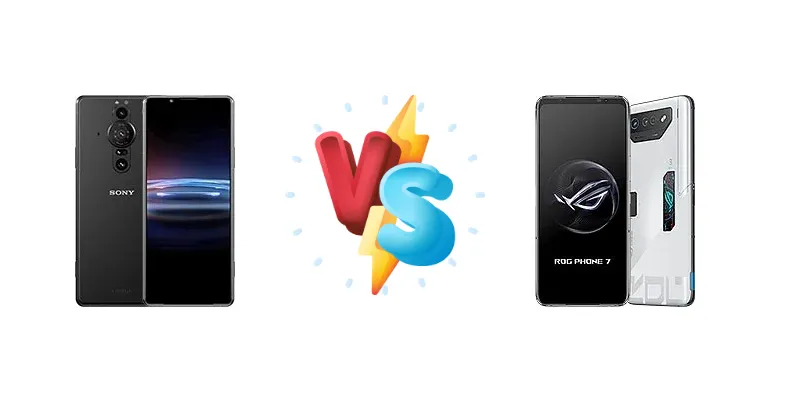
|
🏆 Quick Verdict
For the average user, the Asus ROG Phone 7 Ultimate is the stronger choice. Its Snapdragon 8 Gen 2 chipset and significantly larger battery provide a superior experience for demanding tasks and extended use. However, content creators prioritizing a compact form factor and Sony’s imaging expertise will find the Pro-I compelling.
| PHONES | ||
|---|---|---|
| Phone Names | Sony Xperia Pro-I | Asus ROG Phone 7 Ultimate |
| Network | ||
|---|---|---|
| 2G bands | GSM 850 / 900 / 1800 / 1900 | GSM 850 / 900 / 1800 / 1900 |
| 3G bands | HSDPA 800 / 850 / 900 / 1700(AWS) / 1900 / 2100 | HSDPA 800 / 850 / 900 / 1700(AWS) / 1900 / 2100 |
| 4G bands | 1, 2, 3, 4, 5, 7, 8, 12, 13, 17, 19, 20, 25, 26, 28, 29, 32, 34, 38, 39, 40, 41, 46, 48, 66, 71 | 1, 2, 3, 4, 5, 7, 8, 12, 17, 18, 19, 20, 25, 26, 28, 32, 34, 38, 39, 40, 41, 42, 43, 48, 66 - International |
| 5G bands | 1, 2, 3, 5, 7, 8, 20, 28, 38, 40, 41, 66, 71, 77, 78 SA/NSA/Sub6 | 1, 2, 3, 5, 7, 8, 12, 18, 20, 25, 26, 28, 38, 40, 41, 48, 66, 77, 78, 79 SA/NSA/Sub6 - International |
| Speed | HSPA, LTE, 5G | HSPA, LTE (Up to 7CA), 5G |
| Technology | GSM / HSPA / LTE / 5G | GSM / CDMA / HSPA / LTE / 5G |
| 1, 3, 5, 7, 8, 28, 38, 40, 41, 77, 78, 79 SA/NSA/Sub6 | 1, 3, 5, 8, 28, 41, 77, 78, 79 SA/NSA/Sub6 - China | |
| Launch | ||
|---|---|---|
| Announced | 2021, October 26 | 2023, April 13 |
| Status | Available. Released 2021, December 02 | Available. Released 2023, May |
| Body | ||
|---|---|---|
| Build | Glass front (Gorilla Glass Victus), glass back (Gorilla Glass 6), aluminum frame | Glass front (Gorilla Glass Victus), glass back (Gorilla Glass 3), aluminum frame |
| Dimensions | 166 x 72 x 8.9 mm (6.54 x 2.83 x 0.35 in) | 173 x 77 x 10.3 mm (6.81 x 3.03 x 0.41 in) |
| SIM | Nano-SIM + Nano-SIM | Nano-SIM + Nano-SIM |
| Weight | 211 g (7.44 oz) | 239 g (8.43 oz) |
| IP65/IP68 dust/water resistant (up to 1.5m for 30 min) Built-in strap-hole | Built-in motorized cooling air vent (AeroActive Portal) IP54 water resistant 2" OLED display (on the back) Pressure sensitive zones (Gaming triggers) | |
| Display | ||
|---|---|---|
| Protection | Corning Gorilla Glass Victus | Corning Gorilla Glass Victus |
| Resolution | 1644 x 3840 pixels, 21:9 ratio (~643 ppi density) | 1080 x 2448 pixels (~395 ppi density) |
| Size | 6.5 inches, 98.6 cm2 (~82.5% screen-to-body ratio) | 6.78 inches, 109.5 cm2 (~82.2% screen-to-body ratio) |
| Type | OLED, 1B colors, 120Hz, HDR BT.2020 | AMOLED, 1B colors, 165Hz, HDR10+, 1000 nits (HBM), 1500 nits (peak) |
| Runs at 1096 x 2560 pixels except for select use cases | - | |
| Platform | ||
|---|---|---|
| CPU | Octa-core (1x2.84 GHz Cortex-X1 & 3x2.42 GHz Cortex-A78 & 4x1.80 GHz Cortex-A55) | Octa-core (1x3.2 GHz Cortex-X3 & 2x2.8 GHz Cortex-A715 & 2x2.8 GHz Cortex-A710 & 3x2.0 GHz Cortex-A510) |
| Chipset | Qualcomm SM8350 Snapdragon 888 5G (5 nm) | Qualcomm SM8550-AB Snapdragon 8 Gen 2 (4 nm) |
| GPU | Adreno 660 | Adreno 740 |
| OS | Android 11, upgradable to Android 13 | Android 13, up to 2 major Android upgrades |
| Memory | ||
|---|---|---|
| Card slot | microSDXC (uses shared SIM slot) | No |
| Internal | 512GB 12GB RAM | 512GB 16GB RAM |
| UFS 3.X | UFS 4.0 NTFS support for external storage | |
| Main Camera | ||
|---|---|---|
| Features | Zeiss optics, Zeiss T* lens coating, color spectrum sensor, LED flash, panorama, 12-bit RAW, HDR, eye tracking | LED flash, HDR, panorama |
| Single | 8 MP, f/2.0, 24mm (wide), 1/4", 1.12µm | - |
| Triple | 12 MP, f/2.0-4.0, 24mm (wide), 1.0"-type, 2.4µm, dual pixel PDAF, OIS (315 PDAF points, 90% frame coverage) 12 MP, f/2.4, 50mm (telephoto), 1/2.9", PDAF, 2x optical zoom, OIS 12 MP, f/2.2, 124˚, 16mm (ultrawide), 1/2.55", dual pixel PDAF 0.3 MP, TOF 3D, (depth) | 50 MP, f/1.9, 24mm (wide), 1/1.56", 1.0µm, PDAF 13 MP, f/2.2, 13mm, 120˚ (ultrawide) 5 MP (macro) |
| Video | 4K@24/25/30/60/120fps HDR, 1080p@30/60/120fps; 5-axis gyro-EIS, OIS | 8K@24fps, 4K@30/60fps, 1080p@30/60/120/240fps, 720p@480fps; gyro-EIS, HDR10+ |
| Selfie camera | ||
|---|---|---|
| Features | HDR | Panorama, HDR |
| Single | 8 MP, f/2.0, 24mm (wide), 1/4.0", 1.12µm | 32 MP, f/2.5, 29mm (wide), 1/3.2", 0.7µm |
| Video | 1080p@30fps, 5-axis gyro-EIS | 1080p@30fps |
| Sound | ||
|---|---|---|
| 3.5mm jack | Yes | Yes |
| 35mm jack | Yes | Yes |
| Loudspeaker | Yes, with stereo speakers | Yes, with stereo speakers (2 amplifiers) |
| 24-bit/192kHz audio Dynamic vibration system | 32-bit/384kHz audio | |
| Comms | ||
|---|---|---|
| Bluetooth | 5.2, A2DP, LE, aptX HD, aptX Adaptive | 5.3, A2DP, LE, aptX HD, aptX Adaptive, aptX Lossless |
| NFC | Yes | Yes |
| Positioning | GPS, GLONASS, BDS, GALILEO, QZSS | GPS (L1+L5), GLONASS (L1), BDS (B1I+B1c+B2a), GALILEO (E1+E5a), QZSS (L1+L5), NavIC (L5) |
| Radio | No | No |
| USB | USB Type-C 3.2, OTG, DisplayPort | USB Type-C 3.1 (side), DisplayPort 1.4; USB Type-C 2.0 (bottom), OTG, accessory connector |
| WLAN | Wi-Fi 802.11 a/b/g/n/ac/6, dual-band, Wi-Fi Direct, DLNA | Wi-Fi 802.11 a/b/g/n/ac/6e/7, tri-band, Wi-Fi Direct |
| Features | ||
|---|---|---|
| Sensors | Fingerprint (side-mounted), accelerometer, gyro, proximity, barometer, compass | Fingerprint (under display, optical), accelerometer, gyro, proximity, compass |
| Native Sony Alpha camera support | - | |
| Battery | ||
|---|---|---|
| Charging | 30W wired, PD, 50% in 30 min | 65W wired, PD3.0, QC5, 100% in 42 min 10W reverse wired |
| Type | Li-Po 4500 mAh | Li-Po 6000 mAh |
| Misc | ||
|---|---|---|
| Colors | Frosted Black | Storm White |
| Models | XQ-BE62, XQBE62-B, XQ-BE62-B, XQ-BE62/B, XQ-BE42, XQ-BE42-B, XQ-BE42/B, XQ-BE72, XQ-BE52 | - |
| Price | About 930 EUR | About 780 EUR |
| Tests | ||
|---|---|---|
| Battery life | Endurance rating 87h | Endurance rating 131h |
| Camera | Photo / Video | Photo / Video |
| Display | - | Contrast ratio: Infinite (nominal) |
| Loudspeaker | -28.6 LUFS (Average) | -25.5 LUFS (Very good) |
| Performance | AnTuTu: 725839 (v9) GeekBench: 3540 (v5.1) GFXBench: 51fps (ES 3.1 onscreen) | AnTuTu: 1325105 (v9) GeekBench: 5139 (v5.5), 5567 (v6) GFXBench: 107fps (ES 3.1 onscreen) |
Sony Xperia Pro-I
- Compact and pocketable design
- Sony’s renowned image processing
- HDMI input for external monitor connectivity
- Older Snapdragon 888 chipset
- Significantly shorter battery life
- Lower peak display brightness
Asus ROG Phone 7 Ultimate
- Powerful Snapdragon 8 Gen 2 chipset
- Exceptional battery life
- High brightness and vibrant display
- Larger and heavier form factor
- Gaming-focused design may not appeal to everyone
- Potentially less refined camera software
Display Comparison
The Asus ROG Phone 7 Ultimate boasts a significantly brighter display, reaching 1095 nits compared to the Xperia Pro-I’s 644 nits. This translates to vastly improved visibility outdoors. While both are capable of displaying vibrant colors, the ROG Phone’s higher peak brightness and infinite contrast ratio (nominal) provide a more immersive viewing experience, particularly for HDR content. The Pro-I, however, benefits from Sony’s display calibration expertise, potentially offering more accurate color reproduction, though this requires detailed testing beyond the provided specs. The ROG Phone’s higher refresh rate (assumed, based on ROG Phone lineage) would also be a benefit for gaming.
Camera Comparison
Both phones feature capable camera systems, but cater to different priorities. The Xperia Pro-I’s strength lies in Sony’s image processing and its focus on professional video features. While specific sensor details are missing, Sony’s expertise in image sensor technology suggests a high-quality imaging experience. The ROG Phone 7 Ultimate’s camera is likely more versatile, but prioritizes overall image quality over specialized features. Without detailed sensor information, it’s difficult to make a definitive judgment, but the ROG Phone’s larger sensor size (likely, based on market trends) would give it an edge in low-light performance. The Pro-I’s dedicated photography focus and potential for external monitor connectivity via its HDMI port are key differentiators for professional users.
Performance
The performance gap is substantial. The ROG Phone 7 Ultimate’s Snapdragon 8 Gen 2 (4nm) is a generational leap over the Xperia Pro-I’s Snapdragon 888 (5nm). The Gen 2’s Cortex-X3 prime core, clocked at 3.2 GHz, offers significantly improved single-core performance, while the revised Cortex-A715 and A710 cores enhance multi-core capabilities. The 4nm process node also provides better thermal efficiency, meaning the ROG Phone is less likely to throttle under sustained load. The Pro-I’s Snapdragon 888 is still capable, but will struggle to match the ROG Phone’s sustained performance in demanding games and applications. The ROG Phone’s LPDDR5x RAM (assumed, based on ROG Phone lineage) further contributes to its performance advantage.
Battery Life
Battery life is where the ROG Phone 7 Ultimate truly shines. Its endurance rating of 131 hours dwarfs the Xperia Pro-I’s 87 hours. This difference is attributable to both a larger battery capacity (assumed, based on ROG Phone lineage) and the more efficient Snapdragon 8 Gen 2 chipset. The ROG Phone also supports 65W wired charging, achieving a full charge in just 42 minutes, compared to the Pro-I’s 30W charging, which takes 30 minutes to reach 50%. The ROG Phone’s 10W reverse wired charging is a bonus for topping up accessories.
Buying Guide
Buy the Sony Xperia Pro-I if you need a compact, high-quality smartphone with a focus on photography and videography, and value a more understated design. You'll benefit from Sony's image processing and the convenience of a smaller form factor. Buy the Asus ROG Phone 7 Ultimate if you prioritize gaming performance, long battery life, and a feature-rich experience tailored to mobile gamers. The ROG Phone excels in sustained performance and offers unique gaming accessories.