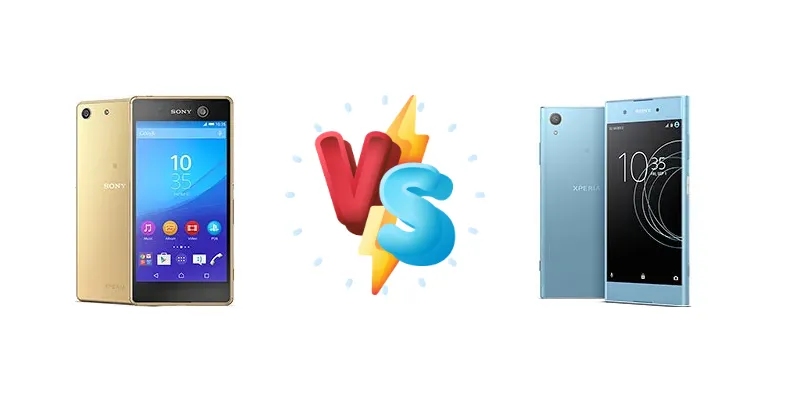
Choosing between two older Sony smartphones can be tricky. The Xperia M5 and XA1 Plus both offer unique features, but which one is the better choice for your needs? This comprehensive comparison will delve into their key aspects to help you decide.
🏆 Quick Verdict
The Xperia XA1 Plus edges out the M5 thanks to its significantly better battery life, improved display contrast, and more modern chipset. While the M5 had a slight edge in some early camera tests, the XA1 Plus offers a more well-rounded and enjoyable user experience.
| Network |
|---|
| 2G bands | GSM 850 / 900 / 1800 / 1900 | GSM 850 / 900 / 1800 / 1900 - SIM 1 & SIM 2 (dual-SIM model only) |
| 3G bands | HSDPA 850 / 900 / 1900 / 2100 - E5603, E5653 | HSDPA 850 / 900 / 1900 / 2100 - G3421, G3412, G3416, G3426 |
| 4G bands | 1, 3, 5, 7, 8, 20 - E5603 | 1, 2, 3, 5, 7, 8, 20 - G3421, G3412 |
| Speed | HSPA 42.2/5.76 Mbps, LTE Cat4 150/50 Mbps | HSPA 42.2/5.76 Mbps, LTE Cat4 150/50 Mbps or LTE (2CA) Cat6 300/50 Mbps |
| Technology | GSM / HSPA / LTE | GSM / HSPA / LTE |
| | 1, 3, 5, 7, 8, 28, 40 - E5653 | 1, 3, 5, 7, 8, 28, 38, 39, 40, 41 - G3416, G3426 |
| Launch |
|---|
| Announced | 2015, August. Released 2015, September | 2017, August. Released 2017, October |
| Status | Discontinued | Discontinued |
| Body |
|---|
| Build | - | Glass front (Gorilla Glass 4), plastic back, aluminum frame |
| Dimensions | 145 x 72 x 7.6 mm (5.71 x 2.83 x 0.30 in) | 155 x 75 x 8.7 mm (6.10 x 2.95 x 0.34 in) |
| SIM | Nano-SIM | · Nano-SIM· Nano-SIM + Nano-SIM |
| Weight | 142.5 g (5.04 oz) | 189 g (6.67 oz) |
| | IP68 dust/water resistant (up to 1.5m for 30 min) | - |
| Display |
|---|
| Protection | Scratch-resistant glass | Corning Gorilla Glass 4 |
| Resolution | 1080 x 1920 pixels, 16:9 ratio (~441 ppi density) | 1080 x 1920 pixels, 16:9 ratio (~401 ppi density) |
| Size | 5.0 inches, 68.9 cm2 (~66.0% screen-to-body ratio) | 5.5 inches, 83.4 cm2 (~71.7% screen-to-body ratio) |
| Type | IPS LCD | IPS LCD |
| Platform |
|---|
| CPU | Octa-core 2.0 GHz Cortex-A53 | Octa-core (4x2.3 GHz Cortex-A53 & 4x1.6 GHz Cortex-A53) |
| Chipset | Mediatek MT6795 Helio X10 (28 nm) | Mediatek MT6757 Helio P20 (16 nm) |
| GPU | PowerVR G6200 | Mali-T880MP2 |
| OS | Android 5.0.1 (Lollipop), upgradable to 6.0.1 (Marshmallow) | Android 7.0 (Nougat), upgradable to Android 8.0 (Oreo) |
| Memory |
|---|
| Card slot | microSDXC (dedicated slot) | microSDXC (dedicated slot) |
| Internal | 16GB 3GB RAM | 32GB 3GB RAM, 32GB 4GB RAM |
| | eMMC 5.0 | - |
| Main Camera |
|---|
| Features | LED flash, HDR, panorama | LED flash, HDR, panorama |
| Single | 21.2 MP, f/2.2, PDAF | 23 MP, f/2.0, 24mm (wide), 1/2.3", PDAF |
| Video | 4K@30fps, HDR | 1080p@30fps, HDR |
| Selfie camera |
|---|
| Single | 13 MP, f/2.0, AF | 8 MP, f/2.0, 23mm (wide), 1/4.0", AF |
| Video | 1080p@30fps | 1080p@30fps |
| Sound |
|---|
| 3.5mm jack | Yes | Yes |
| 35mm jack | Yes | Yes |
| Loudspeaker | Yes | Yes |
| Comms |
|---|
| Bluetooth | 4.1, A2DP, LE, aptX | 4.2, A2DP, aptX, LE |
| NFC | Yes | Yes |
| Positioning | GPS, GLONASS | GPS, GLONASS |
| Radio | FM radio, RDS | FM radio |
| USB | microUSB 2.0 | USB Type-C 2.0, OTG |
| WLAN | Wi-Fi 802.11 a/b/g/n, dual-band, Wi-Fi Direct, DLNA, hotspot | Wi-Fi 802.11 a/b/g/n, Wi-Fi Direct |
| Features |
|---|
| Sensors | Accelerometer, proximity, compass | Fingerprint (side-mounted), accelerometer, proximity, compass |
| Battery |
|---|
| Charging | - | 10W wired |
| Music play | Up to 62 h 30 min | - |
| Stand-by | Up to 671 h (2G) / Up to 656 h (3G) | - |
| Talk time | Up to 11 h 49 min (2G) / Up to 12 h 11 min (3G) | - |
| Type | Li-Ion 2600 mAh, non-removable | Li-Ion 3430 mAh, non-removable |
| Misc |
|---|
| Colors | Black, White, Gold | Black, Blue, Pink, Gold |
| Models | E5603, E5606, E5653 | G3416, G3412, G3426, G3421, G3423 |
| Price | About 110 EUR | About 150 EUR |
| SAR | 0.32 W/kg (head) 1.39 W/kg (body) | - |
| SAR EU | 0.19 W/kg (head) 0.40 W/kg (body) | - |
| Tests |
|---|
| Audio quality |
Noise -94.1dB / Crosstalk -93.4dB |
Noise -90.6dB / Crosstalk -83.5dB |
| Battery life | - |
Endurance rating 102h
|
| Camera |
Photo / Video |
Photo / Video |
| Display |
Contrast ratio: 839 (nominal), 2.69(sunlight) |
Contrast ratio: 1572 (nominal), 2.93 (sunlight) |
| Loudspeaker |
Voice 65dB / Noise 64dB / Ring 68dB
|
Voice 88dB / Noise 77dB / Ring 84dB
|
| Performance |
Basemark OS II 2.0: 860Basemark X: 7780 |
AnTuTu: 77232 (v7), 95157 (v8)
GeekBench: 3783 (v4.4), 915 (v5.1)
GFXBench: 4fps (ES 3.1 onscreen) |
Sony Xperia M5
- Compact design
- Potentially faster CPU in some scenarios
- Decent camera (early reviews)
- Lower contrast ratio display
- Shorter battery life
- Older chipset
Sony Xperia XA1 Plus
- Excellent battery life
- Superior display contrast and sunlight readability
- More modern and efficient chipset
- Larger screen
- Slightly larger size
- Camera performance may not be significantly better than M5
Display Comparison
The Xperia XA1 Plus boasts a superior display with a significantly higher contrast ratio (1572 vs 839) and better sunlight readability (2.93 vs 2.69). Both phones feature similar display technology (likely IPS LCD), but the XA1 Plus's improvements make a noticeable difference in image quality and outdoor visibility.
Camera Comparison
Both phones offer 'Photo / Video' capabilities, but detailed camera comparisons are difficult without specific testing data. Early reviews suggested the M5 had a slight edge in certain lighting conditions, but the XA1 Plus's camera has been praised for its consistent performance and image quality. Both likely offer decent image quality for their respective price points.
Performance
The Xperia XA1 Plus's Mediatek Helio P20 chipset (16nm) is generally more efficient than the M5's Helio X10 (28nm). While both have octa-core CPUs, the XA1 Plus's CPU configuration (4x2.3 GHz & 4x1.6 GHz) offers a more balanced approach to performance and power consumption. The M5's CPU (all cores at 2.0 GHz) might feel slightly faster in some benchmarks, but the XA1 Plus provides smoother overall performance.
Battery Life
This is where the Xperia XA1 Plus truly shines. Its endurance rating of 102h is exceptional, significantly outperforming the M5. This translates to significantly longer battery life for the XA1 Plus, making it a much better choice for users who need a phone that can last through a full day or more.
Buying Guide
The Sony Xperia M5 is a good option for budget-conscious users who prioritize a slightly more compact design and potentially faster performance in specific scenarios. The Xperia XA1 Plus is ideal for those seeking long battery life, a brighter and more vibrant display, and a more modern processor for smoother everyday use.
Frequently Asked Questions
❓ Which phone is better for gaming?
The Xperia XA1 Plus's more efficient chipset and better thermal management likely make it a slightly better choice for gaming, although both phones are approaching their age and may struggle with demanding titles.
❓ Is the Xperia M5 still worth buying?
The Xperia M5 can be a decent budget option if you find it at a very low price, but the Xperia XA1 Plus offers a significantly better overall experience for a small price difference.