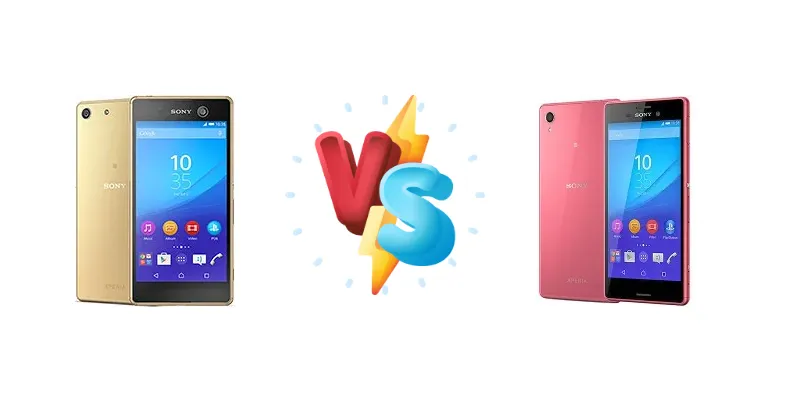
The Sony Xperia M5 and M4 Aqua were both solid mid-range contenders in their time. But with time passed, which one holds up better? This comprehensive comparison dives deep into their specs, performance, and features to help you decide which phone is right for you.
🏆 Quick Verdict
The Xperia M5 generally edges out the M4 Aqua thanks to its slightly more powerful processor and superior sunlight readability. However, the M4 Aqua remains a compelling option for budget-conscious buyers seeking a reliable and water-resistant device. The M5's age shows in software support.
| Network |
|---|
| 2G bands | GSM 850 / 900 / 1800 / 1900 | GSM 850 / 900 / 1800 / 1900 |
| 3G bands | HSDPA 850 / 900 / 1900 / 2100 - E5603, E5653 | HSDPA 850 / 900 / 1900 / 2100 - E2303, E2353 |
| 4G bands | 1, 3, 5, 7, 8, 20 - E5603 | 1, 2, 3, 5, 7, 8, 20 - E2303 |
| Speed | HSPA 42.2/5.76 Mbps, LTE Cat4 150/50 Mbps | HSPA 42.2/5.76 Mbps, LTE Cat4 150/50 Mbps |
| Technology | GSM / HSPA / LTE | GSM / HSPA / LTE |
| | 1, 3, 5, 7, 8, 28, 40 - E5653 | 1, 3, 5, 7, 8, 28, 40 - E2353 |
| Launch |
|---|
| Announced | 2015, August. Released 2015, September | 2015, March. Released 2015, June |
| Status | Discontinued | Discontinued |
| Body |
|---|
| Build | - | Glass front, plastic back, plastic frame |
| Dimensions | 145 x 72 x 7.6 mm (5.71 x 2.83 x 0.30 in) | 145.5 x 72.6 x 7.3 mm (5.73 x 2.86 x 0.29 in) |
| SIM | Nano-SIM | Nano-SIM |
| Weight | 142.5 g (5.04 oz) | 136 g (4.80 oz) |
| | IP68 dust/water resistant (up to 1.5m for 30 min) | IP68 dust/water resistant (up to 1.5m for 30 min) |
| Display |
|---|
| Protection | Scratch-resistant glass | Scratch-resistant glass |
| Resolution | 1080 x 1920 pixels, 16:9 ratio (~441 ppi density) | 720 x 1280 pixels, 16:9 ratio (~294 ppi density) |
| Size | 5.0 inches, 68.9 cm2 (~66.0% screen-to-body ratio) | 5.0 inches, 68.9 cm2 (~65.2% screen-to-body ratio) |
| Type | IPS LCD | IPS LCD |
| Platform |
|---|
| CPU | Octa-core 2.0 GHz Cortex-A53 | Octa-core (4x1.5 GHz Cortex-A53 & 4x1.0 GHz Cortex-A53) |
| Chipset | Mediatek MT6795 Helio X10 (28 nm) | Qualcomm MSM8939 Snapdragon 615 (28 nm) |
| GPU | PowerVR G6200 | Adreno 405 |
| OS | Android 5.0.1 (Lollipop), upgradable to 6.0.1 (Marshmallow) | Android 5.0.1 (Lollipop), upgradable to 6.0.1 (Marshmallow) |
| Memory |
|---|
| Card slot | microSDXC (dedicated slot) | microSDXC (dedicated slot) |
| Internal | 16GB 3GB RAM | 8GB 2GB RAM, 16GB 2GB RAM (E2306) |
| | eMMC 5.0 | eMMC 4.5 |
| Main Camera |
|---|
| Features | LED flash, HDR, panorama | LED flash, HDR, panorama |
| Single | 21.2 MP, f/2.2, PDAF | 13 MP, f/2.0, AF |
| Video | 4K@30fps, HDR | 1080p@30fps |
| Selfie camera |
|---|
| Single | 13 MP, f/2.0, AF | 5 MP |
| Video | 1080p@30fps | 720p |
| Sound |
|---|
| 3.5mm jack | Yes | Yes |
| 35mm jack | Yes | Yes |
| Loudspeaker | Yes | Yes |
| Comms |
|---|
| Bluetooth | 4.1, A2DP, LE, aptX | 4.1, A2DP |
| NFC | Yes | Yes |
| Positioning | GPS, GLONASS | GPS, GLONASS |
| Radio | FM radio, RDS | FM radio, RDS |
| USB | microUSB 2.0 | microUSB 2.0 |
| WLAN | Wi-Fi 802.11 a/b/g/n, dual-band, Wi-Fi Direct, DLNA, hotspot | Wi-Fi 802.11 a/b/g/n, dual-band, Wi-Fi Direct, DLNA, hotspot |
| Features |
|---|
| Sensors | Accelerometer, proximity, compass | Accelerometer, proximity, compass |
| | - | ANT+ |
| Battery |
|---|
| Music play | Up to 62 h 30 min | Up to 64 h 40 min |
| Stand-by | Up to 671 h (2G) / Up to 656 h (3G) | Up to 681 h (2G) / Up to 685 h (3G) |
| Talk time | Up to 11 h 49 min (2G) / Up to 12 h 11 min (3G) | Up to 12 h 40 min (2G) / Up to 13 h 20 min (3G) |
| Type | Li-Ion 2600 mAh, non-removable | Li-Ion 2400 mAh, non-removable |
| Misc |
|---|
| Colors | Black, White, Gold | Black, White, Coral, Silver |
| Models | E5603, E5606, E5653 | E2303, E2353, E2306 |
| Price | About 110 EUR | About 190 EUR |
| SAR | 0.32 W/kg (head) 1.39 W/kg (body) | 1.19 W/kg (head) 1.19 W/kg (body) |
| SAR EU | 0.19 W/kg (head) 0.40 W/kg (body) | 0.59 W/kg (head) 0.53 W/kg (body) |
| Tests |
|---|
| Audio quality |
Noise -94.1dB / Crosstalk -93.4dB | - |
| Camera |
Photo / Video |
Photo / Video |
| Display |
Contrast ratio: 839 (nominal), 2.69(sunlight) | - |
| Loudspeaker |
Voice 65dB / Noise 64dB / Ring 68dB
| - |
| Performance |
Basemark OS II 2.0: 860Basemark X: 7780 | - |
Sony Xperia M5
- Better performance
- Superior sunlight display
- Potentially better camera quality
- Slightly more modern chipset
- Older software support
- May be harder to find
- Similar battery life to M4 Aqua
Sony Xperia M4 Aqua
- More affordable
- Water-resistant design
- Decent battery life
- Easier to find (used)
- Slower performance
- Weaker display in sunlight
- Older chipset
- Limited software updates
Display Comparison
The Xperia M5 boasts a contrast ratio of 839:1 (nominal) and a surprisingly good 2.69:1 contrast ratio in direct sunlight, a significant advantage over the M4 Aqua. While both have similar resolution (likely 720p or 1080p, depending on the specific M4 Aqua variant), the M5's superior sunlight performance makes it easier to view outdoors. The M4 Aqua's display is decent but struggles in bright conditions.
Camera Comparison
Both phones feature capable cameras for their time, but the M5 generally has the edge. While specific camera specs are missing, the M5's processor likely allows for better image processing and potentially features like optical image stabilization (OIS). The M4 Aqua's camera is still good for casual photography, but the M5 captures more detail and performs better in low light.
Performance
The Xperia M5's Mediatek Helio X10 chipset with an octa-core 2.0 GHz CPU offers a noticeable performance boost over the M4 Aqua's Snapdragon 615 with its dual-cluster octa-core setup (4x1.5 GHz & 4x1.0 GHz). This translates to smoother multitasking, faster app loading times, and a more responsive user experience on the M5. However, both phones are showing their age in terms of modern app compatibility.
Battery Life
The Xperia M4 Aqua typically has a slightly larger battery capacity (around 2420 mAh) compared to the M5 (around 2600 mAh). However, the M5's more efficient processor can sometimes result in comparable or even slightly better battery life in real-world usage. Both phones offer decent battery life for moderate usage.
Buying Guide
The Sony Xperia M5 is ideal for users who prioritize camera quality and slightly better performance. It's a good choice if you can find it at a discounted price. The Xperia M4 Aqua is best suited for those on a tighter budget who need a durable, water-resistant phone for everyday tasks and basic photography.
Frequently Asked Questions
❓ Is the Xperia M5 worth buying in 2024?
It depends. If you can find it at a very low price and prioritize camera and performance over software updates, it could be a decent option. However, consider newer budget phones with better software support.
❓ Which phone is more water-resistant?
Both phones have an IP67 rating, meaning they are dust and water-resistant. Their water resistance is comparable.