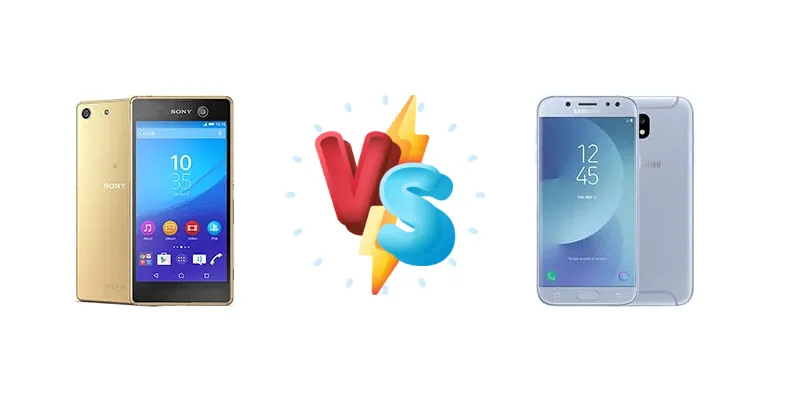
The Sony Xperia M5 and Samsung Galaxy J5 (2017) were both popular mid-range Android phones. Both offered a decent experience for their price point, but which one ultimately delivers more? This comprehensive comparison dives deep into their specs, performance, and features to help you decide.
🏆 Quick Verdict
The Samsung Galaxy J5 (2017) edges out the Xperia M5 thanks to its significantly better battery life and superior sunlight display performance. While the M5 might have a slight edge in certain camera scenarios, the J5's overall package is more compelling for most users.
| Network |
|---|
| 2G bands | GSM 850 / 900 / 1800 / 1900 | GSM 850 / 900 / 1800 / 1900 - SIM 1 & SIM 2 (dual-SIM model only) |
| 3G bands | HSDPA 850 / 900 / 1900 / 2100 - E5603, E5653 | HSDPA 850 / 900 / 1700(AWS) / 1900 / 2100 |
| 4G bands | 1, 3, 5, 7, 8, 20 - E5603 | 1, 3, 5, 7, 8, 20, 40 |
| Speed | HSPA 42.2/5.76 Mbps, LTE Cat4 150/50 Mbps | HSPA 42.2/5.76 Mbps, LTE (2CA) Cat6 300/50 Mbps |
| Technology | GSM / HSPA / LTE | GSM / HSPA / LTE |
| | 1, 3, 5, 7, 8, 28, 40 - E5653 | - |
| Launch |
|---|
| Announced | 2015, August. Released 2015, September | 2017, June. Released 2017, June |
| Status | Discontinued | Discontinued |
| Body |
|---|
| Build | - | Glass front, aluminum back, aluminum frame |
| Dimensions | 145 x 72 x 7.6 mm (5.71 x 2.83 x 0.30 in) | 146.2 x 71.3 x 8 mm (5.76 x 2.81 x 0.31 in) |
| SIM | Nano-SIM | · Nano-SIM· Nano-SIM + Nano-SIM |
| Weight | 142.5 g (5.04 oz) | 160 g (5.64 oz) |
| | IP68 dust/water resistant (up to 1.5m for 30 min) | - |
| Display |
|---|
| Protection | Scratch-resistant glass | - |
| Resolution | 1080 x 1920 pixels, 16:9 ratio (~441 ppi density) | 720 x 1280 pixels, 16:9 ratio (~282 ppi density) |
| Size | 5.0 inches, 68.9 cm2 (~66.0% screen-to-body ratio) | 5.2 inches, 74.5 cm2 (~71.5% screen-to-body ratio) |
| Type | IPS LCD | Super AMOLED |
| Platform |
|---|
| CPU | Octa-core 2.0 GHz Cortex-A53 | Octa-core 1.6 GHz Cortex-A53 |
| Chipset | Mediatek MT6795 Helio X10 (28 nm) | Exynos 7870 Octa (14 nm) |
| GPU | PowerVR G6200 | Mali-T830 MP1 |
| OS | Android 5.0.1 (Lollipop), upgradable to 6.0.1 (Marshmallow) | Android 7.0 (Nougat), upgradable to Android 9.0 (Pie), One UI |
| Memory |
|---|
| Card slot | microSDXC (dedicated slot) | microSDXC (dedicated slot) |
| Internal | 16GB 3GB RAM | 16GB 2GB RAM, 32GB 2GB RAM, 32GB 3GB RAM |
| | eMMC 5.0 | eMMC 5.1 |
| Main Camera |
|---|
| Features | LED flash, HDR, panorama | LED flash, panorama, HDR |
| Single | 21.2 MP, f/2.2, PDAF | 13 MP, f/1.7, 27mm (wide), 1/3.1", 1.12µm, AF |
| Video | 4K@30fps, HDR | 1080p@30fps |
| Selfie camera |
|---|
| Features | - | LED flash |
| Single | 13 MP, f/2.0, AF | 13 MP, f/1.9, 1/3.1", 1.12µm |
| Video | 1080p@30fps | 1080p@30fps |
| Sound |
|---|
| 3.5mm jack | Yes | Yes |
| 35mm jack | Yes | Yes |
| Loudspeaker | Yes | Yes |
| Comms |
|---|
| Bluetooth | 4.1, A2DP, LE, aptX | 4.1, A2DP |
| NFC | Yes | Yes |
| Positioning | GPS, GLONASS | GPS, GLONASS, BDS |
| Radio | FM radio, RDS | FM radio |
| USB | microUSB 2.0 | microUSB 2.0 |
| WLAN | Wi-Fi 802.11 a/b/g/n, dual-band, Wi-Fi Direct, DLNA, hotspot | Wi-Fi 802.11 a/b/g/n/ac, dual-band, Wi-Fi Direct |
| Features |
|---|
| Sensors | Accelerometer, proximity, compass | Fingerprint (front-mounted), accelerometer, gyro, proximity, compass |
| | - | ANT+ |
| Battery |
|---|
| Music play | Up to 62 h 30 min | Up to 83 h |
| Stand-by | Up to 671 h (2G) / Up to 656 h (3G) | - |
| Talk time | Up to 11 h 49 min (2G) / Up to 12 h 11 min (3G) | Up to 21 h (3G) |
| Type | Li-Ion 2600 mAh, non-removable | Li-Ion 3000 mAh, non-removable |
| Misc |
|---|
| Colors | Black, White, Gold | Blue, Pink, Gold, Black |
| Models | E5603, E5606, E5653 | SM-J530F, SM-J530Y, SM-J530FM, SM-J530G, SM-J530YM, SM-J530L, SM-J530S, SM-J530K, SM-J530GM |
| Price | About 110 EUR | About 130 EUR |
| SAR | 0.32 W/kg (head) 1.39 W/kg (body) | - |
| SAR EU | 0.19 W/kg (head) 0.40 W/kg (body) | 0.35 W/kg (head) 1.36 W/kg (body) |
| Tests |
|---|
| Audio quality |
Noise -94.1dB / Crosstalk -93.4dB |
Noise -85.0dB / Crosstalk -90.3dB |
| Battery life | - |
Endurance rating 97h
|
| Camera |
Photo / Video |
Photo / Video |
| Display |
Contrast ratio: 839 (nominal), 2.69(sunlight) |
Contrast ratio: Infinite (nominal), 3.599 (sunlight) |
| Loudspeaker |
Voice 65dB / Noise 64dB / Ring 68dB
|
Voice 68dB / Noise 70dB / Ring 82dB
|
| Performance |
Basemark OS II 2.0: 860Basemark X: 7780 |
GeekBench: 3667 (v4.4)
GFXBench: 3.8fps (ES 3.1 onscreen) |
Sony Xperia M5
- Potentially better camera detail in good light
- Compact design
- Water resistant
- Weaker battery life
- Lower sunlight display readability
- Older chipset
Samsung Galaxy J5 (2017)
- Exceptional battery life
- Brighter and more readable display
- Slightly better performance
- Samsung's UI
- Camera may lack detail compared to M5 in some scenarios
- Plastic build
Display Comparison
Both phones feature Super AMOLED (J5) and IPS LCD (M5) displays, respectively. The J5 (2017) boasts an 'infinite' contrast ratio (though this is a marketing term) and a significantly better sunlight readability score of 3.599 compared to the M5's 2.69. The M5's 839:1 contrast ratio is respectable, but the J5's display is noticeably more vibrant and easier to see outdoors.
Camera Comparison
The Xperia M5 was known for its 21MP camera, offering good detail in well-lit conditions. The Galaxy J5 (2017) had a 13MP camera. While megapixels aren't everything, the M5's camera often produced slightly more detailed photos. However, the J5's camera often had better color accuracy and dynamic range. Both offer photo and video capabilities.
Performance
The Xperia M5 utilizes a Mediatek Helio X10 chipset, while the Galaxy J5 (2017) features an Exynos 7870. While both are Octa-core processors, the Exynos 7870 generally offers slightly better performance and efficiency. The J5's 14nm process also contributes to better power management. Expect smoother multitasking and app loading on the J5.
Battery Life
This is where the Galaxy J5 (2017) truly shines. Its endurance rating of 97 hours is exceptional, significantly outperforming the Xperia M5. Users can expect multiple days of use on a single charge with the J5, while the M5 requires more frequent charging.
Buying Guide
The Sony Xperia M5 is a good choice for users prioritizing camera features and a slightly more compact design. The Samsung Galaxy J5 (2017) is ideal for those who value long battery life, a brighter display for outdoor use, and a generally smoother user experience.
Frequently Asked Questions
❓ Which phone is better for taking photos?
It's a close call. The Xperia M5 might offer slightly more detail in well-lit conditions, but the Galaxy J5 (2017) often produces more accurate colors and better dynamic range.
❓ Which phone will last longer on a single charge?
The Samsung Galaxy J5 (2017) wins by a significant margin, offering exceptional battery life.